
If your goal is measurable cost reduction, favor a claims-driven, employer-led population health strategy aimed at your highest-cost employees. If your goal is culture-building or broad engagement, plan-level lifestyle programs can do that job without the same short-term savings pressure. Before you pick either lane, check two things: who controls the incentive design, and whether you can get claims-level data to measure results.
TL;DR:
- Employers should prioritize claims-driven programs targeting high-cost employees for measurable cost savings, rather than broad lifestyle initiatives.
- When programs are managed directly by employers, they retain control over incentives and data, enabling more precise measurement and quicker response.
- Incentive sizes are legally limited to 30% of self-only coverage costs, rising to 50% for tobacco-related programs, affecting program design and scope.
- Disease management programs show the fastest and most significant short-term savings, while lifestyle campaigns tend to improve engagement with delayed or minimal financial return.
- Vendors must provide transparent, data-driven estimates, quarterly outcome reports, and contract terms tied to actual results before signing any wellness program agreement.
Table of Contents
- How program funding and administration change design, incentives and control
- Compliance and legal checkpoints: ACA, HIPAA, ADA and GINA rules to know
- What the evidence shows about ROI: disease management vs lifestyle programs
- Decision framework and checklist HR/CFOs can use now
- Hadaco's perspective: evidence-driven, claims-focused population health
- If you want measurable savings, here's how to evaluate Hadaco
- Sources
- FAQ
How program funding and administration change design, incentives and control
Who runs your wellness program shapes almost everything downstream, from what you can measure to how fast you can act on it; for example, Corporate Wellness Programs in Westchester NY and Greenwich CT illustrate various vendor services and program delivery models employers can consider.
When employers administer wellness programs directly, they typically keep control over incentive design, targeting, and data access. When a program is routed through group-plan benefits instead, incentives have to follow plan mechanics and reporting is often slower to reach HR's desk.
- Ownership and control: employer-run programs let you set incentive rules and choose which employee groups to target; plan-administered programs constrain those choices to plan structure.
- Incentive reach: employer-funded incentives can be customized and paid outside plan rules, though they may trigger other legal obligations; plan-funded incentives must follow plan nondiscrimination rules but can scale automatically across every enrollee.
- Data and measurement: programs that integrate directly with claims data support cohort-level ROI tracking and targeted outreach to high-cost employees, while plan-level reporting tends to arrive aggregated and on a lag.
That last point matters more than it sounds. A program you cannot measure at the cohort level is a program you cannot defend to your CFO next budget cycle. Before signing anything, ask who owns the data pipeline and how often you will see results tied back to actual claims.
Compliance and legal checkpoints: ACA, HIPAA, ADA and GINA rules to know
Federal rules split workplace wellness programs into two categories, and the category determines what you can legally require.
Participatory programs, like a gym membership reimbursement available to everyone, carry few restrictions. Health-contingent programs, which tie a reward to a health outcome like a biometric target, must satisfy five requirements under federal HIPAA guidance:
- Give employees a chance to qualify for the reward at least once a year.
- Keep the reward within permitted limits.
- Design the program reasonably to promote health, not just to collect data.
- Make the full reward available to everyone, with a reasonable alternative standard for those who cannot meet the original one.
- Disclose the availability of that alternative in all program materials.
The commonly cited incentive ceiling is 30% of the cost of self-only coverage, rising to 50% when the program targets tobacco use, according to federal HIPAA guidance. That ceiling shapes how large an incentive you can legally attach to a health-contingent goal.
The ADA and GINA add another layer: biometric screenings and health questionnaires must stay voluntary and reasonably designed, and genetic or family health information needs careful handling in HR communications. Review any ADA compliance guidance for wellness programs before rolling out biometric testing, and if a program element risks crossing plan boundaries, consider running it outside the group health plan entirely.
What the evidence shows about ROI: disease management vs lifestyle programs
The financial return on wellness spending depends heavily on what kind of program you run and who it targets.

RAND's multi-employer analysis found that disease management, not general lifestyle programming, drove most of the measurable near-term savings. In the employer RAND studied, the overall wellness program reduced costs by about $30 per member per month, and disease management alone accounted for roughly 87% of that figure, with disease-management participants showing savings of $136 per member per month in some evaluations.
Lifestyle management, covering things like general fitness and nutrition coaching, showed smaller and slower financial returns in the same body of research. A separate randomized trial published in Health Affairs reinforces the caution: it found improved self-reported health behaviors but no significant reduction in clinical measures or health care spending up to three years out.
- Disease management concentrated on high-cost, high-risk employees produces the fastest measurable savings.
- Broad lifestyle campaigns build engagement and behavior change but rarely show up in claims data within a year or two.
- Targeting and participation quality matter more than program breadth for near-term financial impact.
Decision framework and checklist HR/CFOs can use now
Choosing the right wellness approach starts with naming what you actually need it to do.
- Declare your primary objective and timeline. Decide whether you need cost reduction, chronic disease control, or engagement and retention, and set a realistic window: claims savings typically take longer to surface than participation metrics.
- Evaluate your data and measurement capability. Confirm you can access claims data at the frequency you need, and require any vendor to report against agreed KPIs on a set cadence rather than an annual summary.
- Choose an incentive pathway that matches your legal and administrative scope. Decide whether incentives run through the employer outside the plan or through the plan under nondiscrimination limits, since each path carries different documentation obligations.
- Pilot before you scale. Start with a defined cohort, track 90, 180, and 365-day metrics, and write vendor contracts that specify outcome metrics, a transparent savings estimator, and quarterly reporting rather than vague promises of engagement.
Pro Tip: Put your early budget behind disease-management services for high-cost employees, and save broad lifestyle campaigns for longer-term culture goals once the savings case is proven.
Reviewing how claims data integration works in practice can help you write sharper requirements into a vendor RFP before you ever sign a contract.

Hadaco's perspective: evidence-driven, claims-focused population health
We built Hadaco around a simple premise: wellness programs should be measured the same way any other line item is measured, against real claims data, on a schedule finance can actually use. Our model integrates with an employer's existing plan rather than replacing it, focusing on chronic disease and preventive care where the RAND and Health Affairs evidence shows the fastest returns.
Companies working with wellness programs similar to Hadaco's may see measurable savings per employee in the first year, alongside improved engagement and retention, tracked through a transparent savings estimator and quarterly reports that feed directly into payroll and finance review.
— Gene
If you want measurable savings, here's how to evaluate Hadaco
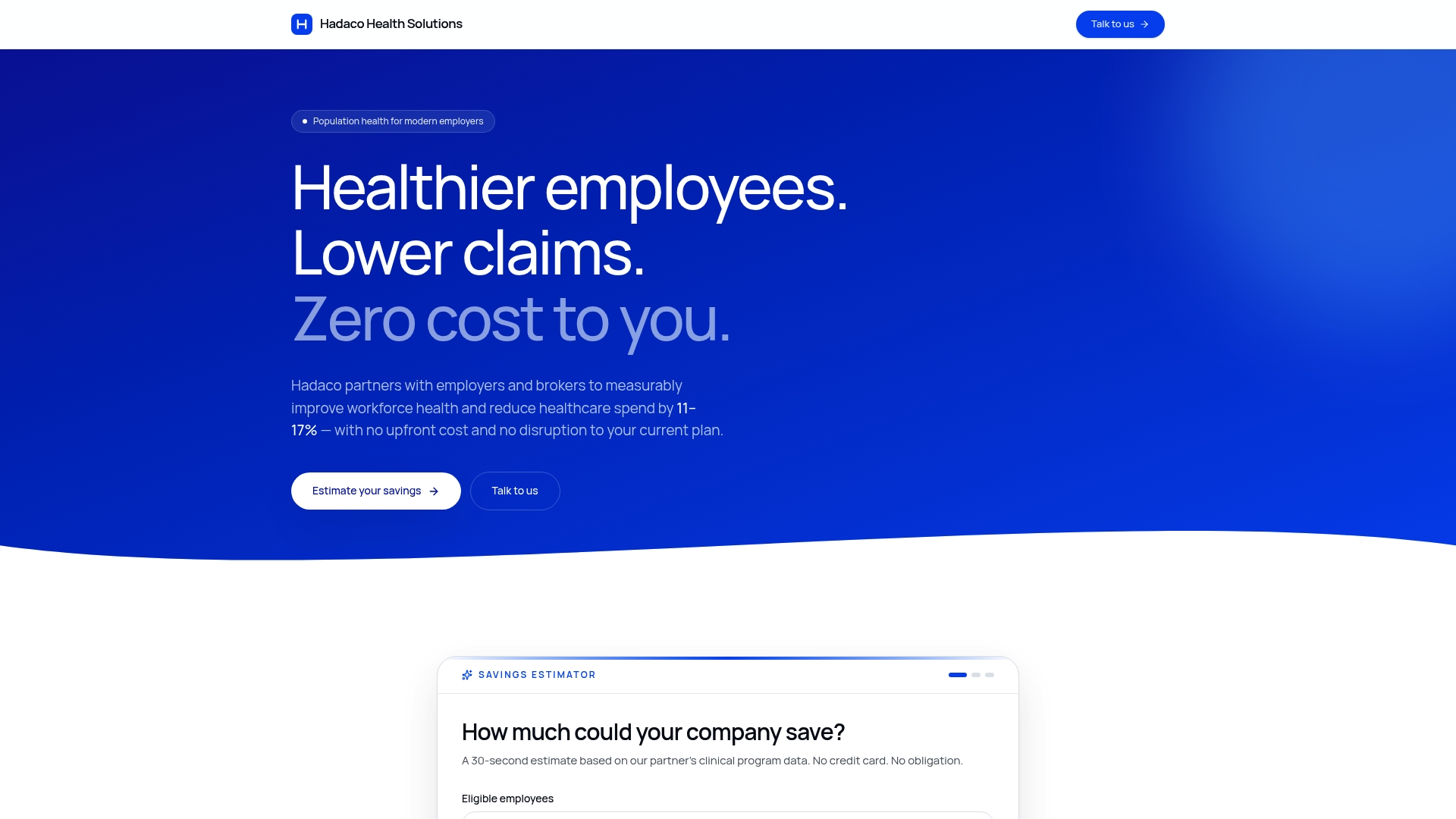
Hadaco runs population health programs that plug into your existing benefits without disrupting them, giving you a way to pursue claims-driven savings without changing carriers or plan design.
Before you commit to any vendor, including Hadaco, request the following:
- A transparent savings estimator built on your own employee population, not industry averages.
- A sample quarterly report showing how outcomes are tracked and presented to finance.
- Case metrics from comparable employer groups.
- Contract terms that tie fees to demonstrated outcomes rather than flat retainer pricing.
If those materials hold up, book a consultation with Hadaco to get a savings estimate built around your own claims data.
Sources
- U.S. Department of Labor: HIPAA compliance FAQs (EBSA)
- Do Workplace Wellness Programs Save Employers Money? | RAND
- Health Affairs: Health and economic outcomes up to three years after a workplace wellness program
FAQ
What's the difference between participatory and health-contingent wellness programs?
Participatory programs offer a reward for taking part, like reimbursing a gym membership, and carry few legal restrictions. Health-contingent programs tie a reward to a health outcome and must follow five specific requirements under federal HIPAA guidance, including reasonable alternative standards for employees who cannot meet the original goal.
How large can a wellness incentive legally be?
Incentives for health-contingent programs are generally capped at 30% of the cost of self-only coverage, rising to 50% for programs targeting tobacco use, according to federal HIPAA guidance. Any program above those limits, or one that penalizes rather than rewards, needs closer legal review.
Do wellness programs actually reduce health care spending?
The evidence is mixed and depends heavily on program type. RAND's analysis found disease management drove most measurable near-term savings, while a Health Affairs randomized trial found no significant reduction in clinical measures or health care spending up to three years out.
What should employers ask a wellness vendor for before signing a contract?
Ask for a savings estimator built on your own claims data, a sample quarterly report, and contract terms that tie fees to measured outcomes rather than flat pricing. Hadaco provides a transparent savings estimator and quarterly reporting as part of its standard model, which gives finance teams a way to track results against the original projection.
Are ADA and GINA rules different from HIPAA wellness rules?
Yes. HIPAA nondiscrimination rules govern incentive size and program design for health-contingent programs, while the ADA and GINA separately regulate how biometric screenings, health questionnaires, and genetic information can be collected and used, with their own voluntariness and disclosure requirements.