
Stop loss insurance is a financial backstop, not a health intervention. It reimburses your organization for catastrophic medical claims above a set threshold, which protects your budget from a bad year, but it does nothing on its own to lower blood pressure, manage diabetes, or get an employee to see a primary care doctor. Treat stop loss as risk management. Pair it with wellness programs you can actually measure, and give those programs a realistic timeline before judging results.
TL;DR:
- Self-funding with stop loss shifts financial risk to outlier claims, with specific attachments typically between $50,000 and $150,000 and aggregate caps around 125% of expected costs.
- Claims data access under self-funding provides insight into high-cost cohorts and utilization gaps but has limits due to delays and privacy restrictions, requiring deliberate program design.
- Most evidence shows wellness programs improve behavior but do not significantly reduce healthcare spending within the first three years, making patience and proper sequencing essential.
- Effective strategy involves setting participation and behavior goals early, evaluating clinical impacts over 24 months, and ensuring stop-loss reporting and contract terms are clear before implementation.
- Combining clear claims visibility with targeted interventions can maximize return, but reinsurance protects only against catastrophic claims, not directly lowering employee healthcare costs.
Table of Contents
- What Is Stop Loss Insurance and How Does It Work?
- How Stop Loss Changes Finances, Plan Design, and Claims Data Access
- Does Stop Loss Insurance Improve Employee Wellness?
- What Does the Research Say About Wellness Programs and Costs?
- How to Combine Stop Loss, Claims Data, and Wellness Programs
- How Do You Evaluate a Stop-Loss Proposal and Vendor Reporting?
- What Employers Should Actually Expect From This Strategy
- A Measurable Next Step for Self-Funded Employers
- Sources
- FAQ
What Is Stop Loss Insurance and How Does It Work?
Stop loss is reinsurance for a self-funded employer. Instead of paying a fixed premium to a fully insured carrier for every claim, your organization pays claims directly and buys stop loss coverage that reimburses you once costs cross a specific threshold. There are two main types, and most self-funded plans carry both.
- Specific stop loss reimburses claims tied to a single individual once that person's costs exceed a set attachment point, often $50,000 to $150,000 depending on group size and risk appetite.
- Aggregate stop loss caps your total plan liability across the whole group, typically triggered around 125% of expected claims for the year.
- Incurred versus paid distinctions matter: a claim incurred in December but paid in February usually needs contract language covering that runout period, or you risk an uncovered gap.
Here's a simple illustration. Say your group's expected annual claims are $2 million, with a specific attachment point of $100,000. If one employee's cancer treatment runs $400,000, your plan pays the claim, then stop loss reimburses $300,000 of it. Without that coverage, the full $400,000 would have hit your budget in a single year. That volatility, not the underlying health outcome, is what stop loss exists to manage.
How Stop Loss Changes Finances, Plan Design, and Claims Data Access
Moving to self-funding with stop loss shifts where financial risk sits. Instead of paying a level premium every month regardless of claims experience, your organization absorbs routine claims below the attachment point and only calls on the reinsurer for the outliers. That structure changes more than your budget line.
- Plan design flexibility improves because you're no longer locked into a fully insured carrier's standard benefit templates.
- Claims data access becomes possible, since self-funded employers typically see de-identified claims detail that fully insured groups rarely get.
- Vendor relationships grow more complex, since you're now managing a third-party administrator, a stop-loss carrier, and often a separate pharmacy benefit manager.
- Reserves and cash flow need attention because claims can be lumpy month to month even with stop loss protection.
The Department of Labor's annual report on self-insured group health plans lays out these tradeoffs clearly: self-funding buys flexibility and visibility, but routine claims below your attachment point remain entirely your responsibility. Many contracts also include a monthly accommodation clause, which smooths cash flow by letting the stop-loss carrier front large claims mid-month rather than waiting for the annual settlement. That detail is easy to overlook during a renewal and expensive to discover you're missing after a bad claim hits.
Does Stop Loss Insurance Improve Employee Wellness?
No, not directly. Stop loss protects your balance sheet from claims volatility. It doesn't screen anyone for hypertension, coach an employee through a smoking cessation program, or change what happens in an exam room. Those two functions, financing and intervention, solve different problems, and conflating them is where a lot of benefits strategy goes wrong.
Where stop loss does help wellness efforts indirectly is through the claims data that comes with self-funding. Once you can see de-identified claims patterns, you can identify high-cost cohorts, chronic condition prevalence, and utilization gaps that a fully insured group typically cannot access. That data has real limits, though. Claims lag by weeks or months before they're fully coded, diagnosis codes don't always capture the full clinical picture, and privacy rules restrict how granular that data can get before it becomes individually identifiable.
Turning data into outcomes requires deliberate program design: incentives structured within legal limits, convenient access points like telehealth or on-site screenings, and coaching tailored to the specific conditions your claims data flags. Data alone changes nothing. It just tells you where to aim.

Pro Tip: Before you build a wellness initiative around claims data, confirm your TPA can deliver cohort-level reports on a predictable schedule. A one-time data pull is far less useful than quarterly trends you can act on.
What Does the Research Say About Wellness Programs and Costs?
Self-funding paired with stop loss has become the default arrangement for most covered workers in the United States. The KFF 2025 Employer Health Benefits Survey found that a majority of covered workers were in self-funded plans, with higher adoption among larger firms and lower adoption at firms with 10 to 199 workers. Wellness program adoption tracks a similar pattern, with larger employers far more likely to offer structured programs than small ones.
The harder question is what those programs actually deliver, and the randomized evidence is more sobering than most vendor pitches suggest.
- The Illinois Workplace Wellness Study, a randomized trial, found increased self-reported healthy behaviors but no detectable reduction in medical spending or clinical measures within its study window.
- A follow-up three-year cluster randomized study published in Health Affairs confirmed the same pattern: people reported healthier habits, but clinical outcomes, healthcare spending, and employment measures showed no significant change over three years.
- Observational studies outside randomized designs sometimes report savings, but those estimates are vulnerable to selection effects, since healthier employees are often the ones who choose to participate.
The math here matters for how you set expectations internally. A wellness program can genuinely move behavior, participation, and engagement in the first year. Spending reductions, if they materialize at all, tend to show up much later than most pilot budgets are designed to wait for.
How to Combine Stop Loss, Claims Data, and Wellness Programs
Building a program that actually works means sequencing your expectations correctly and protecting the data you're using. Here's a practical approach.
- Set participation goals for months 0 to 6. Track enrollment, screening completion, and engagement with coaching or digital tools. These are the fastest signals you'll get.
- Track behavior and clinical markers from 6 to 24 months. Blood pressure readings, A1C trends, and self-reported activity levels move faster than total spending does.
- Evaluate utilization and spending trends only after 24 months. Judging a wellness program on first-year claims data almost guarantees disappointment, since the Illinois study and the Health Affairs trial both found no spending impact even at three years for the average participant.
- Run every incentive design past compliance before launch. Federal guidance from Healthcare caps wellness incentives at up to 30% of the cost of coverage, higher for tobacco cessation programs, and you'll need to separately verify HIPAA, ADA, and GINA requirements depending on how the program collects health information.
- Pilot before you scale. Test one intervention against a comparable group before rolling it company-wide, so you have some basis for attributing results to the program rather than to general trends.
Pro Tip: Ask your data team how claims information gets linked to HR records before any cohort targeting begins. Poorly de-identified data creates both privacy exposure and biased targeting, and it's much easier to fix in the design phase than after a program launches.
An evidence-based guide to program design can help structure this sequencing before you commit budget to a vendor.
How Do You Evaluate a Stop-Loss Proposal and Vendor Reporting?
A stop-loss contract has more moving parts than the premium quote suggests, and the details determine whether you're protected when a catastrophic claim actually happens.
- Confirm the attachment points for both specific and aggregate coverage, and ask whether they reset annually or carry over.
- Clarify whether the policy is specific only, aggregate only, or both, since some carriers bundle them differently than you'd expect.
- Verify runout protection, meaning claims incurred before your contract ends but paid after it, are still covered.
- Ask about subrogation rights and who pursues reimbursement when a third party is liable for an injury.
- Confirm whether a monthly accommodation clause exists to smooth cash flow on large claims.
- Review reimbursement caps and any lifetime maximums buried in the policy language.
| What to check | Why it matters |
|---|---|
| Reporting frequency | Quarterly reporting lets you catch cost trends early; annual-only reporting leaves you reacting after the fact |
| Data fields provided | Cohort-level, de-identified exports support wellness targeting; individual-level claims raise privacy concerns |
| Exclusion language | Vague or broad exclusions can leave high-cost conditions uncovered when you need the reimbursement most |
Watch for carriers that offer limited reporting access or punitive language around late notification of large claims. Those are negotiation points worth pushing back on before you sign, not after a denied claim teaches you the hard way.
What Employers Should Actually Expect From This Strategy
Stop loss and wellness solve different problems, and no contract language will change that. Stop loss keeps a catastrophic claim from wrecking your budget. Wellness, done well, changes behavior over a multi-year horizon and might eventually show up in your claims trend, but the randomized evidence says not to expect it in year one.

Where I think most benefits teams go wrong is treating claims data as an afterthought instead of the connective tissue between the two. If your TPA can hand you clean, quarterly, cohort-level data, you have the foundation to target wellness spending where it will actually matter, chronic condition management, high-utilization groups, preventable ER visits, rather than spreading a flat program across everyone and hoping.
Start with three moves: confirm your stop-loss contract's reporting terms, pilot one intervention against a real cohort, and commit to a 24-month measurement window before you call the program a win or a loss. Hadaco's self-funded wellness resources and case examples are built around that same sequencing.
— Gene
A Measurable Next Step for Self-Funded Employers
If you've already got stop loss in place, the next question is what you do with the claims visibility it gives you. There are population health programs, chronic disease management, preventive care outreach, mental health support, and engagement initiatives available that can be layered on top of your existing plan without upfront fees, minimizing disruption to the coverage you already have.
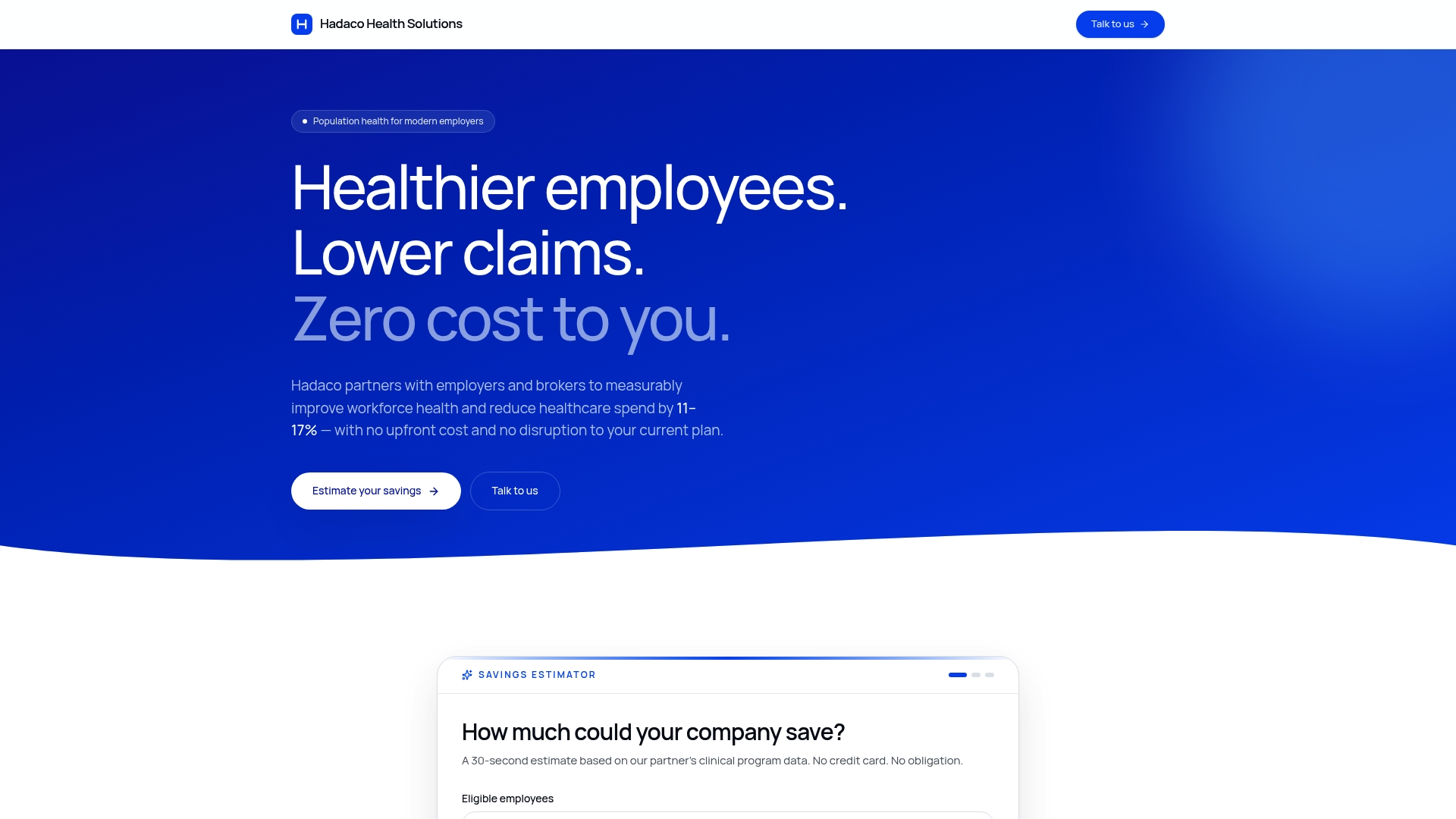
Employers have reported significant healthcare cost savings in the first year, which can be tracked through transparent savings estimators and quarterly reporting that clarifies the source of these savings. That kind of accountability matters more than a vendor's marketing claims, especially given how mixed the broader wellness research has been. If you want to see what that could look like against your own claims data, request a savings estimate from Hadaco and talk through where your specific cohorts show the most opportunity.
Sources
- Kaiser Family Foundation — 2025 Employer Health Benefits Survey
- What do Workplace Wellness Programs do? Evidence from the Illinois Workplace Wellness Study (PMC)
- Health Affairs — Workplace wellness programs up to three years (cluster RCT)
- Healthcare
FAQ
Am I better off not having health insurance for my company?
No. Dropping group coverage exposes your organization to unpredictable catastrophic claims and makes recruiting far harder in a market where most covered workers are already in self-funded plans with stop loss protection. Stop loss exists precisely so you don't have to choose between offering coverage and protecting your budget.
Can employees switch insurance if they have a pre-existing condition?
Yes. Federal rules under the Affordable Care Act prohibit group health plans from denying coverage or charging more based on pre-existing conditions, so employees moving between employer plans generally face no exclusion period. Employers should confirm this protection applies the same way whether the new plan is fully insured or self-funded with stop loss.
What happens to an employee's deductible if they change jobs?
Deductibles typically reset when an employee moves to a new employer's plan, since deductible accumulation is tracked at the plan level, not portable between employers. Some employers coordinate mid-year transfers during acquisitions, but that's a contract-specific arrangement, not a standard rule.
Is employer-sponsored health insurance still worth it?
For most mid-sized and large employers, yes, particularly when paired with self-funding and stop loss, which gives you both cost control and the claims data needed to target wellness spending effectively. The bigger question isn't whether to offer coverage, it's whether you're using the claims visibility that comes with self-funding to actually improve outcomes rather than just process claims.
Does stop loss insurance itself reduce employee healthcare costs?
Not directly. Stop loss reimburses catastrophic claims and stabilizes your budget, but the randomized evidence on wellness programs shows that actual cost reductions come from targeted interventions built on claims data, not from the reinsurance arrangement itself.