
A wellness champions program run by a population health vendor can measurably reduce your organization's medical claim costs, but only when the vendor measures results across your entire covered population, not just the employees who show up. Before you sign anything, ask for a population-level savings estimator and a sample quarterly report. If a vendor can't produce both, keep looking.
TL;DR:
- Vendors must provide population-level savings estimates and sample quarterly reports to prove the program’s true impact and avoid inflated results.
- Longer program durations consistently produce higher ROI, especially when combining comprehensive interventions focused on high-cost members over at least 12 months.
- Evaluation should prioritize claims-based, population-level metrics rather than participant-only comparisons or short-term results to ensure accurate cost savings measurement.
- Data access to medical, pharmacy, and eligibility files is crucial for identifying at-risk employees quickly and accurately.
- Employers should negotiate performance guarantees, quarterly reporting, and a third-party validation clause to ensure transparent, verifiable ROI.
Table of Contents
- What Is a Wellness Champions Program, Exactly?
- Does the Evidence Support Real Cost Savings?
- How Do You Evaluate and Choose a Vendor?
- How Should You Measure ROI Once the Program Launches?
- What's the Realistic Timeline and Cost Structure?
- What Pitfalls Should You Watch For?
- Where Hadaco Fits Into This Picture
- Ready to Request a Savings Estimate?
- The Gap Between Vendor Promises and Verifiable Results
- Sources
What Is a Wellness Champions Program, Exactly?
A vendor-run wellness champions program is not a volunteer committee handing out step-challenge T-shirts. It's an outsourced population health operation that layers evidence-based clinical and behavioral interventions on top of your existing health plan, using your claims data to find and engage the employees whose health issues are driving your costs according to the industries we serve expertise in workforce safety.
These programs typically cover:
- Chronic disease management for conditions like diabetes, hypertension, and cardiovascular risk
- Preventive care outreach tied to gaps in screenings or overdue checkups
- Mental health support and referral pathways
- Care coordination that routes high-cost cases to in-network providers or centers of excellence
- Engagement campaigns designed to sustain participation past the first 90 days
The vendor identifies at-risk employees through risk stratification, combining medical and pharmacy claims history rather than relying on self-reported health surveys. Integration matters here: a program that can't pull data from your carrier, your PBM, and your HRIS system for enrollment tracking is going to run blind. The best vendors plug into your current benefit stack without requiring you to switch carriers or disrupt existing coverage.
Does the Evidence Support Real Cost Savings?
The research backs the concept, with real numbers attached. A study tracking a workforce mental health program's medical spending found reductions of $2,295 to $2,304 per person per year in medical plan spend for program users compared to non-users, across two consecutive plan years.

That's not an outlier. A systematic review of 112 studies on workplace health prevention and promotion found a median ROI of about 1:3.1, meaning every dollar spent returned roughly $3.10 in savings, and 89% of the studies reviewed reported a positive cost-benefit ratio.
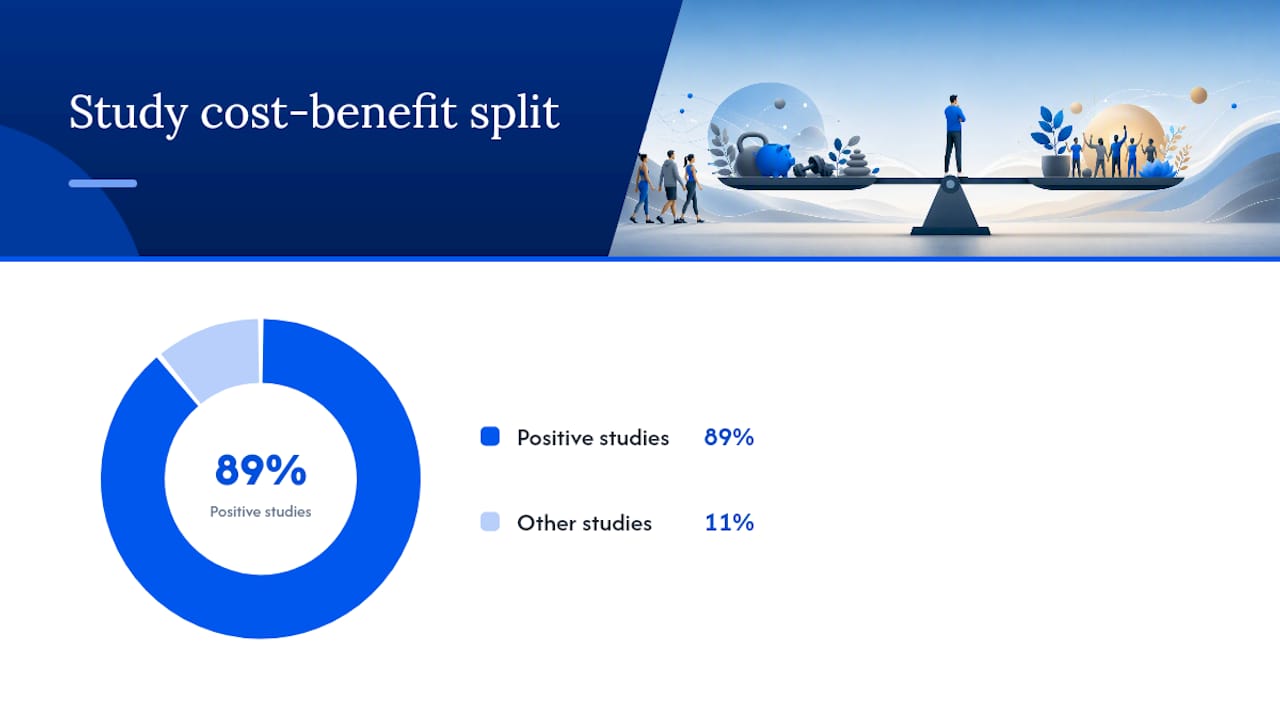
The number that should shape your contract negotiation: ROI climbs with program duration. The same review found longer-running programs consistently outperformed shorter ones, which tells you a lot about why a 90-day pilot rarely proves much.
Three factors explain most of the variability employers see between vendors:
- Comprehensiveness: programs with assessment, screening, coaching, and referral built together tend to outperform single-tactic offerings, especially among higher-risk participants
- Duration: short engagements rarely capture the lag between behavior change and reduced claims
- Targeting: programs that focus resources on your highest-cost members generate savings faster than broad, low-touch outreach
How Do You Evaluate and Choose a Vendor?
Procurement here is a data exercise before it's a sales conversation. Follow this sequence and you'll filter out most of the vendors who can't back up their pitch.
- Require full data access. Ask for both medical and pharmacy claims plus eligibility files. Pharmacy data often flags high-cost members and therapy gaps before medical claims catch up, which speeds identification and outreach.
- Insist on population-level evaluation. A vendor comparing "participants" to "non-participants" is comparing motivated employees to everyone else, a setup that flatters the results regardless of what the program actually does. If your population is small enough that population-level analysis is statistically shaky, ask the vendor to explain their alternative method in writing.
- Negotiate contract must-haves up front: performance guarantees tied to population-level claims, a transparent savings estimator you can review before signing, quarterly reporting cadence, a third-party validation clause, and defined data security and integration service levels.
- Set engagement targets you can audit: enrollment percentage, sustained engagement past six months, and a Net Promoter Score benchmark.
Pro Tip: Ask the vendor to show you a sample quarterly report from an existing client (anonymized) before you sign. If they can't produce one, that tells you how mature their reporting infrastructure actually is.
How Should You Measure ROI Once the Program Launches?
Two different clocks run at once here, and confusing them is how employers end up disappointed in month four. Leading indicators move fast; lagging indicators take time to surface.
Leading indicators (available within weeks to a few months):
- Enrollment and participation rates
- Sustained engagement over time, not just initial sign-ups
- Risk-factor change (blood pressure, A1C, weight)
- Medication adherence
Lagging indicators (the ones that actually validate savings):
- Aggregated medical and pharmacy claims trends
- Hospitalization and emergency room utilization changes
- Total cost of care across the covered population
The HERO/PHA Program Measurement & Evaluation Guide lays out core metrics and five accepted methods for calculating claims-based ROI, and it's worth having your vendor confirm which method they use. Expect claims-based results to lag actual program activity by several months, since claims take time to process and aggregate. That means your quarterly report should show leading indicators trending in the right direction, while the real financial reconciliation happens annually against your actual claims experience.
What's the Realistic Timeline and Cost Structure?
Set expectations correctly with your CFO now, because the biggest source of buyer's remorse in this category is expecting claims-based savings in quarter one.
- Months 1 to 3: data setup and integration. Claims files, eligibility feeds, and HRIS connections get established. Nothing measurable happens financially yet.
- Months 3 to 12: pilot and engagement build. Enrollment ramps, leading indicators start moving, and the vendor should be sending you quarterly progress reports.
- Months 12 to 24: year-one claims reconciliation. This is when population-level medical and pharmacy claims data becomes credible enough to validate actual savings against baseline.
Pricing models vary. Some vendors charge per-employee-per-month fees regardless of outcome. Others, including performance-based structures with no upfront fee, tie compensation to demonstrated savings, which aligns incentives far better for a buyer who's skeptical of inflated projections. Before signing, map the new program against your existing benefits stack to confirm you're not paying two vendors to chase the same population, a common and expensive overlap.
What Pitfalls Should You Watch For?
Most disappointing vendor relationships trace back to the same handful of mistakes, and they're avoidable if you know what to ask.
- Participant-only comparisons. Comparing engaged employees to everyone else overstates impact, since the people who enroll tend to be healthier or more motivated to begin with.
- Short observation windows. A vendor citing three-month results, or citing their entire "book of business" instead of your specific population, is a red flag worth pushing back on.
- Program overlap. Running two point solutions targeting the same chronic condition dilutes impact and doubles your spend without doubling results.
Pro Tip: Build a sunset and clawback clause into every population health contract. If year-one results fall short of the guarantee, you want a defined remedy, not a renewal conversation you're not prepared for.
Independent, employer-specific third-party analysis remains the most reliable check against inflated vendor claims, according to Milliman's guidance on point-solution evaluation.
Where Hadaco Fits Into This Picture
Hadaco builds its programs around the same principle this article has been making: population-level measurement or the numbers don't mean anything. Its evidence-based interventions for chronic disease, preventive care, and mental health integrate directly with your existing benefits, so there's no disruption to current carrier relationships or plan design.
In year one, employers working with Hadaco have seen average savings of $451 per employee, tracked through a transparent savings estimator and delivered via quarterly reporting rather than an annual black box. That reporting cadence matters more than most buyers realize going in. It's the difference between waiting a full plan year to find out whether a program worked and catching a stalled rollout while there's still time to fix it.
Ready to Request a Savings Estimate?
Before booking a discovery call, pull together your medical and pharmacy claims extract, current headcount and eligibility counts, a list of your existing wellness or point-solution vendors, and a short statement of what you're actually trying to solve, whether that's rising diabetes-related claims, mental health utilization, or overall trend.
On the call, ask Hadaco three things directly: how population-level evaluation works in practice, what a live savings estimator looks like for a company your size, and what a sample quarterly report actually contains. Ask about contract terms for performance guarantees and data security service levels too. This is the same scrutiny CFO.com recommends for any vendor claiming to lower medical costs, and Hadaco's model is built to answer it without the deflection you'll get from vendors relying on book-of-business claims. If the numbers and the reporting structure hold up, request a pilot scoped to your highest-cost population segment and get a timeline in writing before you sign anything.
The Gap Between Vendor Promises and Verifiable Results
Here's what the research keeps circling back to, and what most employers underweight when they're comparing proposals: a program's design matters less than how it's measured. A mediocre program with honest, population-level reporting will teach you more in twelve months than an excellent program hiding behind participant-only comparisons and a vendor's aggregate book-of-business numbers.
The median ROI of 1:3.1 found across 112 studies is real, but it's a pooled average across programs with wildly different measurement rigor. Some of those studies almost certainly overstate their results the same way a vendor's marketing deck does. The employers who actually see savings close to that range are the ones who insisted on claims-based, population-level evaluation from day one, and who treated the first year as a data-collection exercise rather than a victory lap.
If there's a contrarian takeaway here, it's this: the vendor with the most conservative, most boring measurement methodology is usually the one telling you the truth. Flashy dashboards and inflated year-one projections are marketing. Quarterly reports that show slow, believable movement in leading indicators, backed by a willingness to reconcile against your actual annual claims, are what separates a program that works from one that just sounds like it does.
— Gene
Sources
- Study reporting medical-spend reductions associated with a workforce mental health program (PMC)
- Return on investment in workplace health prevention and promotion: a systematic review (2003–2024)
- Cfo
- Effectively measuring the value of employer point solution programs | Milliman