
The most effective wellness communications strategy is behavior-driven, segmented into 3 to 5 employee personas, and built around a year-round calendar tied to real benefit moments—not a once-a-year email blast during open enrollment. Four components make this work:
- Segmentation: Group employees into personas based on life stage, role type, and motivation, then set one measurable goal per group.
- Channels and timing: Run a multi-channel calendar (email, manager talking points, SMS, intranet) scheduled around when employees actually need the information.
- Message design: Use behavioral science, benefit-focused framing, social proof, and simple next steps instead of feature lists.
- Measurement: Track leading and lagging KPIs so communications tie directly to participation and cost outcomes.
More than half of employees with access to wellness programs say they're only somewhat, or not at all, aware of what's available to them, according to SHRM's reporting. Hadaco built its programs around this exact gap, pairing evidence-based health interventions with the kind of quarterly, transparent reporting that shows HR teams whether messages are landing or falling flat.
Key Takeaways
A wellness communications strategy succeeds when segmented, behavior-driven messaging runs year-round and every campaign ties back to a measurable participation or cost outcome.
| Point | Details |
|---|---|
| Build 3 to 5 personas | Segment by life stage, role, and motivation, then assign one measurable goal per group. |
| Run a year-round calendar | Tie quarterly themes to real benefit moments instead of relying on open enrollment alone. |
| Lead with WIIFM messaging | Use benefit-focused framing, social proof, and simple next steps instead of feature lists. |
| Track leading and lagging KPIs | Pair click-to-enroll rates with utilization and satisfaction data to prove real impact. |
| Pair messaging with measurable programs | Hadaco's evidence-based programs and quarterly reporting turn communication effort into tracked savings. |
Table of Contents
- What Is a Wellness Communication Strategy, Exactly?
- Segment Employees Into 3 to 5 Personas Before You Write a Single Message
- Build a Year-Round Calendar That Follows Benefit Moments
- Write Messages People Actually Act On
- Which KPIs Actually Prove Your Communications Are Working
- Your 90-Day Pre-Enrollment Playbook
- Extending Reach Beyond the Manager Layer
- Personalizing Content Without Building a New Persona for Every Employee
- Closing the Loop: Getting Feedback on Your Own Messages
- Making Wellness Messaging Accessible to Every Employee
- Planning for Wellness Communications During a Crisis
- Connecting Communications to Your Broader Wellness Program Goals
- Why Most Wellness Playbooks Get This Backwards
- Get a Clear Picture of What Your Communications Could Save
- Frequently Asked Questions
- Sources
What Is a Wellness Communication Strategy, Exactly?
A wellness communication strategy is the deliberate plan for what you tell employees, when, through which channel, and to what end. It's different from a generic communications plan because it has to move people toward a specific health behavior, be it a biometric screening, an EAP call, or HSA enrollment, not just deliver information. The World Health Organization's Strategic Communications Framework frames this as a continuum: audiences move from awareness to understanding to action, and each stage needs a different message. Too many corporate wellness messaging plans skip straight to "action" language (sign up now) before employees even know the program exists.
Segment Employees Into 3 to 5 Personas Before You Write a Single Message
Broadcast messaging, the same email to everyone, treats a 24-year-old warehouse worker and a 55-year-old remote manager as if they have identical needs. They don't, and the response rates prove it. Segmented communication consistently converts better than one-size-fits-all messaging because relevance is the single biggest driver of whether someone opens, reads, and acts, according to audience segmentation research published in the International Journal of Wellbeing.
You don't need a data science team to build personas. Use what you already have:
- Pull payroll and HRIS data to separate employees by role type (frontline vs. remote/desk) and life stage (early career, caregiving years, near-retirement).
- Layer in tenure and enrollment history to spot who's new to benefits versus who's a repeat non-participant.
- Group by motivation, prevention-minded employees respond to screening and checkup messaging, while cost-conscious employees respond better to savings-framed messages.
- Assign one measurable goal per persona, screening uptake for the prevention group, HSA enrollment for the savings group, EAP engagement for the caregiving group.
- Pick a default channel for each group based on how they already communicate at work (email for desk staff, SMS or break-room signage for frontline shifts).
Pro Tip: Start with just three personas in your first year. Five is the ceiling, not the floor, and trying to build granular messaging for eight or nine groups usually means none of them get done well.
Build a Year-Round Calendar That Follows Benefit Moments
A single open-enrollment push can't carry a whole year of behavior change, and it shows in the numbers. Structured, year-round benefits communication increases how much employees say they value their benefits by 30 to 50%, without adding a dollar to plan costs, according to Benefitra's research on mid-size employer communications.
Your channel mix should include:
- Email with a single, clear call to action, not five competing links.
- Intranet or benefits portal placements for anything employees need to reference later.
- SMS or mobile push for frontline and field employees who don't check email daily.
- Manager talking points delivered as a one-page cheat sheet before every major push.
- Peer or wellness ambassadors who reinforce messages informally, which builds the kind of word-of-mouth trust that formal channels can't replicate.
- Digital signage in break rooms and shared spaces for high-visibility reminders.
| Quarter | Focus | Sample Trigger |
|---|---|---|
| Q1 | Financial foundations | HSA/FSA contribution deadlines, new-year goal setting |
| Q2 | Wellbeing check-in | Mid-year biometric screenings, EAP awareness |
| Q3 | Enrollment prep | Plan comparison tools, total compensation statements |
| Q4 | Enrollment and year-end | Open enrollment deadlines, use-it-or-lose-it FSA reminders |
Space major pushes at least two weeks apart and vary the format between them, an email one week, a manager huddle talking point the next, so the same message doesn't feel like static.
Write Messages People Actually Act On
Feature lists don't move people. "Our EAP offers 24/7 counseling, financial coaching, and legal referrals" reads like a brochure. "Feeling stretched thin? A free, confidential call could help" answers the question employees are actually asking, which is what's in it for me. Benefit-focused framing consistently outperforms feature-heavy copy because it speaks to the employee's immediate situation rather than the program's specifications, a pattern documented in Chapman Institute's research on wellness message design.
A handful of behavioral levers do most of the work:
- Social proof: "68% of your department already completed their screening" pulls harder than any generic reminder.
- Loss framing: "You have 12 days left to use your FSA funds" motivates faster action than "You still have FSA funds available."
- Micro-commitments: Ask for one small step (schedule a call) instead of a full behavior change (join the program) in the first message.
- Timely nudges: Send the reminder the week a deadline hits, not a month in advance when it's easy to forget.
- Simplified next steps: One button, one link, one action. Every extra click loses people.
For subject lines, try direct and specific over clever: "3 days left: use your FSA funds" beats "Don't forget about your benefits!" For incentive messaging, always be explicit about the mechanics, what qualifies, what the reward is, and by when, because vague incentive language breeds distrust faster than no incentive at all.
Trust matters as much as tactics. Every message involving personal health data should state plainly that participation is voluntary and specify what data is collected and who sees it. WHO's framework lists credibility and trust as two of its six core principles for health communication, right alongside being accessible and actionable.
Pro Tip: Put your privacy language in the same sentence as the ask, not buried in a footer link. "This is voluntary and your results stay confidential" belongs in the body of the email, not a legal disclaimer nobody reads.
Which KPIs Actually Prove Your Communications Are Working
Open rates tell you if people saw the message. They don't tell you if anyone acted on it. Track two tiers:
- Leading indicators: open rate, click-through rate, and click-to-enroll conversion for each campaign.
- Lagging indicators: program utilization, HSA activity, EAP engagement, benefits satisfaction scores, and HR inquiry volume.
A benefits communication strategy should be judged by outcomes, not send volume, according to Empyrean's guidance on employee benefits communication, which lists utilization and turnover linked to benefits understanding as the metrics that matter most.
Set a separate benchmark for each persona rather than one blended target. A frontline persona reached mostly through SMS won't hit the same click-through rate as a desk-based persona reached by email, and treating them identically hides real performance gaps.
Run small A/B tests: two subject lines, two send times, two CTA phrasings. Review results monthly at the campaign level and do a full quarterly deep-dive tying communications activity back to utilization and cost trends. Assign a single owner, usually the benefits or wellness communications lead, who reports these numbers to HR leadership each quarter.
Your 90-Day Pre-Enrollment Playbook
Waiting until open enrollment to start planning guarantees a rushed, generic push. Here's a realistic 90-day runway:
- Weeks 1 to 2: Audit current personas, enrollment data, and past campaign performance.
- Weeks 3 to 4: Draft persona-specific messages and test two subject line variants per group.
- Weeks 5 to 6: Build manager kits, a one-page FAQ and three talking points per persona.
- Weeks 7 to 9: Launch early nudges (screening reminders, HSA contribution prompts) and monitor click-to-enroll rates weekly.
- Weeks 10 to 12: Run the full enrollment push, review metrics weekly, and adjust cadence in real time.
Assign clear owners: an HR lead for strategy, a comms lead for execution, manager champions for on-the-ground reinforcement, and your benefits vendor for data and enrollment mechanics. Quick wins worth prioritizing early include distributing total compensation statements, which Benefitra's research ties to higher perceived benefits value, along with one-click enrollment links and a small group of peer ambassadors.
Watch for three red flags: sending too many messages in a short window (fatigue kills open rates fast), CTAs that ask for more than one action at a time, and campaigns with no measurement plan attached before launch.
Extending Reach Beyond the Manager Layer
Managers can't carry a wellness communication plan alone, and expecting them to often backfires. HR staff and appointed wellness champions need their own support system: short scripts for answering common questions, a shared FAQ document, and a monthly huddle where communicators compare notes on what's landing and what isn't.
Training doesn't need to be elaborate. A 30-minute session covering the quarter's messaging themes, the persona goals behind them, and two or three sample responses to common employee pushback (privacy concerns, skepticism about incentives) equips most non-manager communicators well enough to represent the program accurately. Give wellness champions a standing Slack or Teams channel to flag questions they can't answer, so nothing gets stuck or answered incorrectly.
Equip HR generalists specifically, since they're often the first point of contact when an employee has a benefits question that a manager can't answer. A shared knowledge base, updated quarterly alongside your communications calendar, keeps everyone working from the same facts instead of improvising.
The goal is consistency of message, not uniformity of delivery. A wellness champion on the warehouse floor and an HR generalist answering emails should be saying the same thing about eligibility and deadlines, even if their tone and channel differ. Build a short reference card, one page, updated each quarter, that every communicator beyond the manager layer can pull up in seconds. That single document does more to prevent conflicting information than any amount of ad hoc training.
Personalizing Content Without Building a New Persona for Every Employee
Dynamic fields are the simplest lever: pulling in an employee's actual FSA balance, enrollment deadline, or screening due date into an email template makes a mass message feel individually relevant without any manual work. Behavioral triggers work similarly, a message that fires automatically when someone clicks a benefits link but doesn't complete enrollment within 48 hours feels far more responsive than a static reminder sent to everyone on the same day.
Language and format preferences matter too. Offering a Spanish-language version of key materials, or a plain-text option for employees who prefer not to click through a heavily designed email, extends your reach without multiplying your persona count. Timing personalization, sending the same message at 7 a.m. to early-shift frontline workers and at 10 a.m. to office staff, is a low-effort adjustment that noticeably improves open rates.
None of these techniques require new segmentation work. They layer on top of the personas you've already built, using data you likely already collect through your HRIS or benefits platform. The mistake most HR teams make is treating personalization as an all-or-nothing investment when even one dynamic field, like a first name or a deadline date, measurably improves engagement over a fully generic template.
Closing the Loop: Getting Feedback on Your Own Messages
A wellness communication plan without a feedback mechanism is a plan that never improves. Build in at least three ways to hear back from employees: a two-question pulse survey after major campaigns (Did this message make sense? Did you know what to do next?), an open comment field on your benefits portal, and informal feedback collected by managers and wellness champions during regular check-ins.
Treat low click-through rates and high HR inquiry volume as feedback too, even when nobody fills out a survey. A spike in questions to HR about a topic you just emailed about usually means the message wasn't clear enough, not that employees weren't paying attention. Track these signals alongside your formal KPIs so the two data streams inform each other.
Close the loop visibly. If a survey response leads you to simplify a confusing enrollment link or shorten an overly long email, say so in the next round of communications: "Based on your feedback, we shortened this." That small acknowledgment does more to build long-term trust than any single campaign, because it shows employees their input actually changes something.
Review feedback on the same monthly cadence you use for KPI reporting, not as a separate, ad hoc process. Folding qualitative feedback into your existing measurement rhythm keeps it from becoming an afterthought that only gets reviewed once a year.
Making Wellness Messaging Accessible to Every Employee
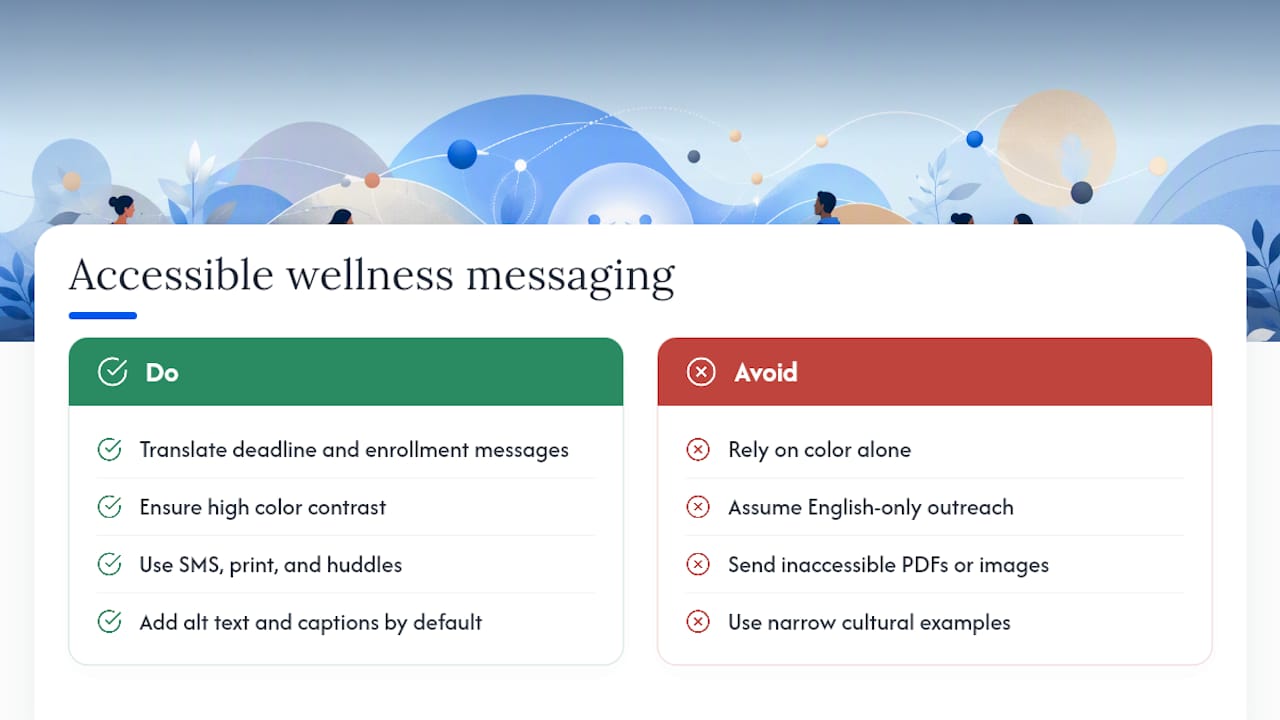
A wellness communication strategy that only reaches English-speaking, desk-based, sighted employees with reliable email access isn't reaching your whole workforce. Accessibility has to be built into the plan from the start, not patched on afterward.
Start with language. If a meaningful share of your workforce speaks a language other than English at home, translate at minimum the messages tied to deadlines and enrollment, not just general wellness tips. Format matters just as much: use sufficient color contrast, avoid relying on color alone to convey urgency (a red banner means nothing to a colorblind employee), and keep font sizes legible on mobile screens where a growing share of employees now read email.
Frontline and shift-based employees need channels that don't assume desk access, think SMS, printed break-room materials, and shift-start huddles rather than an email that sits unread in an inbox they check once a week. Employees with disabilities need alt text on images, screen-reader-compatible PDFs, and video content with captions built in by default, not added only when someone asks.
Inclusivity extends to the content itself. Wellness messaging built around traditional family structures, specific dietary norms, or assumptions about physical ability alienates employees who don't see themselves reflected in the examples you use. A screening reminder framed around "getting back to the gym" lands differently for an employee managing a chronic condition than a neutral framing built around "checking in on your health."
None of this requires a separate accessibility budget. It requires reviewing your existing calendar and templates with these questions in mind before each quarterly push goes out, not after an employee flags a problem.
Planning for Wellness Communications During a Crisis
Every wellness communication plan needs a branch that only activates during a crisis, a sudden layoff round, a public health event, or an internal incident involving employee safety. Waiting until the moment arrives to figure out tone and channel guarantees a delayed, inconsistent response.

Build a short crisis communication protocol in advance: who has authority to approve a message on short notice, which channel gets used first (usually the fastest one, SMS or intranet banner, not a scheduled email), and a small library of pre-approved language for common scenarios (EAP availability during a layoff, mental health resources following a workplace incident). Speed matters more than polish in these moments, so overly long approval chains work against you.
Crisis messaging should point employees toward one clear resource, usually the EAP or a dedicated hotline, rather than a menu of options that requires them to make a decision while stressed. Keep the tone calm and factual, avoid corporate language that feels detached from what employees are actually experiencing, and repeat the same core message across every channel you use so there's no confusion about where to turn.
Follow up after the acute phase passes. A short, low-key message a week or two later, checking in on utilization of the resources you pointed people toward, shows employees the offer was genuine and not just a one-time announcement. This follow-up habit also gives you a real data point (did EAP calls actually increase?) to fold into your regular KPI reporting rather than treating the crisis response as a one-off exercise disconnected from your measurement rhythm.
Connecting Communications to Your Broader Wellness Program Goals
Communications don't exist separately from your wellness program. They're the delivery mechanism for it, and treating them as an afterthought bolted onto a program that was designed without them in mind is a common, costly mistake.
Start by mapping your communication calendar directly against your program's actual goals. If the program's stated priority is reducing diabetes-related claims, your Q2 messaging should be built around screening and prevention, not generic "stay active" content that doesn't connect to the outcome you're actually trying to move. Every quarter's theme should trace back to a specific line item in your broader health strategy, whether that's chronic disease management, preventive care uptake, or mental health support.
This alignment also determines what you measure. If your wellness program includes a chronic condition management component, your communications KPIs should include enrollment and completion rates for that specific program, not just generic open rates that say nothing about whether the underlying health goal is being met.
Hadaco's model illustrates this connection directly: evidence-based interventions for chronic disease and preventive care only produce measurable savings when employees actually know about them and act on them, which is why the Hadaco approach pairs its population health programs with the kind of transparent, quarterly outcome reporting that shows HR exactly which messages are converting into utilization. Communication isn't a separate workstream from the health outcome, it's the mechanism that makes the health outcome possible at all.
Why Most Wellness Playbooks Get This Backwards
Most wellness communication advice obsesses over volume: more emails, more channels, more touchpoints. That instinct is wrong, and it's the reason so many programs report high send counts alongside flat participation.
Conversion, not volume, is the right measure of a wellness communications strategy, and the research backs this up plainly, segmented messaging built around 3 to 5 personas consistently outperforms broadcast campaigns because it answers a specific person's specific question instead of shouting a generic message at everyone. HR teams that build five well-targeted messages a quarter will beat teams sending twenty generic ones almost every time.
The bigger blind spot is measurement. Most programs track opens and clicks and stop there, never connecting a campaign to whether utilization or claims actually moved. That's the gap Hadaco's quarterly reporting model was built to close, tying communication activity to real cost and engagement outcomes instead of vanity metrics.
If you take one thing from this playbook, prioritize building three solid personas and a genuine feedback loop before you touch your channel mix or your send calendar. Everything else compounds from there.
Get a Clear Picture of What Your Communications Could Save
Everything in this playbook, the personas, the calendar, the behavioral messaging, only pays off when it's paired with programs that actually move the needle on health outcomes. That's where Hadaco fits in.
Hadaco delivers evidence-based population health programs that plug into your current benefit plans without disrupting them, covering chronic disease management, preventive care, and the employee engagement work this article has walked through. Employers typically see an average savings of $451 per employee in the first year, tracked through a transparent savings estimator and reported back to you every quarter, not just once a year. There's no upfront fee to get started, and the quarterly reporting means you're never guessing whether your investment is working. If you're ready to see what your organization could save, run the numbers through Hadaco's estimator and book a consultation to walk through the results.
Frequently Asked Questions
What is the difference between a wellness communication strategy and a benefits communication strategy?
A wellness communication strategy focuses specifically on health behaviors, screenings, preventive care, chronic condition management, while a broader benefits communication strategy covers all plan offerings, including retirement and financial benefits. The two overlap heavily and often share the same calendar and channels.
How often should HR send wellness communications?
Aim for a steady monthly cadence with heavier pushes around enrollment and specific benefit deadlines. Sending too frequently in a short window causes fatigue and drops open rates, while long gaps between messages let awareness fade.
What's the fastest way to start segmenting employees without new software?
Use existing payroll and HRIS data to sort employees by role type, tenure, and enrollment history. That alone is usually enough to build 3 solid personas without any new tools.
How do you measure whether wellness communications are actually working?
Track click-to-enroll conversion and program utilization, not just open rates. Utilization, HSA activity, and benefits satisfaction scores connect communication activity to real outcomes.
Does a wellness communication plan need a crisis component?
Yes. A short, pre-approved protocol for layoffs, safety incidents, or public health events prevents delayed or inconsistent messaging when speed matters most.
Sources
- Communicating for health: WHO strategic communications framework
- Employee benefits communication strategy | Benefitra
- Designing effective employee wellness communications that convert - Chapman Institute