
An effective wellness report proves three things: who engaged, whether health risks moved, and what it did to costs. That means every report should lead with a segmented participation breakdown, a risk-trend chart, and an ROI or claims-linkage summary. Compliance disclosures and evaluation methods matter too, but they support these three outputs. They don't replace them.
TL;DR:
- Tracking participation rates alone is insufficient; reports must break down participation, completion, and engagement quality across departments, risk tiers, and locations.
- Health-risk trends should focus on movement over time rather than snapshots, demonstrating risk reduction progress for greater leadership impact.
- Linking claims data to wellness participation requires careful matching and validation, with clear assumptions and quality checks before reporting savings estimates.
- Regular performance monitoring differs from periodic program evaluations, which identify root causes of risk changes and guide targeted interventions.
- Legal compliance requires strict data access controls, disclosure of reasonable alternative standards, and adherence to HIPAA and EEOC rules, especially when reporting on medical information.
Table of Contents
- What Metrics Should Employers Track in Wellness Program Reporting?
- How Do You Build a Reporting Framework That Leadership Trusts?
- Where Does Wellness Program Data Actually Come From?
- When Should You Run a Formal Program Evaluation?
- What Compliance Rules Apply to Wellness Program Reporting?
- How Should Quarterly Wellness Reports Be Structured?
- Author perspective: what actually wins leadership support
- How Hadaco Supports Outcome-Focused Wellness Reporting
- Sources
- FAQ
What Metrics Should Employers Track in Wellness Program Reporting?
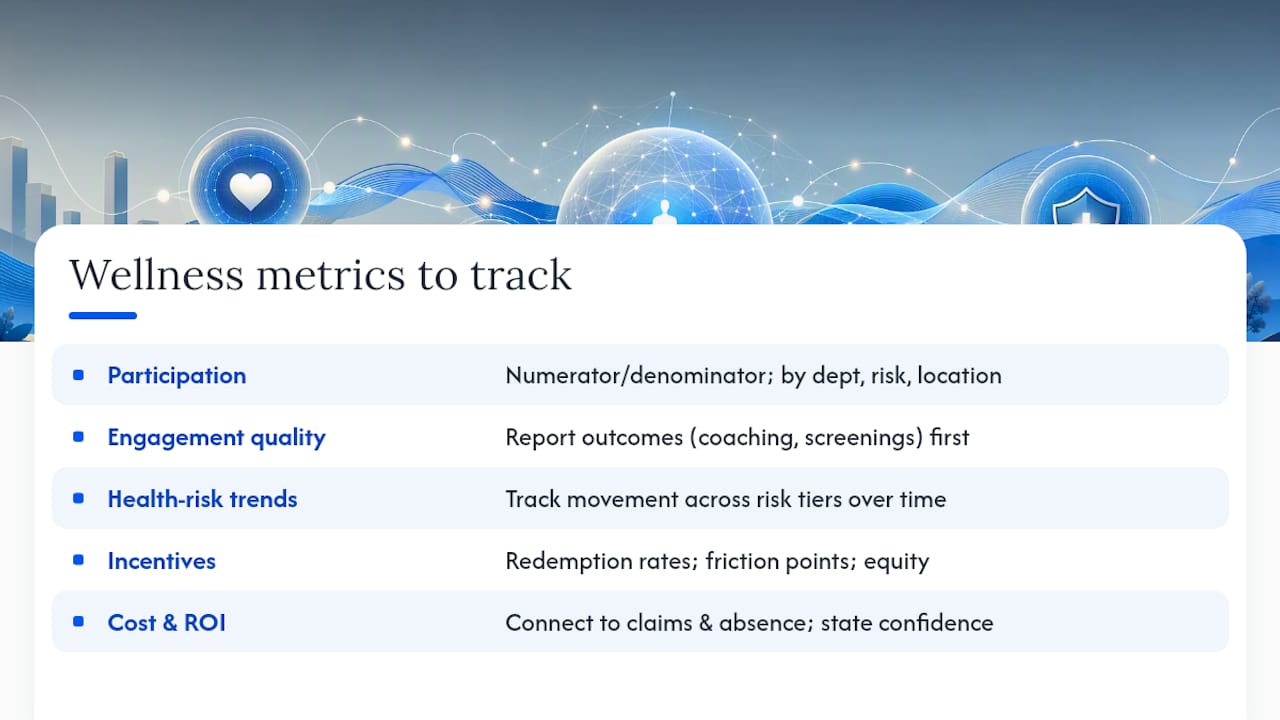
Most wellness program reporting still leads with a single number: how many people signed up. That number tells you almost nothing about whether the program worked. Real wellness program reporting tracks five categories of employee wellness analytics, each answering a different question leadership will eventually ask.
Participation and completion need a clear numerator and denominator. "412 employees participated" is meaningless without knowing the eligible population and without breaking that figure down by department, risk tier, and location. A completion rate at the company-wide level can hide a much lower rate among your highest-risk employees, which is exactly the group the program exists to reach.
Engagement quality separates real behavior change from vanity metrics. Logins and app downloads are activity. Coaching contacts completed, biometric screenings finished, and care-gap closures (a diabetic employee finally getting an overdue eye exam, for instance) are outcomes. Report the second category first.
Health-risk trends track movement across risk tiers over time, not a single snapshot. Are people moving from high risk to moderate risk on blood pressure, weight, or tobacco use? That trend line, even a modest one, is more persuasive to a CFO than any participation percentage.
Incentive performance deserves its own line item. Track redemption rates, but also look for friction points: are people abandoning the incentive process at a specific step? And confirm equitable access. Under EEOC rules, health-contingent reward programs must disclose the availability of a reasonable alternative standard for employees who can't meet the standard outcome, so your reporting should show whether that alternative is actually being used.
Cost and ROI metrics connect all of the above to claims trends, absenteeism, and productivity proxies. This is the category HR most often gets wrong by overstating certainty. Attribution is genuinely hard. State a savings estimate, then state the confidence level behind it, rather than presenting a single number as gospel. Guidance on employee wellness analytics offers a useful structure for organizing these five categories into one dashboard rather than five disconnected spreadsheets.
How Do You Build a Reporting Framework That Leadership Trusts?
Start by identifying who reads each report and what decision they're trying to make. An executive team wants to know if the program is worth the spend. Finance wants claims trend correlation. HR operations wants to know which cohorts need outreach this month. One report can't serve all three audiences equally well, so most organizations build a layered framework instead.
- Pick 6 to 8 primary KPIs tied to specific business questions, not to whatever the vendor dashboard happens to display by default. Set a numeric target for each (a 10-point risk-tier shift, a 20% increase in high-risk engagement) so "success" has a defined threshold.
- Segment every top-line number by department, risk tier, and location before you report it in aggregate. Aggregate figures routinely mask underperformance in exactly the group that matters most, and breaking out participation this way is often the single highest-leverage change a reporting effort can make.
- Set a cadence by audience. Monthly operational signals for the wellness team, quarterly finance-ready packages for leadership, and a full annual outcome evaluation that steps back from the noise of any single quarter.
- Define escalation rules in advance. If a risk tier moves the wrong direction two quarters running, or an incentive redemption rate drops below a set floor, that triggers a deeper look rather than waiting for the annual review.
Pro Tip: Write your target numbers down before the quarter starts, not after you see the results. Retrofitting a "success" threshold to match whatever number came in is the fastest way to lose credibility with finance.
The framework itself matters less than the discipline of segmenting before you aggregate, and reporting against a target you set in advance.
Where Does Wellness Program Data Actually Come From?
Reliable wellness program reporting draws from several systems that rarely talk to each other by default:
- Medical and pharmacy claims data
- HRIS records for demographics and employment status
- Benefits enrollment and eligibility files
- Health risk assessments and biometric screening results
- Wellness vendor participation logs
- EAP utilization summaries (aggregated, never individual)
- Absence and short-term disability records
Linking claims data to participation is the hardest integration and the most valuable one. It requires a pre-agreed matching strategy using unique identifiers and a defined time window, plus a lag period since claims take time to stabilize after they're incurred. Document your matching assumptions and any confidence interval around savings estimates before you present them, not after someone in finance asks how you got the number.
Before any figure reaches a dashboard, run it through a basic quality checklist: is the dataset complete for the reporting period, is it timely enough to matter, has it been deduplicated, and has someone validated it against a prior period for sanity? A dashboard tends to work best when it leads with three or four top-line KPIs, then allows drilldown by cohort, with cohort comparisons and an export function finance can actually use. For most mid-sized employers, vendor exports handle the wellness-specific data while internal BI tools handle the claims and HRIS integration. Bring in IT or a dedicated analytics resource once you're matching across three or more systems. Integrating claims data with wellness participation is usually the point where that becomes necessary.
When Should You Run a Formal Program Evaluation?
Performance measurement and program evaluation solve different problems, and conflating them is a common mistake. Performance measurement is ongoing monitoring. It tells you a risk tier moved or participation dipped last month. Program evaluation is periodic and attribution-focused. It tells you why, and what to do about it.
The CDC Program Evaluation Framework lays out six steps: assess the context, describe the program, focus the evaluation questions, gather credible evidence, generate justified conclusions, and act on findings. It also names three cross-cutting actions that should run through every step: engage collaboratively with the people affected by the program, advance equity in how questions are asked and data is interpreted, and learn from insights rather than filing them away.
Here's what that looks like in practice. Say your quarterly report shows high-risk employees moving into an even higher-risk tier for the second straight quarter. A performance metric flags the trend. A program evaluation asks the real question:
Is this a coaching engagement problem, a screening access problem, or a population shift from new hires with different baseline risk? Answering that requires pulling coaching contact logs against risk-tier movement, checking screening completion by tenure, and comparing new-hire risk profiles against the existing population, not just re-running last quarter's dashboard.
That's the difference between noticing a problem and knowing what to fix. Reporting that only tracks the number will keep flagging the same trend every quarter without ever explaining it.
What Compliance Rules Apply to Wellness Program Reporting?
Wellness data touches employee medical information, so reporting has legal guardrails that pure business metrics don't. Under EEOC final rules, any wellness program that includes disability-related inquiries or medical examinations must include specific disclosures in the plan materials describing the program, including availability of a reasonable alternative standard for health-contingent rewards.
HIPAA applies when a program is offered through a group health plan and handles protected health information; it generally does not apply the same way to programs run directly by the employer outside the plan, though the distinction is easy to get wrong. A closer look at when HIPAA governs a workplace wellness program is worth reading before you finalize a reporting structure.
Build these safeguards into every report:
- Role-based access so only authorized staff see individual-level data
- Redacted, aggregated figures in anything distributed beyond HR
- A documented data retention policy
- Required plan disclosures included in employee-facing materials
Certain wellness rewards may also carry wage-reporting implications on tax forms. Loop in benefits counsel before finalizing incentive structures, not after.
How Should Quarterly Wellness Reports Be Structured?
A finance-ready quarterly report follows a predictable shape: an executive summary of three bullets, a KPI dashboard, a claims trend analysis with attribution caveats stated plainly, participation highlights by segment, and a targeted action plan for the next quarter.
- Data freeze. Lock the reporting period so numbers stop shifting mid-analysis.
- Validation. Run the quality checklist before anyone touches the narrative.
- Analysis. Build the risk-tier trends, the engagement-to-outcome funnel, and cohort comparisons.
- Leadership briefing. Present conclusions first, appendices second.
Visuals do a lot of the persuasion here. A detailed reporting structure built around succinct summaries paired with fuller appendix tables tends to land better with executives than a dense slide of raw numbers, since decision-makers generally want a handful of answers up front and the supporting detail available if they ask.
| Visual | What it shows |
|---|---|
| Risk-tier trend line | Movement across risk categories over 2 to 4 quarters |
| Engagement to outcome funnel | Where people drop off between sign-up and completed action |
| Cohort heatmap | Participation and risk by department or location, side by side |
| ROI confidence table | Estimated savings paired with a stated confidence level |
When you brief finance, state the estimated savings, state your confidence in that estimate, and propose a specific next test rather than declaring victory. A pilot proposal earns more trust than an overstated number ever will.
Author perspective: what actually wins leadership support
Most wellness reports fail for the same reason: they report activity, not outcome. A count of app logins impresses nobody in finance. What works is starting from evaluation questions, not dashboards. Pull claims data in early, even messy, rather than waiting for a clean quarter. And show your savings math, confidence interval included, instead of a polished number nobody can trace. Programs built this way, including the ones Hadaco runs with its clients, hold up under scrutiny because the numbers were never dressed up to begin with.
— Gene
How Hadaco Supports Outcome-Focused Wellness Reporting
Most employers building wellness program reporting from scratch spend months stitching together claims data, HRIS exports, and vendor logs before they ever produce a report finance will trust. Many engagements include quarterly, finance-ready dashboards that link participation directly to claims trends, plus a transparent savings estimator so leadership sees the math behind every number, not just the conclusion.
Programs typically integrate with existing benefit plans at no upfront cost, and companies often see measurable gains in engagement and retention alongside financial benefits. If you want to see what that reporting actually looks like before committing to anything, request a sample report and review the Hadaco savings estimator for your own employee population.
Sources
For readers who want to go directly to the primary guidance behind this article:
- EEOC issues final rules: employer wellness programs
- CDC Program Evaluation Framework, 2024
- Incorporating reporting efforts to manage and improve health
FAQ
What Is the 5-3-1 Rule for Wellness?
The 5-3-1 rule is a general wellness guideline suggesting servings of fruits and vegetables, hours of physical activity, and an hour of screen time or leisure limit per day. It's a personal health guideline, not a wellness program reporting metric, so it doesn't appear as a standard KPI in employer dashboards.
What Should Be Included in a Wellness Program Report?
A complete wellness program report includes segmented participation data, engagement quality indicators like coaching contacts and care-gap closures, health-risk trend movement, incentive redemption and equity metrics, and a claims-linked ROI summary with a stated confidence level. Required legal disclosures, including reasonable alternative standards for health-contingent rewards, belong in the plan materials referenced alongside the report.
Are Wellness Programs Legal?
Yes, employer wellness programs are legal in the United States, but health-contingent programs that include medical exams or disability-related inquiries must follow EEOC disclosure rules, and programs tied to a group health plan may trigger HIPAA obligations. Consulting benefits counsel before finalizing incentive design is standard practice given how these rules interact.
What Is a Wellness Report?
A wellness report is a structured summary showing how an employee wellness program is performing, typically covering participation by segment, health-risk trends, and financial impact such as claims trend correlation. Hadaco delivers this as a quarterly, finance-ready package tied to a transparent savings estimator, so leadership sees both the outcome and the confidence behind it.