
Employers who want results should implement a combined counseling plus pharmacotherapy tobacco cessation program, pair it with a smoke-free workplace policy, and add financial incentives. That combination consistently outperforms any single-component approach in both quit rates and employer ROI.
Here is why that matters right now:
- Tobacco remains a leading cause of preventable disease and death in the U.S., which means every employee who smokes carries elevated claims risk into your benefits plan.
- Combined counseling and medication programs are the standard recommended by both the CDC and the Surgeon General's Public Health Service guidelines.
- Financial incentives added on top of free cessation aids produced meaningfully higher 6-month quit rates in a pragmatic trial across 54 companies published in the New England Journal of Medicine.
- Employers who partner with a population-health provider like Hadaco can integrate cessation into existing benefits without disruption and track savings from day one.
Pro Tip: Before you select a vendor or write a policy, run a 10-minute needs assessment: pull your claims data for tobacco-related diagnoses, survey employees on readiness to quit, and check what your current benefits plan already covers for NRT and counseling. That baseline shapes every decision that follows.
Key Takeaways
Evidence-based workplace tobacco cessation programs that combine counseling, pharmacotherapy, and financial incentives consistently outperform single-component approaches and deliver measurable employer ROI.
| Point | Details |
|---|---|
| Combine counseling and medication | CDC and Surgeon General guidelines recommend both together; neither alone matches the combined effect. |
| Add financial incentives | A 54-company NEJM trial found that incentive groups had notably higher sustained abstinence rates compared to usual care, which had very low quit rates. |
| Cover medications at zero cost-share | Removing co-pays on NRT and prescription meds is the single highest-leverage benefits change you can make. |
| Measure at 6, 12, and 24 months | Track participation, sustained abstinence, and tobacco-related claims; run a full ROI analysis at month 12. |
| Hadaco integrates and reports | Hadaco embeds cessation into existing benefits with no upfront fees and averages $451 per-employee savings in year one. |
This article is general information, not a substitute for advice from a qualified doctor. Consult a qualified healthcare professional about your own circumstances before acting on anything here.
Table of Contents
- Why workplace tobacco cessation programs work
- What every complete cessation program should include
- Which delivery format fits your workforce?
- How to design and launch your program step by step
- How much does a program cost, and who pays?
- What to measure and how to show ROI
- Why partner with a population-health provider like Hadaco
- Authoritative resources HR can use right now
- What I've learned from real-world program implementation
- Hadaco makes workplace cessation turnkey for employers
- Sources
Why workplace tobacco cessation programs work
The evidence base here is unusually strong for a workplace health intervention. A systematic review and meta-analysis of randomized and cluster trials found a large pooled effect for workplace smoking cessation interventions, with a Hedges' g of approximately 1.171 across modalities including counseling, telephone coaching, web-based programs, and financial incentives. That is a large effect by any standard, though study heterogeneity was high, so individual program results will vary.
The NEJM pragmatic trial across 54 companies adds a layer of real-world specificity. Sustained abstinence at 6 months was higher in the redeemable deposit and rewards groups than in the free cessation aids and usual care groups, which showed very low quit rates. Free cessation aids alone did not significantly improve abstinence over usual care in that trial. The incentive groups did. That finding has direct implications for program design: free NRT is necessary but not sufficient.
What the evidence says: Financial incentives added to free cessation aids produced higher 6-month sustained abstinence than free aids alone in a 54-company randomized trial. Free aids alone showed no significant improvement over usual care.
CDC and WHO data reinforce the economic rationale. Tobacco imposes substantial costs on employers through higher medical claims, absenteeism, and productivity losses. Quitting reduces those risks at any age, which means even a modest improvement in quit rates across a workforce of 500 or 1,000 employees moves the needle on claims.
Key evidence points HR and benefits leaders should know:
- Workplace interventions show large pooled effects in meta-analyses when counseling, pharmacotherapy, and incentives are combined.
- Incentive design matters: redeemable deposits (where employees put up their own money and earn it back) outperformed straight rewards in the NEJM trial.
- CDC/NIOSH guidance specifically calls out job stress and workplace culture as drivers of tobacco use, not just individual motivation.
- The Surgeon General's Public Health Service guidelines recommend combining counseling with FDA-approved medications as first-line treatment.
Pro Tip: Opt-in enrollment yields higher quit rates among motivated participants; opt-out designs increase reach but typically lower average quit rates. Set your participation targets accordingly, and do not benchmark your program against clinical trial rates achieved under tightly controlled conditions.
What every complete cessation program should include
The CDC Best Practices cessation user guide is the clearest single reference for program design. It recommends combining counseling with FDA-approved medications as the evidence-based standard. Here is what that looks like in practice.
Counseling options
Individual counseling, group sessions, proactive telephone coaching, and digital coaching all have evidence behind them. Intensity matters: more sessions and longer total contact time produce higher quit rates. The national quitline, 1-800-QUIT-NOW, provides free proactive telephone counseling and is a no-cost referral option every employer should include in benefits communications.
Pharmacotherapy
FDA-approved options fall into two categories:
- Nicotine replacement therapy (NRT): patch, gum, lozenge, nasal spray, and inhaler. Combination NRT (patch plus a short-acting form) outperforms single-product use.
- Prescription medications: bupropion SR and varenicline (Chantix/generic). Varenicline has the strongest evidence among prescription options. Employers who cover these medications through pharmacy benefits see higher utilization and better outcomes than those who require out-of-pocket payment.
For medication adherence support, benefits integration is the key lever. Employees who start NRT or varenicline but abandon it at week two or three rarely quit successfully.
Policy and culture
CDC/NIOSH guidance is direct on this: smoke-free policies work better when paired with cessation resources and supervisor training. A policy without support is a compliance exercise. Supervisors trained to refer employees discreetly to cessation resources are a high-leverage, low-cost investment.
Program component summary
| Component | Evidence basis | Employer action |
|---|---|---|
| Individual counseling | Strong; dose-response relationship | Cover via EAP or vendor |
| Group counseling | Moderate to strong | Offer onsite or virtual |
| Telephone quitline (1-800-QUIT-NOW) | Strong; free to employees | Include in all communications |
| NRT (patch, gum, lozenge) | Strong | Cover with no cost-share |
| Prescription meds (varenicline, bupropion SR) | Strong | Cover via pharmacy benefit |
| Financial incentives | Strong in workplace trials | Design with verification |
| Smoke-free policy | Strong as enabler | Enforce with referral support |
| Supervisor training | Moderate; high leverage | Annual refresher recommended |
Pro Tip: Covering NRT and prescription medications with zero cost-share removes the single most common barrier employees cite. If your plan currently has a co-pay on cessation medications, removing it costs less than one avoided hospitalization.
Which delivery format fits your workforce?
The right delivery channel depends on workforce size, geography, shift patterns, and the participation barriers your needs assessment surfaces.
Onsite group programs and clinic-based services work well for larger, co-located populations, union environments, and manufacturing settings where employees share a physical space and a break schedule. The social accountability of a group setting increases early engagement. The limitation is reach: employees on night shifts or remote locations get left out.
Virtual group coaching and one-on-one video or phone counseling are the practical choice for distributed workforces, hybrid employees, and shift workers. Participation barriers drop when employees do not have to leave their desk or drive somewhere. Engagement tends to be slightly lower than in-person, but reach is substantially higher.
Proactive telephone quitlines scale to any workforce size at low cost. The national quitline (1-800-QUIT-NOW) is free and available in multiple languages. Proactive outreach (the program calls the employee, not the other way around) consistently outperforms reactive models where employees must initiate contact.
Digital tools and apps from smokefree.gov and similar platforms provide 24/7 access, quit plans, and text-based coaching. They work best as a supplement to counseling, not a replacement. Employees who use digital tools alongside telephone or in-person counseling show better sustained engagement than those using digital tools alone.
Hybrid models that combine a proactive quitline with digital support and employer-paid NRT tend to produce the best balance of reach and quit rates for mid-sized to large employers. The key is removing friction at every step: one phone number, one website, one enrollment form.
- Onsite group: best for co-located, high-density worksites.
- Virtual one-on-one: best for distributed or remote employees.
- Proactive quitline: best for scale and language access.
- Digital tools: best as a supplement, not a standalone.
- Hybrid (quitline + digital + NRT): best overall reach-to-quit ratio.
How to design and launch your program step by step
A well-run launch follows a predictable sequence. Skipping the early steps (especially the needs assessment and steering committee) is the most common reason programs underperform in year one.
Phase 1: Planning (months 1–3)
- Conduct a needs assessment: pull tobacco-related claims data, survey employees on smoking prevalence and quit readiness, and audit current benefits coverage for NRT and counseling.
- Form a cross-functional steering committee with HR, benefits, occupational health, legal, and at least one employee representative.
- Select your program model based on workforce size, geography, and budget.
- Secure funding and benefits coverage: confirm pharmacy benefit coverage for NRT and prescription meds, allocate wellness budget for incentives, and identify any grant or federal funding options.
- Draft or update your smoke-free workplace policy and get legal review.
Phase 2: Procurement and setup (months 3–5)
- Issue an RFP or select a population-health vendor (or confirm use of free national resources like 1-800-QUIT-NOW and smokefree.gov).
- Negotiate vendor contracts and data-sharing agreements with privacy/HIPAA review.
- Build the communications plan: benefits portal updates, manager talking points, enrollment materials.
- Train supervisors on the policy, referral process, and how to have supportive conversations.
Phase 3: Launch and ongoing support (month 6 onward)
- Launch with a multi-channel communications push (email, intranet, benefits portal, manager cascade).
- Open enrollment and begin proactive outreach to identified tobacco users.
- Run quarterly operational check-ins; conduct 12-month ROI analysis.
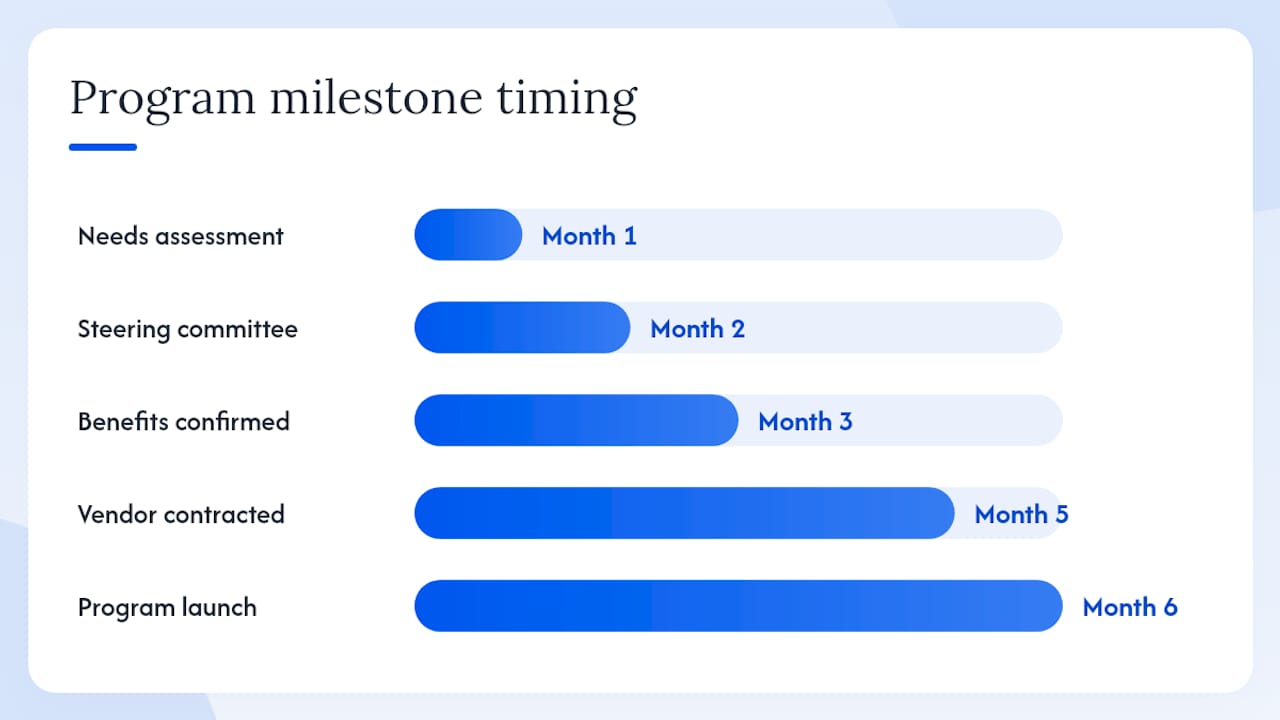
| Milestone | Target timing |
|---|---|
| Needs assessment complete | Month 1 |
| Steering committee formed | Month 2 |
| Benefits coverage confirmed | Month 3 |
| Vendor contracted | Month 5 |
| Supervisor training complete | Month 5 |
| Program launch | Month 6 |
| First operational review | Month 9 |
| 12-month ROI analysis | Month — |
For multi-site or union environments, add a site-coordinator role and build union leadership into the steering committee from the start. Data privacy coordination with HR and legal is non-negotiable before any employee-level data is shared with a vendor.
How much does a program cost, and who pays?
Cost varies widely depending on what you cover and how you deliver it. The main cost drivers are medication subsidies, counseling provider fees, incentive payouts, and program administration. Here is how employers typically fund each:
- Benefits integration: The most cost-effective approach. Covering NRT and prescription medications through the pharmacy benefit with zero cost-share adds modest per-member-per-month cost but removes the biggest utilization barrier.
- Wellness budget: Incentive payouts (cash, gift cards, premium reductions) typically run $200–$750 per participant depending on design. Redeemable deposit designs, where employees contribute and earn back, shift some cost to participants.
- Federal funding (public employers): OPM guidance explicitly allows federal agencies to use appropriated funds for pharmacotherapy and counseling, and recommends covering both without co-pays.
- Free national resources: 1-800-QUIT-NOW and smokefree.gov are free to employees and free to reference in employer communications. They do not replace a structured program but meaningfully extend reach at zero cost.
On ROI: The NEJM trial found that incentive-based programs improved cost-effectiveness compared to free cessation aids alone. Employers who track cost-per-sustained-quit (total program spend divided by verified 6-month quitters) typically see that figure fall as program maturity and incentive design improve.
For a concrete ROI model, Hadaco's wellness ROI framework walks through how healthcare claim reductions translate to employer savings across a population.
What to measure and how to show ROI
A measurement plan has two audiences: program managers who need operational data to improve the program, and finance and leadership who need to see dollar impact.
Primary KPIs:
- Participation rate (enrolled / eligible tobacco users)
- 6-month and 12-month sustained abstinence (self-reported; biochemically verified when feasible)
- Quit attempts per participant
- NRT and prescription medication utilization rates
- Program reach (employees who received at least one touchpoint)
Operational metrics:
- Enrollment funnel (awareness to enrollment to active participation)
- Cost per participant
- Cost per sustained quit
- Changes in tobacco-related claims at 12 and 24 months
- Short-term absenteeism trends
Reporting cadence:
- Monthly: enrollment numbers, active participant count, NRT utilization.
- Quarterly: operational review with steering committee; flag drop-off points.
- 12 months: full ROI analysis comparing tobacco-related claims pre/post enrollment.
- 24 months: sustained abstinence rates and long-term claims trend.
On verification: self-reported quit rates are standard for employer programs and acceptable for most ROI reporting. Biochemical verification (cotinine testing) is more accurate but adds cost and raises privacy concerns. Use it selectively, for incentive verification where the payout is large enough to warrant it. The CDC Best Practices guide provides evaluation metrics and measurement frameworks you can adapt directly.
Hadaco's quarterly reporting and savings estimator give HR teams a ready-made framework for tracking these metrics without building a custom dashboard from scratch.
Why partner with a population-health provider like Hadaco
Most employers have the intent to run a cessation program. The gap is integration: connecting the program to existing benefits, clinical workflows, and reporting systems without creating a parallel administrative burden.
Hadaco integrates evidence-based cessation programs into your existing benefits plan without disrupting employees' current care relationships. The model is performance-based, meaning no upfront fees, with quarterly reporting that ties program activity to claims outcomes. Employers in their first year have seen an average savings of $451 per employee across Hadaco's population-health programs.
What that looks like operationally:
- Cessation program components (counseling referrals, NRT coverage, incentive administration) are embedded in the benefits structure employees already use.
- Hadaco's savings estimator lets HR model expected first-year savings before committing, so the business case goes to leadership with numbers, not projections.
- Quarterly reports show participation, quit rates, and claims trends in one place, which is what finance needs to approve continued investment.
- The no-upfront-fee model means the program pays for itself or you do not pay for it.
For employers who want to bundle cessation with broader chronic disease and preventive care programs, Hadaco's population-health approach covers financial wellness and other benefit dimensions in the same integrated framework.
To see what your workforce could save, book a consultation at Hadaco.
Authoritative resources HR can use right now
Every communications package, benefits portal update, and manager training deck should reference at least a few of these:
- CDC tobacco guidance: Employer-specific recommendations on policy, counseling, and medication coverage.
- CDC Best Practices cessation user guide: Implementation checklists, evaluation metrics, and evidence-based treatment components. Downloadable PDF.
- Smokefree: Quit plans, text programs, and employer referral materials. Free. Available in multiple languages.
- 1-800-QUIT-NOW: National quitline. Free proactive telephone counseling for employees. Include this number in every employee communication about cessation.
- OPM tobacco cessation guidance: For federal agencies and public employers: procurement notes, benefit coverage recommendations, and a group cessation program checklist.
- WHO tobacco fact sheet: Global context and economic burden data for broader stakeholder communications.
- NEJM pragmatic trial (54 companies): The strongest real-world employer evidence for incentive-based program design.
For sample policy language, quit kit ordering instructions, and manager talking points, the CDC and OPM both offer downloadable templates. Smokefree.gov has employer-specific communication assets ready to drop into a benefits portal.
What I've learned from real-world program implementation
The programs that actually move quit rates share one trait that does not show up in any meta-analysis: someone inside the organization owns the program. Not a vendor. Not a benefits broker. An internal champion, usually in HR or occupational health, who treats cessation as a clinical priority rather than a wellness checkbox.
The evidence for combined counseling and pharmacotherapy is solid. The implementation gap is almost always cultural, not clinical. Supervisors who do not know how to refer an employee, benefits portals that bury the quit-line number three clicks deep, incentive designs that require employees to jump through verification hoops before they see a dollar. These are the friction points that kill participation.
What I'd tell any HR leader starting this process: the policy and the benefits coverage matter, but the manager training is what determines whether employees actually use what you build. Invest there first, and the rest follows.
If you want to talk through what a program assessment looks like for your workforce, Hadaco's team is a good starting point.
Hadaco makes workplace cessation turnkey for employers
Employers who want a cessation program that runs without a full internal build should look at what Hadaco delivers: evidence-based tobacco cessation integrated directly into your existing benefits, no upfront fees, and quarterly reporting that shows leadership exactly what the program is producing.
The average first-year savings across Hadaco's employer programs is $451 per employee. The savings estimator at Hadaco lets you model that figure for your specific workforce before you sign anything. For HR teams managing wellness incentive design alongside cessation, Hadaco's integrated approach means one reporting framework covers both.
No disruption to current care. No upfront cost. Measurable outcomes from quarter one. Book a consultation at Hadaco to see what your population could save.
Sources
- A Pragmatic Trial of E‑Cigarettes, Incentives, and Drugs for Smoking Cessation | New England Journal of Medicine
- Effectiveness of smoking cessation interventions in the workplace: A systematic review and meta-analysis
- Tobacco | Substance Use | CDC
- Tobacco Cessation: Guidance on Establishing Programs Designed to Help Employees Stop Using Tobacco | OPM
- Best practices for comprehensive tobacco control programs — cessation user guide | CDC
- Smokefree
- Tobacco | World Health Organization