
Employers should implement reasonable, low-cost accommodations and open an interactive accommodation conversation with any employee who asks, rather than waiting for a formal complaint. The ADA requires employers to consider reasonable accommodations for ADHD unless doing so causes undue hardship, and most effective fixes cost little to nothing. Companies that treat this well see better retention and output. It's also a place where tools like Hadaco can show you the dollar impact of a healthier, more engaged workforce.
TL;DR:
- Most effective accommodations for ADHD are low-cost or free, such as noise control, structured communication, and flexible scheduling, which can cost under $200.
- Managers who focus on employees' strengths, run brief check-ins, and document instructions are more successful in supporting employees with ADHD.
- Employers are only legally required to consider accommodations after being informed of a disability, and most fixes involve minimal expense that doesn't constitute undue hardship.
- Employees should specify the impact of their challenges rather than disclose diagnoses when requesting support, and managers should respond with clear, trial-based solutions.
- Using programs like Hadaco allows companies to measure how mental health and accommodation efforts improve retention, engagement, and healthcare costs.
Table of Contents
- Practical Workplace Accommodations for ADHD Support at Work
- Managing ADHD at Work: Manager Strategies That Actually Help
- ADA and Reasonable Accommodation: What Employers Are Legally Required to Do
- How to Ask for ADHD Accommodations at Work: Scripts That Work
- HR's Rollout Plan for ADHD Accommodations at Work
- Resources and Support Options for ADHD in the Workplace
- Why ADHD Accommodations Are a Business Decision, Not Just a Compliance One
- How Hadaco Helps Employers Measure the Impact of Mental Health Support
- Sources
- FAQ
Practical Workplace Accommodations for ADHD Support at Work
Most accommodations that actually move the needle are low-cost or free. The Job Accommodation Network catalogs dozens of low-cost fixes that employers can implement without a lawyer, a budget request, or a six-month wait.
Start with the ones that address the biggest friction points for employees with ADHD:
- Noise control: Noise-canceling headphones, a desk moved away from high-traffic areas, or a quiet room booking privilege. Cost: usually under $200.
- Structure and clarity: Written meeting agendas sent in advance, a follow-up email summarizing decisions and deadlines, and explicit due dates instead of "soon" or "when you can."
- Time management tools: Visual timers, shared calendars with automated reminders, and breaking large projects into smaller, dated chunks rather than one looming deadline.
- Flexible scheduling: Adjusted start times, remote days during heavy focus work, or permission to batch meetings on fewer days.
- Assistive supports: Job coaching, a peer mentor, or a referral to the company's Employee Assistance Program for skills coaching.
None of these require restructuring a job description or lowering performance standards. They remove friction so the employee can meet the same bar everyone else is held to.
Pro Tip: Don't wait for a diagnosis disclosure to offer flexible deadlines or written follow-ups to meetings. Universal design accommodations that help ADHD employees also help new hires, parents, and anyone juggling a heavy week.
Managing ADHD at Work: Manager Strategies That Actually Help
Supervisors do more to shape whether an ADHD accommodation works than any HR policy does. Five habits separate managers who get results from managers who just mean well.
- Assign around strengths, not job titles. Someone who hyperfocuses well on deep design work but struggles with routine admin often produces more when tasks are split that way, not against it.
- Run short, structured check-ins. A 10-minute weekly sync with three explicit priorities beats a monthly review with a vague agenda.
- Put instructions in writing, always. Verbal-only direction gets lost. A two-line follow-up email with the task, the deadline, and the priority order fixes most confusion before it starts.
- Watch for burnout hiding as productivity. Employees with ADHD often overcompensate by working late or taking work home to mask missed deadlines earlier in the day. That pattern is a warning sign, not a compliment.
- Loop in HR early, not after a crisis. If a strategy stops working after a few weeks, escalate to HR for a formal accommodation review rather than letting performance slide quietly.
Strengths-based management is not a soft skill exercise. It is a documented lever for engagement that costs a manager nothing but attention.
ADA and Reasonable Accommodation: What Employers Are Legally Required to Do
The ADA requires covered employers to provide reasonable accommodations to qualified employees with ADHD unless the accommodation causes undue hardship, meaning significant difficulty or expense given the size and resources of the business. That threshold is high. Most requested ADHD accommodations, like a quiet workspace or a modified schedule, don't come close to it.

The obligation kicks in once an employer knows about the disability and the need for accommodation, whether that comes as a formal written request or an offhand comment about struggling to focus.
What the interactive process actually looks like:
- The employee identifies the limitation and, ideally, a proposed fix.
- The employer discusses options and may request limited medical documentation confirming the need, not a full diagnosis.
- Both sides agree on an accommodation, document it, and set a review date.
- If one accommodation doesn't work, the process starts again rather than ending in denial.
Job Accommodation Network guidance is blunt on this point: most accommodations discussed in these conversations are inexpensive, and the interactive process should be documented at every step to show good faith even when a final solution takes a few tries.
How to Ask for ADHD Accommodations at Work: Scripts That Work
Employees don't need to disclose a diagnosis to request support, only enough detail to connect the ask to a job function.
- Employee opens with impact, not diagnosis: "I'm having trouble retaining verbal instructions in fast-moving meetings. Could we try written follow-ups for my action items?"
- Manager responds with a first-meeting checklist: confirm the specific task affected, ask what's been tried, and propose a trial period rather than a permanent commitment.
- Set a review date, typically two to four weeks out, to assess whether the fix worked or needs adjusting.
- Bring in EAP or occupational health if the fix touches medical documentation or if coaching support would help beyond what a manager can offer.
Pro Tip: Employees who show up with one or two proposed accommodations, rather than an open-ended "I need help," tend to get faster answers. Specificity moves conversations forward.
HR's Rollout Plan for ADHD Accommodations at Work
A pilot beats a policy memo nobody reads. Here's a compact rollout HR can run in one quarter:
- Adopt or update an accommodation request form that captures the interactive process in writing, not just verbal agreements.
- Train managers with a short workshop covering the ADA basics, disclosure etiquette, and the check-in habits covered above.
- Pilot accommodations with three simple KPIs: task completion rate, absenteeism, and a quarterly engagement pulse survey.
- Document every decision and outcome, then scale what works to other teams rather than reinventing it each time.
- Tie results to cost, where possible. Employers using structured health and engagement programs, including platforms like Hadaco, can pair accommodation outcomes with quarterly reporting on healthcare claim trends to build a business case for continued investment.
This isn't a compliance checkbox. It's a measurement discipline that turns "we accommodated someone" into "here's what changed."
Resources and Support Options for ADHD in the Workplace
HR doesn't have to build every support internally. A short list of vetted resources covers most needs:
- Job Accommodation Network: free, confidential accommodation guidance for any employer size.
- CHADD and NAMI: employee-facing guides on disclosure, self-advocacy, and strengths framing.
- CDC: general ADHD prevalence and public health resources useful for internal training materials.
- Coaching and psychoeducation: systematic reviews show psychosocial interventions like CBT-based coaching often outperform medication alone on work-relevant outcomes, which makes coaching a smart line item in an EAP contract.
When evaluating any vendor, ask what outcomes they track, how often they report, and whether they can show a pilot reference.
Why ADHD Accommodations Are a Business Decision, Not Just a Compliance One
Treating ADHD accommodations as a legal minimum misses the point. The employers who do this well see it as a retention and engagement lever, not a liability shield. A quiet accommodation conversation handled early costs a fraction of the turnover, disengagement, and claims that follow when it's ignored. That's the same logic behind measurable employer health programs generally, and it's why the reporting side matters as much as the accommodation itself.
— Gene
How Hadaco Helps Employers Measure the Impact of Mental Health Support
Hadaco gives HR leaders a way to see whether investments like ADHD accommodations, coaching benefits, and manager training actually move the numbers, without disrupting the benefit plans already in place.
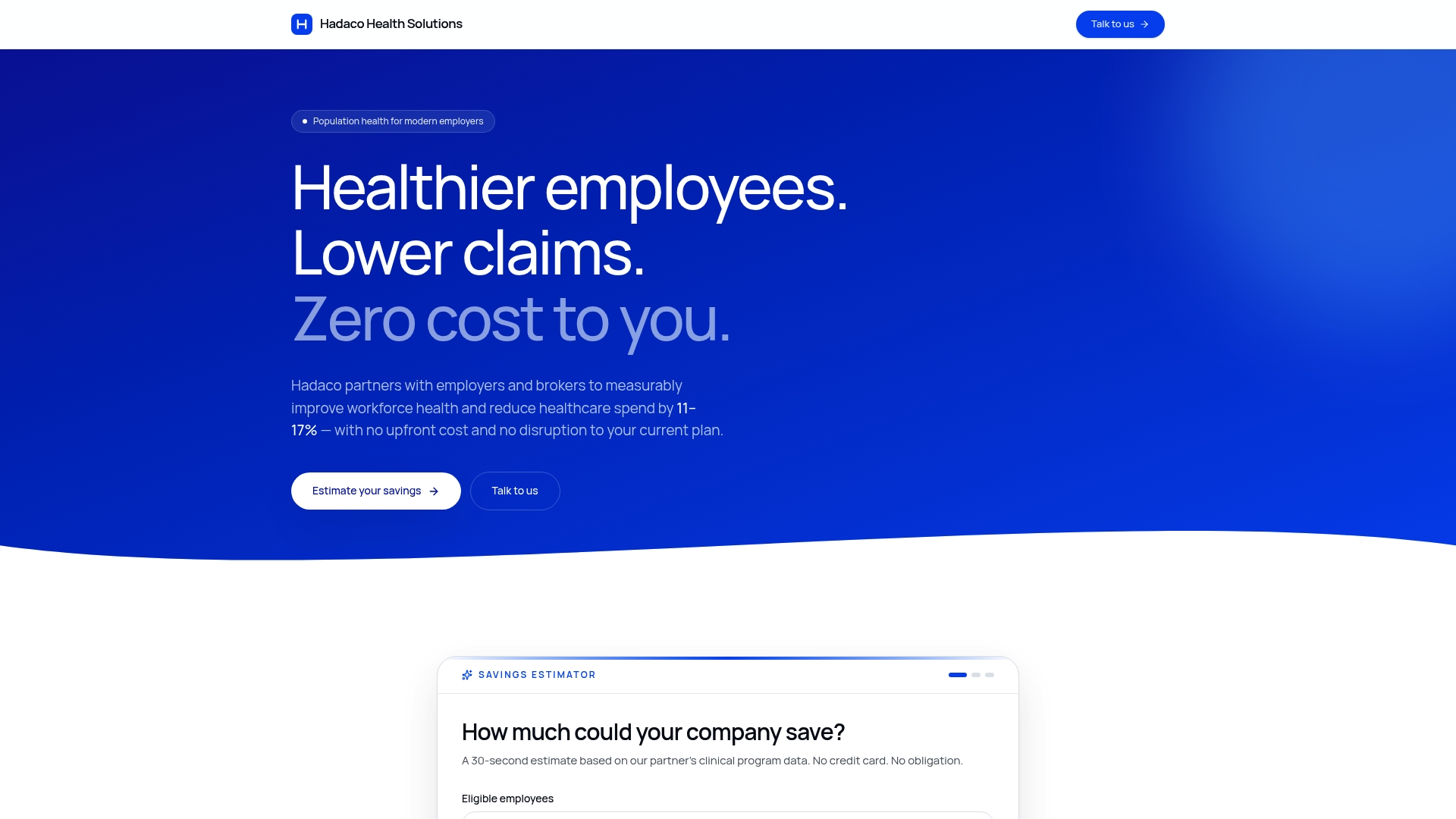
The platform layers evidence-based programs for chronic disease, preventive care, and mental health on top of existing plans, then tracks results with a transparent savings estimator and quarterly reporting. Companies have seen average first-year savings per employee, alongside improved engagement and retention. If your team is rolling out accommodations and manager training this quarter, pairing that effort with a population health program that reports real numbers gives you the data to defend the budget next year. Start by checking your estimated savings and see how mental health support fits into your broader benefits strategy.
Sources
- EEOC guidance: your employment rights as an individual with a disability
- Job Accommodation Network: accommodation ideas
- Systematic review on interventions for adults with ADHD and work outcomes
- NAMI StigmaFree: Working with ADHD — a guide for employees
- CDC: Attention-deficit / hyperactivity disorder (ADHD)
FAQ
What Is the 30% Rule in ADHD?
The "30% rule" is a shorthand some clinicians and coaches use to describe the developmental lag often seen in executive function skills for people with ADHD, roughly 30% behind same-age peers. It's a general framing concept, not a precise clinical measurement, and it's most useful for explaining why standard deadlines or expectations may need adjusting rather than abandoning.
How Can I Manage My Adult ADHD at Work?
Break tasks into smaller chunks with explicit deadlines, use visual timers or calendar blocking to manage transitions, and request written follow-ups after verbal meetings. Combining these habits with coaching or CBT-based support tends to improve work outcomes more than relying on medication alone.
What ADHD Accommodations Can I Ask for at Work?
Common, low-cost requests include noise-canceling headphones, a quieter workspace, written instructions instead of verbal-only direction, flexible start times, and task restructuring into smaller pieces. The Job Accommodation Network maintains a full list of accommodation ideas by job function and limitation.
How Do I Work a 9 to 5 With ADHD?
Structure the day around your energy, not the clock: front-load demanding tasks during your sharpest hours and batch routine work like email during lower-focus periods. Pair that with short, written daily priorities from your manager and a scheduled break every 90 minutes or so to prevent the afternoon crash that often derails focus.
Does Hadaco Help With ADHD-Related Workplace Programs?
Hadaco doesn't provide ADHD accommodations directly, but it helps employers measure the broader impact of mental health and engagement programs, including coaching and EAP utilization, through quarterly reporting and a savings estimator. That data can help HR justify continued investment in accommodation training and support programs.