
The three levers that move activation fastest are personalized nudges and decision support, simplified choices through defaults and quick enrollment, and small incentives paired with automation. Together they turn passive enrollment into confident, timely benefit use, with personalized reminders driving roughly an 18% lift in activation. This guide walks through how to pilot each tactic this quarter, including how programs like ours at Hadaco fit the playbook.
TL;DR:
- Personalized reminders and decision support can increase benefits activation by approximately 18 percent when timed correctly and targeted to the right employees.
- Simplifying choices through defaults and quick enrollment can raise plan participation by 10 to 20 percentage points, with incremental gains when combined with nudges.
- Light-touch outreach and simple reminders significantly outperform high-touch engagement, often increasing benefit take-up by 0.14 to 2 percentage points with much lower costs.
- Conducting small, focused pilots with a control group and staggered rollout enables measurable results within a single enrollment cycle, avoiding simultaneous tactic confounding.
- Starting with system simplification and defaults, then adding personalized nudges and micro-incentives, maximizes activation gains with minimal complexity and cost.
Table of Contents
- What is the benefits activation gap, and why does it matter?
- Which activation strategies deliver the biggest returns?
- How do you run a benefits activation pilot this quarter?
- How do you measure whether activation efforts are working?
- How we deliver measurable activation and cost outcomes
- Where should HR focus first?
- Getting started with Hadaco
- FAQ
- Sources
What is the benefits activation gap, and why does it matter?
Enrollment is a single decision made once a year. Activation is what happens after: whether an employee actually logs a telehealth visit, files an FSA claim, or uses a second-opinion service when a diagnosis arrives. Most benefits strategies stop at the enrollment line and miss everything that follows, which is where the real cost savings and health outcomes live.
Several barriers explain the gap:
- Tasks required to use a benefit (prior authorization, claim submission, portal navigation) carry real cognitive cost.
- Employees frequently misjudge or forget which plan they are on months after enrolling.
- Attention is limited and competing priorities push benefits reminders to the bottom of an inbox.
- Friction in claims and reimbursement processes discourages repeat use even among people who tried once.
Structured education closes part of this gap on its own. Employers running webinars during enrollment saw participation rise about 16%, while three-part email campaigns lifted FSA and HSA participation by roughly 11%. That gap between a single flyer and a structured campaign is the difference between a benefit that sits unused and one that gets claimed.
Which activation strategies deliver the biggest returns?
Not every tactic deserves equal investment. Ranked by evidence and effort, these are the moves worth running first.
- Year-round communications tied to life events. Claims activity tends to spike after enrollment, and sustained, claims-triggered reminders outperform a single open-enrollment push because they reach employees at the moment a benefit becomes relevant.
- Personalized nudges and decision support. Reminders that reach the right employee with the right benefit at the right time produce an 18% lift in activation when the impression actually lands, compared with generic blasts that get ignored.
- Simplified choice architecture. Pre-selected, default-style options modeled on Quick Enrollment raised plan participation by 10 to 20 percentage points in a Harvard Business School working paper, and Easy Escalation design raised contribution rates roughly 15% among employees who were under-contributing.
- Micro-incentives at the moment of decision. A $10 reward increased the odds of a contribution-rate change by about 8 percentage points in field trials, acting less as a financial motivator and more as a trigger that converts intention into action.
- Interface and language design. Plain-language prompts, traffic-light call-to-action buttons, and defaults displayed close to the decision point measurably increased both enrollment and contribution intensity among employees who customized their choices.
- Integrated systems and a single front door. Scattered portals and logins fragment attention; one platform that HR, managers, and employees all use cuts the number of places a benefit can get lost.
Light-touch outreach deserves special mention because it is the most cost-effective lever on this list, as shown by programs like those at Level Up Gym that offer corporate wellness and vendor-run onsite or virtual fitness programming. Large field experiments on benefit take-up found that simple reminders and contacts increased take-up by 0.14 to 2 percentage points, a 150% to 500% relative increase depending on the baseline, while adding more intensive, high-touch outreach on top produced little additional benefit relative to its cost. That argues for spending the marginal dollar on broader, simpler nudges rather than concierge-style outreach for everyone.
Where application steps are genuinely long or confusing, direct help still earns its keep. Caseworker-style application assistance raised take-up specifically for benefits with complex procedures, which suggests reserving hands-on support for the subset of benefits that are hardest to navigate rather than spreading it evenly.
A useful way to sequence this: start with simplification and defaults because they are durable and apply broadly, layer in personalized nudges because they compound on top of simpler choices, then add micro-incentives at the specific moments where you need a nudge to become an action.

How do you run a benefits activation pilot this quarter?
A focused pilot beats a sprawling campaign. Here is a sequence that fits inside a single enrollment or plan-year cycle.
- Assign ownership. Benefits leads own the strategy, communications owns message testing, HR analytics owns measurement, and whoever manages your platform vendor owns the data integration.
- Pick one cohort and one tactic. Choose a segment, new hires, a single location, or employees who did not touch a specific benefit last year, and test a single lever: a personalized nudge sequence, a micro-incentive, or a Quick Enrollment-style default.
- Define a control group. Hold back a comparable group that receives only standard communications so you can measure lift rather than guess at it.
- Set a timeframe and sample size. A single enrollment window or one plan quarter is enough to see directional results; smaller cohorts need longer windows to reach a readable signal.
- Choose channels deliberately. Test email against in-platform push notifications, manager-delivered prompts, and payroll-stuffer style reminders to see which channel the cohort actually responds to.
- Check the operational plumbing. Confirm claims data can feed targeting without creating privacy problems, and confirm your vendor's data flows support timely, relevant triggers rather than static campaigns.
- Report the result and decide whether to scale. A clear lift against the control group is the trigger to extend the tactic company-wide; a flat result tells you to swap the tactic, not to add more of it.
Pro Tip: Sequence one simplification change, one nudge, and one measurement cycle before you add a second concurrent campaign. Running several tactics at once makes it impossible to tell which one worked.
How do you measure whether activation efforts are working?
Four metrics cover most of what a benefits team needs to track: the conversion rate from impression to activation, utilization of the specific benefit you targeted, change in claims or cost trend for that benefit category, and engagement frequency such as logins or reminder opens.
- Education campaigns like webinars and multi-part emails produced lifts of roughly 11% to 16% in FSA and HSA participation, a reasonable benchmark for communications-only interventions.
- Personalized reminder programs produced an 18% impression-to-activation lift, a useful ceiling to aim for once nudges are well targeted.
- Simplification interventions moved enrollment by 10 to 20 percentage points, the widest range on this list and a sign that defaults matter more than most communications budgets.
Build a monthly operational dashboard for impressions, clicks, and early utilization signals, and a quarterly ROI review that ties activation back to claims trend. Stagger rollouts across cohorts or regions rather than launching everywhere simultaneously, since a staggered rollout gives you a natural comparison group without having to withhold the program from anyone permanently. The most common attribution mistake is crediting a lift to a single tactic when several campaigns ran at once; the fix is the staggered or control-group design described in the pilot section above, not a more complicated model after the fact.
How we deliver measurable activation and cost outcomes
Our programs at Hadaco address chronic disease management, preventive care, and employee engagement in one evidence-based structure that layers on top of whatever plan an employer already runs, rather than replacing it.
- We integrate with existing benefit plans without disrupting them, so activation gains come from better use of available employer benefits.
- We typically help employers reach a double-digit reduction in healthcare claim costs with no upfront fees, and companies working with us often see average first-year savings of $451 per employee, alongside improved engagement and retention.
- We provide a savings estimator and quarterly reporting, so employers can track outcomes regularly rather than rely only on annual renewal projections.
- Our wellness engagement strategies and communications playbooks give HR teams the same cadence and message-testing approach described above, built specifically for the benefits categories employers most want to see used.
Where should HR focus first?
The near-term return is in AI-assisted personalization paired with claims-informed nudges, not in bigger enrollment events. Static annual campaigns are reaching their ceiling, while systems that can trigger a message when a claim pattern suggests a relevant benefit are still underused by most employers.
The most useful thing a benefits team can do this quarter is not a strategy document. It is one measurable experiment: one cohort, one tactic, one control group, reported honestly even if the result is flat. Teams that run that single test learn more than teams that plan a perfect campaign for next year.
— Gene
Getting started with Hadaco
Every tactic in this playbook—year-round nudges, simplified choices, micro-incentives—works best when it is tied to a measurable savings target, which is the piece we built our programs around. We map evidence-based interventions for chronic disease, preventive care, and engagement onto your existing plan, then show the projected savings through our estimator before anything launches.
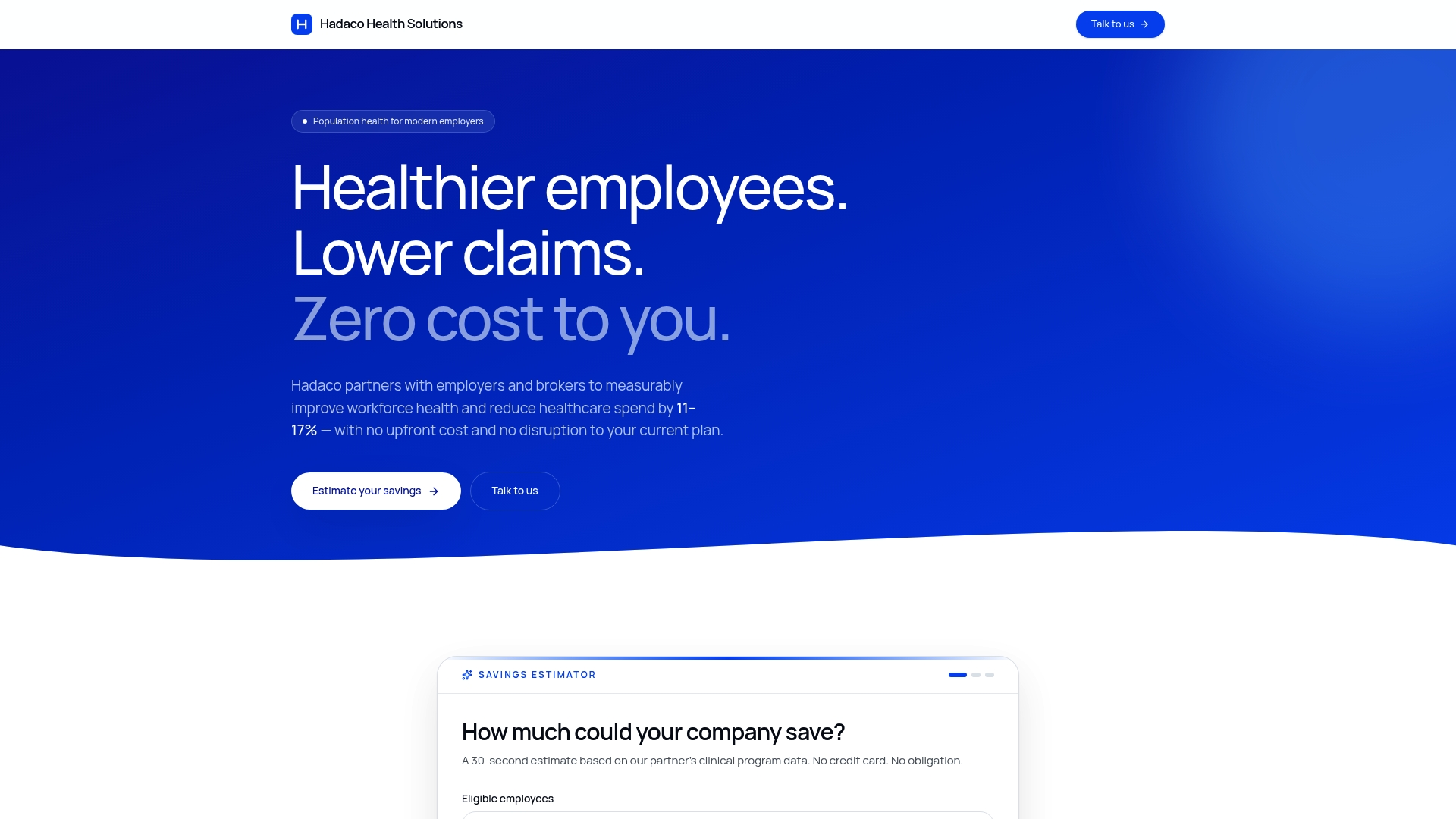
A consult with our team typically produces two concrete outputs: a savings estimate specific to your workforce and a pilot plan for the first benefit category worth activating. From there, quarterly reporting tracks whether the pilot is moving claims and engagement in the right direction, the same control-group logic described earlier in this guide, applied to your own data.
If you want a starting number before committing to a pilot, run a savings estimate with Hadaco and use it as the baseline for your first quarter's experiment.

FAQ
What are activation strategies?
Activation strategies are the specific tactics, personalized nudges, simplified defaults, timely reminders, and small incentives, that convert a benefit an employee is enrolled in into one they actually use. They target the gap between signing up and taking action, which is where most unused benefit value disappears.
What is a benefits strategy?
A benefits strategy is the broader plan covering which benefits an employer offers, how they are priced, and how they are communicated and supported throughout the year. Activation strategies sit inside that larger plan as the piece focused specifically on utilization after enrollment.
What is strategy activation?
Strategy activation refers to turning a planned benefits or communications strategy into real employee behavior through concrete execution: timed messages, simplified choices, and measurement that confirms the plan is working rather than just existing on paper.
How quickly can employers see results from activation tactics?
Education-based tactics like webinars can show lifts within a single enrollment window, with structured campaigns producing 11% to 16% increases in targeted participation. Personalized nudge programs and simplification changes tend to need one full plan cycle to show a clear, attributable result.
Does Hadaco charge upfront fees for its programs?
No, our programs run with no upfront fees, and we tie our model to demonstrated healthcare savings and engagement outcomes rather than charging a flat rate regardless of results. Quarterly reporting lets employers track those outcomes directly against the baseline we estimate at the start.
Sources
- Navia Benefits analysis (2024)
- Simplification and saving (HBS/CLM analysis)
- Businessolver Benefits Insights Report (2025)
- Poverty Action Lab brief on outreach interventions (2025)