
This resource gives you a copy-ready wellness RFP question checklist, a 100-point scoring rubric, and a 90-day pilot template. Paste the checklist into your next RFP, insist on a 90-day pilot with defined success criteria before signing anything long-term, and treat privacy compliance, insurance coverage, and client references as pass/fail gates that eliminate vendors before you ever score a proposal.
TL;DR:
- Vendors must demonstrate clear outcomes with measurable benchmarks for risks like absenteeism, high-cost claims, or turnover, and show proven results with comparable clients.
- All proposals should be rejected if a vendor refuses to sign a HIPAA-compliant Business Associate Agreement, cannot provide proof of insurance, or declines a defined pilot with success criteria.
- The proposal evaluation should prioritize outcome fit (25 points), program rigor (20), data quality (20), logistics (15), privacy (10), and pricing flexibility (10), with strict pass/fail gates at each stage.
- A 90-day pilot should include baseline and milestone measurements, focusing on participation, engagement quality, and early health improvements, with go/no-go criteria built into the contract.
- Rate transparency is essential, requiring detailed, itemized pricing, outcome-based options, and clear termination and renewal terms to ensure fair comparison and procurement safeguards.
Table of Contents
- Categorized Wellness RFP Questions You Can Copy Into Your Next Proposal
- How to Score Vendor Proposals Without Playing Favorites
- Designing a 90-Day Pilot That Actually Tests the Vendor's Claims
- What to Ask About Data Privacy and HIPAA Compliance
- Getting Straight Answers on Pricing and Contract Terms
- A Worked Example: Filling In the RFP Template
- Why Pilots and Pass/Fail Gates Protect Buyers
- Sources
Categorized Wellness RFP Questions You Can Copy Into Your Next Proposal
Most wellness RFPs fail for a simple reason: they ask vague questions and accept vague answers. "Tell us about your program" invites a marketing pitch. The questions below force vendors to commit to specifics you can actually verify.
Business outcomes and scope
- What business risks (absenteeism, high-cost claimants, turnover) does your program address, and what's your baseline measurement method?
- What outcomes have comparable clients achieved in year one, with what population size and industry?
- What's the minimum population size or budget where your model performs best?
Program design and delivery
- What delivery modalities do you offer (in-person, virtual, hybrid, app-based), and what percentage of participants use each?
- How do you handle clinical oversight for chronic condition management, and who supervises that care?
- Can you share a sample 12-month program calendar showing cadence of touchpoints?
Engagement and behavior change
- What specific engagement tactics do you use beyond email reminders and point systems?
- How do you personalize outreach for different risk tiers or demographic segments?
- How do you define and measure "engagement quality" as opposed to simple login counts?
Vendors that can't answer this last question with a real metric, rather than a login count dressed up as engagement, are telling you something important about how they measure their own success. For more on what actually moves participation numbers, see this breakdown of wellness engagement strategies that raise real participation instead of vanity metrics.
Technology and integrations
- Does your platform support single sign-on (SSO) with our identity provider?
- Can you integrate with our HRIS, benefits administration system, and PTO tracking without manual file transfers?
- Which wearable devices and apps does your platform sync with natively?
- What offline or low-tech options exist for employees without smartphone access?
Data, privacy, and security
- Will you sign a Business Associate Agreement (BAA) under HIPAA before any data sharing begins?
- What SOC 2 or ISO certifications do you hold, and can you provide the most recent audit report?
- How is data de-identified before it reaches our reporting dashboards?
Analytics and outcomes
- What leading indicators do you track in the first 90 days, before lagging outcomes like claims data mature?
- Can you show us a sample executive dashboard from an existing client (anonymized)?
- What's your methodology for calculating ROI, and does it separate correlation from causation?
Implementation and support
- Who makes up the implementation team, and what's their average tenure with your company?
- What's the typical timeline from contract signature to program launch?
- What are your service level agreements (SLAs) for support ticket response times?
Logistics and onsite services
If your program includes onsite clinical services or biometric screenings, ask about clinic hours, staffing credentials, and backup coverage if a clinician calls in sick. A municipal RFP process for an employee wellness clinic program spells out exactly this level of detail, down to biometric screening logistics and quarterly reporting formats, and it's a useful model for phrasing your own logistics clauses.
Pricing and contract terms
- Can you provide a full rate card, including pilot pricing and per-employee or per-participant fees?
- What add-on services carry extra charges that aren't in the base package?
- What are the termination clauses, and do they include a notice period we can actually use?
References and evidence
Ask for at least three client references with contact dates, plus de-identified case studies showing real outcome data, not testimonials.
How to Score Vendor Proposals Without Playing Favorites
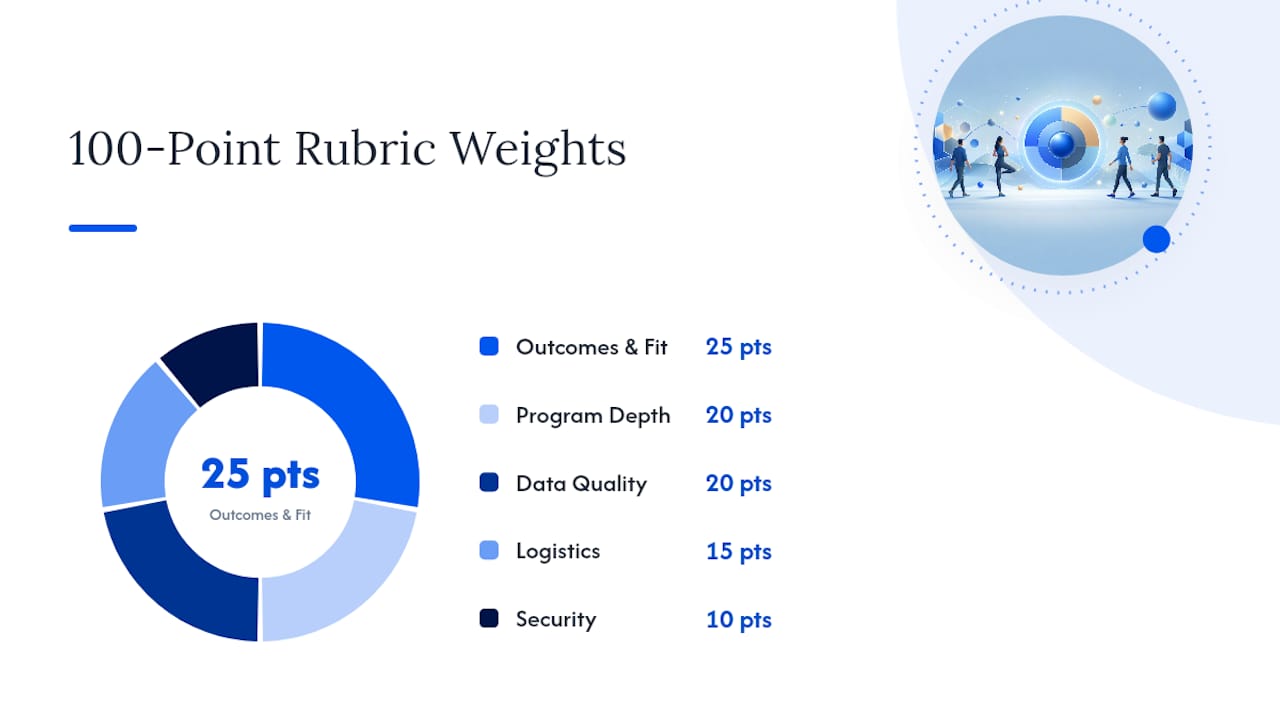
A scoring rubric only works if every reviewer applies the same weights to the same criteria. Without one, procurement decisions default to whoever gave the best presentation, which is exactly the outcome an RFP process is supposed to prevent.
A workable 100-point model, adapted from a corporate wellness RFP checklist and scoring template, breaks down like this:
- Outcomes and fit for your population: 25 points
- Program depth and clinical rigor: 20 points
- Data quality and reporting capability: 20 points
- Logistics and employee experience: 15 points
- Security and privacy posture: 10 points
- Pricing and contract flexibility: 10 points
Before you score anything, run every vendor through pass/fail gates. A vendor that won't sign a BAA, can't produce proof of general liability insurance, has no minimum reporting capability, or refuses to run a pilot doesn't get scored. It gets eliminated.
| Gate | Pass criteria |
|---|---|
| HIPAA compliance | Signed BAA available before data sharing |
| Insurance | Proof of general liability and, if clinical, malpractice coverage |
| Reporting | Sample dashboard with real (anonymized) data |
| Pilot willingness | Written agreement to a defined pilot period |
Once gates are cleared, normalize pricing scores by comparing total cost per participant across each vendor's actual model, whether that's per-employee-per-month, per-engaged-user, or flat platform fees, so a low sticker price doesn't hide a narrower scope. Vendor guidance on this process recommends narrowing your shortlist to two or three finalists before scheduling demos. More than that dilutes scoring discipline and stretches your evaluation timeline without improving the decision.
Designing a 90-Day Pilot That Actually Tests the Vendor's Claims
A pilot is where marketing claims meet reality. Structure it around two cohorts: one higher-risk group (think elevated biometric markers or chronic condition prevalence) and one representative cross-section of your broader workforce. Running both simultaneously shows you whether a vendor's engagement tactics work only on already-motivated employees or actually move the needle with harder-to-reach populations, illustrating why the wellbeing workforce is heartbeat of businesses.
Track these from day one:
- Participation rate by week, not just cumulative enrollment
- Engagement quality, meaning completed actions, not just logins
- Early risk movement on any biometric or self-reported health measures
- Manager feedback after each training session
Cadence matters as much as metrics. Require weekly vendor check-ins, a baseline measurement before week one, and an endline measurement at day 90. The vendor should deliver a written report at the halfway mark and a full pilot summary at close, not just a verbal debrief on a call.
Pro Tip: Build your go/no-go decision criteria into the contract before the pilot starts. If you wait until day 85 to decide what "success" means, the vendor will define it for you.
Set a clear scale-up trigger, such as participation exceeding a target threshold in the higher-risk cohort by week 6, so you're not waiting the full 90 days to spot a vendor that's clearly underperforming.
What to Ask About Data Privacy and HIPAA Compliance
Wellness vendors handle protected health information (PHI), which means HIPAA compliance isn't optional if biometric data, claims data, or health risk assessments are part of the program. Ask directly whether the vendor will sign a BAA before any data changes hands. A vendor that hesitates or offers a modified version with narrower protections is showing you their actual privacy posture, not their sales pitch.
Request their most recent SOC 2 or ISO audit report, a data flow diagram showing exactly where PHI travels and where it's stored, and a written retention policy with a hard deletion timeline. Ask how they anonymize data before it reaches employer-facing dashboards.
- Have you had a data breach in the past five years, and if so, what was your response timeline?
- What are your access controls for employee-level data internally?
- Does your indemnity language specifically cover data incidents, or only general liability?
A Hampton, Virginia RFP attachment for an onsite wellness center lays out this exact line of questioning, including past sanctions and breach history, as standard procurement practice for any vendor touching employee health data.
Red flag: a vendor that refuses to sign a BAA, gives a vague answer on retention ("as long as needed"), or can't name a specific certification body for their compliance claims.
Getting Straight Answers on Pricing and Contract Terms
Rate cards should be itemized, not bundled into a single number that hides what you're actually paying for. Ask for pricing broken into per-employee-per-month or per-participant fees, separate pilot pricing, and a list of any add-ons (biometric screenings, onsite staffing, premium reporting) with their own line items.
- Will you offer outcome-based pricing tied to engagement or health outcome targets?
- If pilot success criteria aren't met, do we get a credit, a refund, or an exit option?
- What's the termination clause, and how much notice does it require?
- Are there rate guarantees for contract renewal years, or does pricing reset annually?
Comparing vendors fairly means normalizing for scope, not just sticker price. A wellness program pricing benchmark guide can help Finance sanity-check whether a quote is in a reasonable range for the services included, rather than negotiating blind.
A Worked Example: Filling In the RFP Template
A filled-in excerpt might read: "Scope: 800 eligible employees across two locations. Reporting: biweekly during pilot, quarterly post-launch." Ask vendors to show a savings estimator, sample quarterly report, and their average reported per-employee savings, then weigh those claims against your own gate criteria before scoring them.

Why Pilots and Pass/Fail Gates Protect Buyers
Require measurable pilots, transparent scoring, and hard privacy gates before any wellness vendor gets a signature. Loop Finance and Legal in at the pass/fail stage, not after you've already picked a favorite. That sequencing is what turns an RFP from a formality into an actual decision tool.
— Gene
If you're evaluating vendors right now and want a program built around measurable claim reduction rather than engagement theater, see how Hadaco's approach works and what a transparent savings estimator looks like in practice before you finalize your shortlist.
Sources
A demo should follow a script you control, not the vendor's slide deck. Structure it in three blocks: 10 minutes on your priority checklist items, 20 minutes of technical questions (integrations, data flow, reporting), and 10 minutes walking through an actual sample dashboard.
- COUNTY OF MONTGOMERY RFP# 25-10 Employee Wellness Clinic Program
- RFP Attachment E — Questionnaire for Onsite Health and Wellness Center (Hampton)
- Corporate Wellness RFP Checklist — Free Vendor Evaluation Template (Workhouse Wellness)