
Mid-size employers with limited reserves and lower risk tolerance typically do better with level-funded plans, while larger employers with strong cash positions tend to save more with self-funded plans over time. The trade-off comes down to predictability versus control. Stop-loss insurance and U.S. regulatory obligations shape both paths, so understanding how each works matters before you commit.
TL;DR:
- Level-funded plans offer predictable monthly costs but include higher embedded stop-loss premiums and stricter renewal underwriting.
- Self-funded plans provide full claims data access, potential long-term savings, and more control, but with variable cash flow and higher administrative responsibilities.
- Employers should scrutinize stop-loss exclusions and compare administrative fees, as these have a significant impact on actual costs.
- Reserves and risk tolerance determine whether an employer benefits more from predictable fixed payments or potential savings from greater control.
- Implementing population health programs before renewal can reduce claims and improve cost trajectory regardless of the chosen funding model.
Table of Contents
- How level-funded and self-funded plans actually work
- Pros and cons: a practical trade-off list for benefits leaders
- Decision checklist and negotiation priorities for HR and CFOs
- U.S. regulatory and filing implications
- Cost drivers and a simple modeling approach
- Lowering claims regardless of funding model
- What benefits leaders should keep in mind
- A practical next step: lowering claims before or after you choose
- FAQ
- Sources
How level-funded and self-funded plans actually work
A level-funded plan bundles three things into one fixed monthly payment: an estimate of expected claims, a stop-loss insurance premium, and administrative fees. Milliman explains level-funded plans as a hybrid structure built on self-funding with stop-loss layered on top specifically to smooth out month-to-month volatility. You pay the same amount every month regardless of how claims actually run, and if claims come in under the estimate, you may receive a refund at year-end.
Self-funding works differently. You pay claims as they happen, dollar for dollar, with a third-party administrator (TPA) processing claims and handling day-to-day operations. Stop-loss coverage is optional rather than built in, though most employers carry it to cap exposure on catastrophic claims. Benefits Collective describes level-funded plans as sitting in the middle ground precisely because they borrow the claims-based structure of self-funding while adding the payment stability of a fully insured plan.
The operational differences go beyond cash flow:
- Self-funded employers typically get full access to raw claims data, which supports targeted wellness or disease-management interventions.
- Level-funded employers often see claims data in summary form only, limiting how precisely they can target high-cost conditions.
- Self-funded plans carry more direct TPA and vendor management responsibility.
- Level-funded plans shift most of that administrative load to the carrier or general agent.
That data access gap matters more than it first appears. An employer that can see which chronic conditions drive claims can act on them. One that only sees a monthly invoice cannot.
Pros and cons: a practical trade-off list for benefits leaders
The right choice depends on which risks you can absorb and which you would rather transfer. Here is how the two models stack up for employers weighing both:
- Level-funded pros: fixed monthly payments make budgeting simple, year-end refunds are possible when claims run low, and smaller groups qualify more easily than they would for full self-funding.
- Level-funded cons: the stop-loss premium embedded in your payment adds cost, underwriting can be stricter at renewal, and refunds are never guaranteed.
- Self-funded pros: lower expected cost over time since you are not paying insurer markup on every claim, complete visibility into claims data, and room to run advanced cost-containment tactics like pharmacy carve-outs.
- Self-funded cons: cash flow varies month to month based on actual claims, you manage more vendor relationships, and regulatory responsibilities land more squarely on your plan.
Pro Tip: Before comparing premiums, ask each vendor for their stop-loss exclusion list. A narrow set of exclusions often matters more than a slightly lower rate.
The pattern is consistent: level funding trades some expected savings for predictability, while self-funding trades predictability for control and long-run cost potential. Milliman's analysis frames the real question as whether an employer can finance adverse timing and claims outcomes, not simply which model has the lower sticker price.
Decision checklist and negotiation priorities for HR and CFOs
Before switching funding models, work through a short internal checklist. Start with your financial profile: do you have reserves to absorb a bad claims month, or does your budget need the same number every quarter?
Then scrutinize the contract itself:
- Confirm specific and aggregate stop-loss attachment points, since these set your actual exposure ceiling.
- Read exclusions carefully, especially around pre-existing high-cost claimants.
- Compare administrative fees across vendors, not just the headline premium.
- Ask how any year-end refund is split between employer and carrier.
Vendor diligence matters just as much; many employers find tools to hire verified clinicians today useful when aligning their clinical networks with quality standards. Ask prospective TPAs how often they report claims data, whether you get line-item access or summaries only, and how pharmacy benefits are carved out and managed. Internally, assign clear ownership: someone needs to own PCORI filings, someone needs to review stop-loss renewals annually, and someone needs to run scenario tests before each renewal cycle. Our benefits decision support playbook walks through this process in more detail for employers comparing options side by side.
U.S. regulatory and filing implications
Self-funded plans are governed federally under ERISA, which generally preempts state insurance mandates. That is one reason larger self-funded employers can design benefits more uniformly across states, while level-funded and fully insured plans remain more subject to state-by-state rules.
Self-insured plan sponsors must file and pay the PCORI fee annually on IRS Form 720, typically by July 31 following the close of the plan year. The fee is calculated from average covered lives, so sponsors should confirm the current IRS amount for their specific plan year rather than relying on a figure from a prior cycle. The IRS application chart clarifies which arrangements, including certain HRAs, are subject to this fee.
One point gets missed often: the Department of Labor has clarified that stop-loss insurance protects the plan sponsor against catastrophic claims, but it does not convert a self-insured plan into a fully insured one. Employees still draw benefits from the underlying self-funded plan, and the sponsor keeps administrative responsibility. Assign PCORI filing, stop-loss renewal review, and TPA reporting explicitly to named roles in HR, finance, or your broker relationship so nothing falls through at renewal.

Cost drivers and a simple modeling approach
A level payment typically breaks into three line items on a per-employee-per-month basis: expected claims, the stop-loss premium, and administrative fees. Where your stop-loss attachment point sits changes both your premium and your exposure. A lower specific attachment point means the carrier picks up claims sooner, which raises your premium but caps your worst-case month more tightly.
To build a credible model before switching funding vehicles, gather:
- Three years of paid claims history, not just one, to see the real variance.
- A breakdown of pharmacy drivers, since specialty drugs often skew totals.
- A list of current and recent high-cost claimants and their trajectory.
- Stress-test scenarios for one bad month and for one large ongoing claimant.
Milliman's guidance on this point is practical: without three years of claims and claimant-level detail, any savings projection is a guess dressed up as a model. Our guide on managing high-cost claimants covers how to flag and plan around these cases before they distort a renewal.
Lowering claims regardless of funding model
Whichever funding structure you choose, the underlying driver of cost is the same: claims. Reducing chronic disease progression and catching conditions earlier through preventive care lowers the odds of a catastrophic claim that blows past a stop-loss attachment point. That math holds whether you are level-funded or self-funded, since both models still live or die on claims experience.

We built our population health programs around that principle: evidence-based interventions for chronic disease, preventive care, and engagement that work alongside your existing plan rather than replacing it, with no upfront fees and a transparent savings estimator so you can see projected impact before committing. Many employers running these programs see average year-one savings per employee. These programs fit naturally whether you are weighing a move to level funding or already self-funded and looking to improve claims trajectory before your next renewal.
Pro Tip: Layer a population health program in before your next renewal cycle, not after. The claims data you need to show improvement takes a full plan year to build.
What benefits leaders should keep in mind
The funding decision is really a financial capacity question dressed up as a benefits question. If a bad claims month would strain your cash flow or force a board conversation, level funding buys you room to breathe. If you can absorb variance and want the upside, self-funding usually pays off over several years.
My one caution: do not sign a stop-loss contract without reading the exclusions line by line, and do not accept quarterly claims summaries when you could be getting line-item data. Pilot any change with a year of scenario modeling before you commit your whole workforce to it.
— Gene
A practical next step: lowering claims before or after you choose
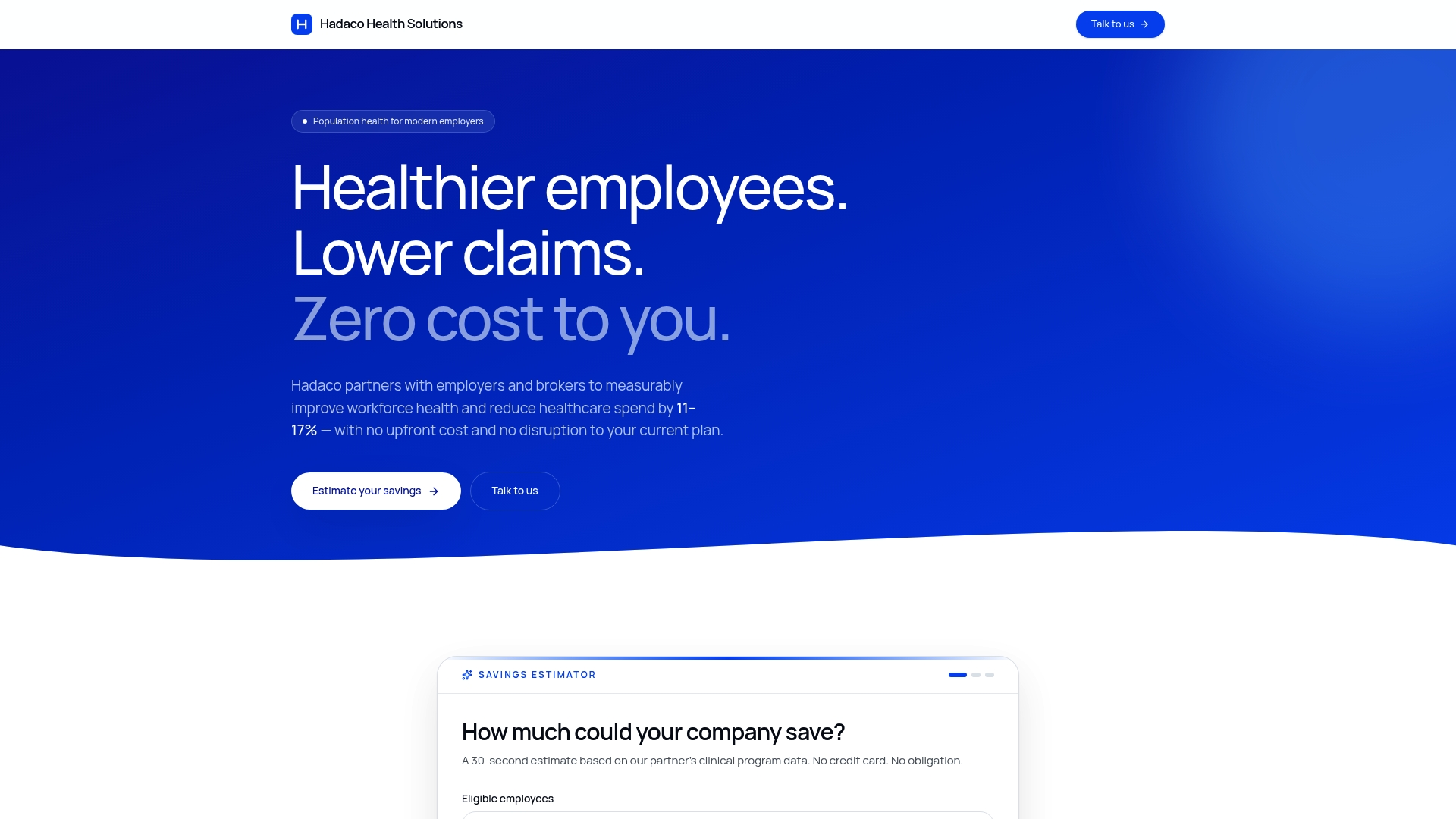
Whichever funding model you land on, the plan still runs on claims experience. We work alongside your existing benefits structure, level-funded or self-funded, to reduce the chronic disease and preventive-care gaps that drive high-cost claims, without requiring you to disrupt your current plan or pay anything upfront.
- Transparent savings estimator shows projected impact before you commit to anything.
- Quarterly reporting gives your team measurable outcomes instead of a once-a-year summary.
- No upfront fees mean the program is structured around demonstrated results.
If you want a clearer picture of what population health support could do for your claims trajectory, visit Hadaco to run the savings estimator or schedule a consultation.
FAQ
What are the cons of a level-funded health plan?
The main drawbacks are the embedded stop-loss premium, which adds cost compared to pure self-funding, and underwriting that can tighten at renewal if claims run high. Refunds are possible but never guaranteed, and claims data access is often limited to summaries rather than line-item detail.
What are the two types of government-funded healthcare in the US?
Medicare and Medicaid are the two primary government-funded healthcare programs in the United States, covering seniors and certain disabled individuals, and lower-income individuals and families, respectively. Neither relates directly to employer-sponsored level-funded or self-funded plans, which are privately financed benefit arrangements.
Is self-funded or fully funded better?
Neither option is universally better. Self-funded plans tend to offer lower expected costs and full claims visibility for employers with the reserves to handle claim variability, while fully insured plans offer more predictable costs and less administrative burden, which smaller or risk-averse employers often prefer.
What does "level funded" mean for a health plan?
A level-funded health plan combines expected claims costs, a stop-loss insurance premium, and administrative fees into one fixed monthly payment. Milliman describes this structure as a hybrid of self-funding and insurance designed to reduce month-to-month cost volatility for the employer.
Which employers typically choose level funding over self-funding?
Level funding is especially common among small to mid-size employers, with KFF reporting that roughly 37% of covered workers in firms with 10 to 199 employees are enrolled in level-funded plans. Larger employers with stronger cash reserves more often choose full self-funding instead.
Sources
- Analyzing the impact of shifts to level-funded plans | Milliman
- DOL technical release on stop-loss and self-insurance
- Patient-Centered Outcomes Research Trust Fund fee | IRS
- 2025 Employer Health Benefits Survey | KFF