
Employer-facing benefits decision support — meaning integrated population-health programs designed to engineer ROI into their own architecture — is the most defensible way for mid-to-large U.S. employers to cut healthcare claim costs without disrupting existing plans. Three elements are non-negotiable: a workforce health assessment that establishes a clinical and cost baseline, a data-driven governance structure, and integrated interventions spanning chronic disease, utilization management, mental health, and preventive care.
Hadaco clients report substantial savings per employee in the first year, with no upfront fees required. The immediate next step: run a savings estimator or book a consultation before your next benefits renewal cycle.
Table of Contents
- Why benefits decision support matters for mid-to-large U.S. employers
- What every employer-facing population-health program must include
- How to evaluate a population-health vendor
- Implementation roadmap: what to expect at each stage
- Measuring ROI: KPIs, attribution, and reporting cadence
- Evidence and results: how Hadaco's methodology works
- Final verdict and recommended next steps
- How to calculate ROI and what real programs show
- How population-health programs complement your existing benefits
- Legal and compliance considerations
- Integration with HR and payroll systems
- Contract negotiation tips and key clauses
- Post-implementation support and continuous improvement
- Key Takeaways
- The gap between what wellness programs promise and what actually works
- What Hadaco offers and how to get started
- Authoritative sources and further reading
Why benefits decision support matters for mid-to-large U.S. employers
Medical spend keeps climbing, and reactive plan design keeps failing. The real lever is changing utilization patterns before claims are filed, not after. Employer-facing population-health programs do exactly that: they identify high-risk employees, steer them toward appropriate care, and reduce the avoidable acute episodes that drive the largest claims.
The CDC recommends a systematic process for building these programs: start with a workforce health assessment, establish governance, then deploy evidence-based interventions. That sequence matters because skipping the assessment means you are guessing at your cost drivers.
What the research actually shows: The Illinois Workplace Wellness Study found that voluntary wellness programs attract healthier, lower-spending employees — meaning the people who most need intervention often opt out. Programs that rely on passive enrollment will not move the needle on total medical spend.
Rigorous trials, including the NBER working paper on workplace wellness, document mixed short-run effects and underscore the need for careful, data-driven program design. The takeaway for CFOs: expect multiyear ROI, not a single-year miracle, and require defensible attribution from day one.

What every employer-facing population-health program must include
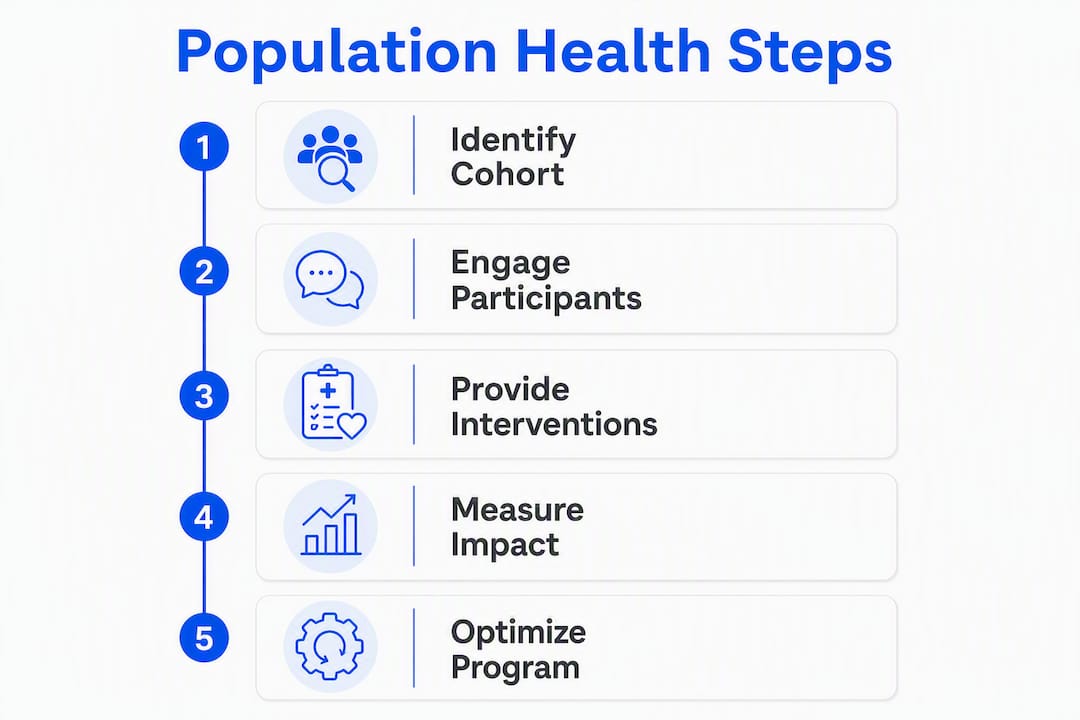
The CDC guidance is clear that combining individual clinical strategies with environmental and policy changes produces better adoption and sustainability. Here is the practical build sequence:
- Workforce health assessment and baseline cost attribution. Pull claims data, biometric screenings, and utilization patterns to identify your highest-cost cohorts. Without this employee health risk assessment, you cannot attribute savings later.
- Data and governance infrastructure. Establish data-sharing agreements, a privacy framework (HIPAA-compliant), and a steering committee with HR, benefits, legal, and finance. Governance is where ROI gets engineered, not in the clinical layer alone.
- Integrated interventions. Per the Forbes HR Council, benefits programs work best on a continuum of appropriateness — chronic disease management, utilization management, primary care access, musculoskeletal support, mental health, and preventive care working together, not in silos.
- Engagement and change management. Incentive design, care navigation outreach, and manager communication all determine whether high-risk employees actually participate.
Pro Tip: Design engagement outreach to actively target your highest-cost, highest-risk cohort. Voluntary, passive enrollment consistently attracts healthier employees — a selection bias that inflates apparent savings without reducing real claim costs.
How to evaluate a population-health vendor
| Evaluation Criterion | What to Require | Red Flag |
|---|---|---|
| Data integration | Claims, EHR, biometric feeds in one attribution model | Vendor uses only self-reported data |
| Attribution methodology | Pre/post with matched controls or interrupted time series | "Trust us" savings estimates with no baseline |
| Reporting cadence | Quarterly outcomes reports tied to documented interventions | Annual-only reporting |
| Clinical model | Nurse-led care navigation, chronic disease management | Generic wellness app with no clinical staff |
| Engagement strategy | Proactive outreach to high-risk members | Passive portal enrollment only |
| Pricing model | Performance-based or no-upfront-fee terms available | Fixed fee regardless of outcomes |
"ROI in population health is engineered into program design — programs with clear governance and data infrastructure link clinical outcomes to financial savings." — Conifer Health Solutions
Any vendor unwilling to tie fees to demonstrated savings, share their attribution methodology, or provide quarterly reporting is not a partner worth contracting.
Implementation roadmap: what to expect at each stage
- Days 0–90: Foundation. Complete the workforce health assessment, execute data-sharing agreements, stand up the governance committee, and select a pilot cohort from your highest-risk population. Define KPIs and measurement methodology before any intervention launches.
- Months 3–6: Deployment. Roll out chronic disease management, care navigation, and utilization management workflows. Track early KPIs: ER visit rates, primary care utilization, and program engagement among high-risk members. Adjust outreach tactics based on participation data.
- Months 6–12: Scale and optimize. Expand coverage to the broader employee population, run the first quarterly savings report, and conduct a contract performance review. Document every clinical action taken — nurse outreach calls, referrals, site-of-care redirects — because that documentation is what makes ROI defensible.
Measuring ROI: KPIs, attribution, and reporting cadence
| KPI | Source Data | Reporting Cadence |
|---|---|---|
| Total cost of care per member | Medical and pharmacy claims | Quarterly |
| Avoidable ER visits | Claims, care navigation logs | Quarterly |
| Inpatient admissions and readmissions | Claims data | Quarterly |
| Site-of-care migration | Claims by place of service | Quarterly |
| Program engagement, high-risk cohort | Vendor platform data | Monthly |
| Chronic condition control rates | Biometric and clinical data | Semi-annual |
ROI in population health rarely appears in a single reporting cycle. Behavior change, care-pathway shifts, and fewer acute episodes take time to show up in claims. CFOs who expect a clean year-one return on every dollar will be disappointed; CFOs who require quarterly documentation of clinical actions tied to utilization changes will have defensible data by month 12.
Attribution methods that hold up to scrutiny: pre/post analysis with matched control groups, interrupted time series, and claims-based attribution tied to documented clinical actions like care navigation calls and referrals.
Pro Tip: Require your vendor to log every nurse outreach call, referral, and site-of-care redirect in a format that can be cross-referenced against claims data. Without that documentation trail, savings claims are assertions, not evidence.
Evidence and results: how Hadaco's methodology works
Hadaco's approach starts where the research says programs fail: at the baseline. Rather than launching interventions into a data vacuum, Hadaco establishes cost attribution by cohort before any clinical activity begins.
- Nurse-led interventions target the highest-cost members directly, with proactive outreach rather than passive portal enrollment.
- Care navigation steers members to lower-cost, clinically appropriate sites of care — a direct driver of claim reduction.
- Quarterly reporting documents the link between clinical actions and utilization changes, creating the defensible ROI trail that CFOs need.
- Average savings of $451 per employee in year one is the representative outcome Hadaco reports, measured against a preprogram baseline.
Selection bias is a real constraint. Programs that rely on voluntary enrollment will consistently attract healthier employees. Hadaco's proactive outreach model is designed specifically to counter that pattern by reaching high-risk, high-cost members who would not self-select into a passive wellness portal.
Realistic expectations: multiyear programs outperform single-year snapshots. The first year establishes the baseline and begins shifting utilization; years two and three typically show compounding savings as chronic conditions stabilize and acute episodes decline.
Final verdict and recommended next steps
The verdict: require a population-health program that engineers ROI into its design from day one, not one that retrofits measurement after the fact.
Three immediate actions:
- Run a workforce health assessment to identify your highest-cost cohorts before issuing any RFP.
- Require quarterly ROI reporting with documented clinical interventions as a contract term, not an optional add-on.
- Negotiate performance-based fee terms so vendor compensation is contingent on demonstrated savings.
Governance committee: include HR, benefits, legal, and finance from the start. Legal needs to review HIPAA data-sharing agreements; finance needs to sign off on the attribution methodology before year-end reporting.
Run the Hadaco savings estimator now or schedule a consultation to see what your workforce's cost profile looks like before your next renewal.
How to calculate ROI and what real programs show
The standard ROI formula for population-health programs: (total medical cost reduction minus program cost) divided by program cost, expressed as a percentage. The honest version adds a matched control group to the numerator so you are measuring causal impact, not regression to the mean.
A CDC-published study of a long-standing academic workplace health program used inverse propensity score-weighted regression across seven years of claims data to estimate ROI — the methodological standard that separates defensible results from marketing claims. The key variables: total cost of care per member, program participation rates among high-risk cohorts, and site-of-care utilization shifts.
For employers building their own ROI model: anchor the baseline to the 12 months immediately before program launch, segment by risk tier, and track the high-risk cohort separately. That cohort drives the majority of claim costs and the majority of potential savings.
How population-health programs complement your existing benefits
A well-designed program does not replace your carrier, your TPA, or your pharmacy benefit manager. It sits alongside them, using their data to identify gaps and redirect utilization. Employees keep their existing plan; the program adds care navigation, chronic disease outreach, and utilization management on top.
The practical result: fewer unnecessary ER visits, more primary care utilization, and better chronic condition management — all of which reduce claims without requiring plan redesign. Hadaco's model is built on this complementary architecture, which means implementation does not require renegotiating carrier contracts or disrupting open enrollment.
Legal and compliance considerations
HIPAA governs how health data flows between employers, vendors, and plan administrators. Any population-health vendor must operate as a Business Associate under a signed BAA (Business Associate Agreement) before accessing claims or clinical data. GINA (Genetic Information Nondiscrimination Act) restricts what health information employers can collect or use in wellness incentive design. The ACA's wellness program rules cap incentive values and require reasonable alternatives for employees who cannot meet health standards.
This is general information, not legal advice. Confirm current HIPAA, GINA, and ACA wellness program requirements with qualified ERISA counsel before finalizing program design.
Integration with HR and payroll systems
Data flows in two directions: eligibility data (from your HRIS or payroll system to the vendor) and outcomes data (from the vendor back to HR and finance). Most mid-to-large employers use platforms like Workday, ADP, or UKG for eligibility feeds. A competent population-health vendor will have standard API or SFTP integrations for these systems and will handle the data mapping as part of implementation.
The critical integration point is claims data from your TPA or carrier. That feed is what makes attribution possible. Establish the data-sharing agreement and test the feed during the 0–90 day foundation phase, not after interventions have already launched.
Contract negotiation tips and key clauses
Watch for these contract terms:
- Attribution methodology clause: Require the vendor to specify, in writing, exactly how savings are calculated and what baseline period is used.
- Performance-based fee structure: Tie at least a portion of vendor compensation to demonstrated savings, not just program delivery.
- Data ownership: Confirm that your organization retains ownership of all claims and outcomes data generated during the engagement.
- Reporting obligations: Specify quarterly reporting as a contractual deliverable, not a best-effort commitment.
- Termination for non-performance: Include a clause allowing exit if savings targets are not met within a defined period, typically 18–24 months.
Vendors who resist performance-based terms or opaque attribution language are signaling that their savings claims will not survive scrutiny.
Post-implementation support and continuous improvement
The first contract year is a calibration period. Expect the vendor to adjust outreach tactics, refine cohort targeting, and update intervention protocols based on early engagement data. A quarterly business review cadence — not annual — is the standard for programs serious about continuous improvement.
After year one, the optimization focus shifts: which interventions produced the largest utilization changes, which cohorts remain under-engaged, and where site-of-care migration is stalling. Workplace wellness challenges around sustained engagement are real, and the best vendors build re-engagement protocols into their standard operating model rather than treating year-two participation as the employer's problem to solve.
Key Takeaways
Employer-facing population-health programs deliver defensible ROI only when governance, baseline data, and proactive high-risk engagement are built into the program from day one.
| Point | Details |
|---|---|
| Require baseline data | No workforce health assessment means no defensible attribution — make it a contract prerequisite. |
| Insist on quarterly reporting | Annual-only reporting hides performance problems; quarterly cadence keeps vendors accountable. |
| Prioritize performance-based fees | Tie vendor compensation to demonstrated savings, not program delivery alone. |
| Engage high-risk members proactively | Passive enrollment attracts healthier employees and inflates apparent savings without reducing real costs. |
| Hadaco's model | Hadaco delivers nurse-led, evidence-based population-health programs with no upfront fees and an average $451 savings per employee in year one. |
The gap between what wellness programs promise and what actually works
Most employers shopping for population-health programs get sold on the concept and under-scrutinize the methodology. The Illinois Wellness Study result — that participants were already healthier before the program started — is not a footnote. It is the central challenge of the entire category. Any vendor who cannot explain, in plain terms, how they reach and engage your highest-cost employees is selling you a program that will improve the health of people who were already doing fine.
The governance piece gets underestimated too. Employers treat it as administrative overhead when it is actually where ROI gets built. A steering committee that meets quarterly, reviews clinical action logs against claims data, and holds the vendor to documented intervention standards is the difference between a program that compounds savings over three years and one that produces a nice slide deck at renewal.
Performance-based fee terms are the clearest signal of vendor confidence. If a vendor will not tie their compensation to your outcomes, they already know their attribution will not hold up.
What Hadaco offers and how to get started
Hadaco delivers employer-facing population-health programs with no upfront fees, a transparent savings estimator, and quarterly outcomes reporting — so you know exactly what you are getting before you commit and throughout the engagement.
The initial engagement includes a workforce health assessment, pilot cohort selection from your highest-risk population, and a measurement plan built before any intervention launches. Fees are performance-based, contingent on demonstrated healthcare savings. That structure means Hadaco's incentives are aligned with yours from day one.
Employers who have run the savings estimator typically see their cost-reduction potential quantified within a single conversation. If you are heading into a benefits renewal cycle, that number belongs in your planning before you finalize carrier negotiations. Book a consultation to get your workforce's cost profile and a clear picture of what a performance-based program looks like for your organization.
Authoritative sources and further reading
- Strategies for Building a Workplace Health Program — CDC: The foundational framework for workforce assessment, governance, and evidence-based interventions.
- Illinois Workplace Wellness Study — PMC: The most rigorous U.S. RCT on workplace wellness; essential reading on selection bias and realistic ROI timelines.
- What Do Workplace Wellness Programs Do? — NBER Working Paper w24229: Documents mixed evidence, industry growth, and the importance of careful evaluation methodology.
- What Is Population Health Management for Employers? — Conifer Health Solutions: Covers the engineered-ROI concept and governance infrastructure requirements.
- The Benefit Leader's Guide to Promoting Population Health Management — Forbes HR Council: Practical framing of the continuum of appropriateness and integrated program design.
- Impacts of Workplace Health Promotion on Healthcare Utilization and Costs — CDC Stacks: Seven-year observational study using propensity-score methods to estimate ROI from a long-standing employer program.
- Health and Economic Outcomes Up to Three Years After a Workplace Wellness Program — Health Affairs: Randomized controlled trial examining longer-run effects; useful for setting multiyear ROI expectations.
- The Impact of Enhanced Behavioral Health Services on Total Healthcare Costs — JHEOR: Site-level analysis of 19 employer cohort studies on behavioral health program ROI.
- Corporate Wellness ROI: What HR Leaders Need to Know — Hadaco Blog: Practical guide to building ROI models and measuring savings from employer wellness programs.