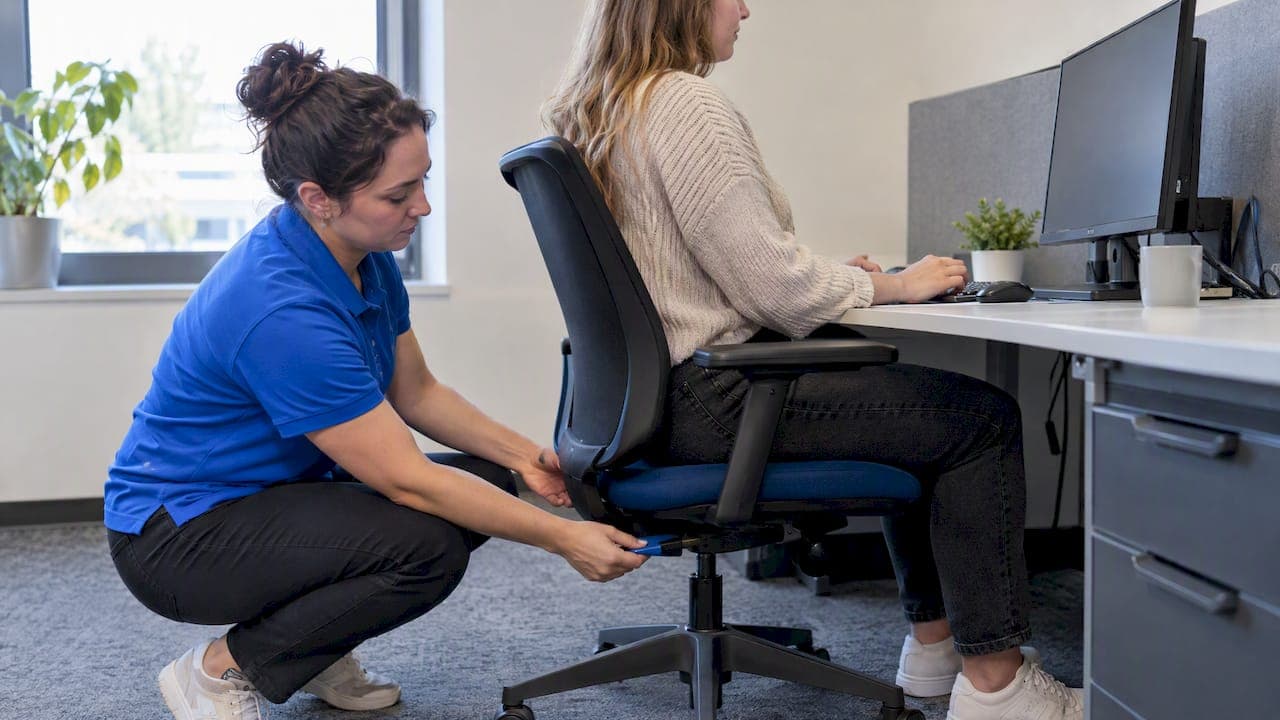
An office ergonomics program is a systematic, ongoing effort to spot and fix the physical factors behind musculoskeletal strain before they turn into claims, absences, or lost productivity. Done well, it lowers musculoskeletal complaints, trims claims exposure, and improves retention. It works through a combination of management sponsorship, employee participation, and controls you can measure, not just equipment purchases.
TL;DR:
- Management must sponsor the program and appoint a specific owner to ensure authority and accountability.
- Starting with symptom surveys and quick walk-throughs helps prioritize high-risk departments efficiently.
- Implementing low-cost fixes like monitor risers and workstation adjustments often produces significant improvements.
- Regular follow-ups at 2 and 8 weeks after interventions are crucial for maintaining progress and building credibility.
- Tracking both symptom reductions and completed fixes is essential to demonstrate tangible program success to leadership.
Table of Contents
- Key takeaways for briefing leadership
- What the core elements of an ergonomics program actually mean
- How to start implementation in 3 to 6 months
- Training and participation that drive real adoption
- Monitoring and evaluation: proving the program works
- A quick workstation checklist for self-assessment or screens
- What measurable program outcomes look like in practice
- A straight-talk perspective on what actually moves the needle
- How we help you sustain and measure ergonomics outcomes
- FAQ
- Sources
Key takeaways for briefing leadership
Before you build a full plan, these are the points worth putting in front of executives:
- Management needs to sponsor the program and name a specific owner, not a committee without authority.
- Start with symptom surveys and targeted walk-throughs rather than guessing which departments need attention first.
- Prioritize engineering and workstation controls before training alone; low-cost fixes like monitor risers often deliver outsized results.
- Build in 2-week and 8-week follow-ups after any intervention, then evaluate the whole program at baseline and every quarter.
What the core elements of an ergonomics program actually mean
NIOSH's Elements of Ergonomics Programs model maps cleanly onto an office setting once you assign real owners to each piece.
- Management leadership and employee participation. Name an executive sponsor, a program coordinator who runs day-to-day logistics, and a small steering committee that includes facilities and at least one frontline employee.
- Hazard identification. Use short symptom surveys, review OSHA injury logs where applicable, and run self-check tools alongside prioritized walk-throughs of the highest-complaint areas.
- Job hazard analysis and controls. Apply the hierarchy of controls: fix the workstation or task first, then consider administrative changes like rotation, and treat personal equipment as a last resort.
- Training. Teach workers self-adjustment basics, train supervisors to recognize early complaints, and brief procurement, facilities, and IT staff on what to buy and how to configure it.
- Medical management and reporting. Create an early-reporting pathway so discomfort gets logged before it becomes an injury, and define who handles each case.
- Evaluation and records. Track the same metrics every quarter so trends are visible over time.
OSHA's sample ergonomics program describes this as a systematic process to anticipate, identify, analyze, and control hazards, and recommends a full program review at least every three years.
How to start implementation in 3 to 6 months
You do not need a year-long rollout to show results. A focused starter plan looks like this:
- Secure an executive sponsor and appoint a coordinator with named contacts in facilities, IT, and procurement.
- Run a baseline assessment: a short symptom survey paired with targeted walk-throughs, including a virtual option for remote staff.
- Triage findings by risk and feasibility, tackling low-cost, high-impact fixes first and documenting every decision.
- Pick one or two departments for a pilot, set a timeline, and define success metrics before you start.
- Coordinate with procurement and facilities on standardized purchasing criteria and a simple equipment demo process.
A GAO review of private-sector ergonomics programs found that management commitment, employee involvement, and structured problem-job identification were common threads in programs that participating facilities believed reduced workers' compensation costs.
Pro Tip: Keep the pilot small enough that you can close every reported hazard within 30 days, since a fast first win builds the credibility you need to scale.

Training and participation that drive real adoption
Training only works if it matches the audience. Build separate modules for quick self-adjustment basics, manager responsibilities for spotting early complaints, and facilitation skills for whoever runs your ergonomics working group.
- Set up a participatory ergonomics working group with mixed representation: facilities, a supervisor, and two or three employees from different roles.
- Run the group through ideation, prioritization, and implementation tracking so suggestions do not stall after the brainstorm.
- Reinforce training with microlearning, printed checklists, and brief manager check-ins rather than a single annual session.
- Schedule follow-up touchpoints at 2 and 8 weeks after any workstation change, escalating to a clinical evaluation if discomfort persists past that window.
Participatory ergonomics process evaluations consistently find that groups generate good prioritized measures but implementation often lags unless logistics and budget are planned in advance. Reinforcing this loop is also where employee engagement best practices for managers can help keep working groups active instead of fading after the first meeting.
Monitoring and evaluation: proving the program works
Track both outcome and process metrics so you can show finance more than anecdotes.
- Outcome metrics: symptom prevalence from surveys, musculoskeletal disorder claims, days away from work, and return-to-work rates.
- Process metrics: number of workstation evaluations completed, the percentage of fixes closed within your target window, and training completion rates.
- Cadence: baseline at launch, a pilot review at 3 to 6 months, quarterly reporting to leadership, and a full program audit at least every three years, as OSHA recommends.
A systematic review and meta-analysis of 24 randomized controlled trials found that multifaceted ergonomic interventions, combining physical workstation changes with training and follow-up, produced more consistent reductions in neck, back, wrist, and ankle pain than single-component changes alone. That is the evidence base for building a program with multiple elements rather than relying on equipment purchases by themselves. For the financial side, our healthcare cost containment playbook walks through how to connect these process metrics to claims trends when you present results.
A quick workstation checklist for self-assessment or screens
Most ergonomic fixes are adjustments, not purchases:
- Chair: seat height lets feet rest flat, lumbar support fills the lower back curve, armrests keep shoulders relaxed.
- Input devices: keyboard and mouse stay at elbow height, with alternative input options available for high-repetition tasks.
- Display: monitor top sits at or slightly below eye level, roughly an arm's length away, with secondary monitors angled to avoid neck twisting.
- Environment: reduce glare, add a footrest or document holder where needed, and schedule short movement breaks every hour.
- Remote workers need the same checklist adapted for home setups, and procurement specs should reflect these same baseline requirements for any new equipment order.
Our guide on conducting employee health risk assessments covers how to adapt this checklist into a broader screening tool.
What measurable program outcomes look like in practice
Once a program is running, the real test is whether you can report outcomes with numbers finance will accept. Our population health programs track measurable savings per employee in the first year through our transparent savings estimator, which gives employers a concrete baseline to measure against rather than a vague promise.
A simple executive summary narrative works well here: baseline claims and symptom data, the intervention period, then measured change in claims or absence trends, reported quarterly. To build that narrative, fold ergonomics metrics into your broader population-health reporting:
- Include musculoskeletal symptom and claims data alongside other chronic-disease metrics in the same quarterly report.
- Tie workstation fix completion rates to the same reporting cadence as other engagement initiatives.
- Use one consistent baseline period so quarter-over-quarter comparisons stay valid.
A straight-talk perspective on what actually moves the needle
Leadership speed matters more than equipment spend. I have seen programs stall for months waiting on sign-off for a $40 keyboard tray while the backlog of reported hazards kept growing. The common failure mode is not a lack of chairs, it is underfunding implementation and never closing the loop on what employees already flagged. By 6 to 12 months, the real sign of success is a shrinking backlog of open fixes and survey scores trending down on discomfort, not a binder full of policies nobody follows.
— Gene
How we help you sustain and measure ergonomics outcomes
Population health programs can integrate with existing benefits instead of replacing them, covering chronic disease, preventive care, and employee engagement alongside the kind of physical health factors an ergonomics program addresses. Quarterly reporting and savings estimators can provide measurable outcomes finance expects from health initiatives, sometimes with no upfront fees. If you want to see what that could look like for your workforce, visit Hadaco to check your savings estimate or book a consultation.
FAQ
How do I become a certified ergonomist?
Certification paths typically involve a combination of relevant coursework, supervised experience, and an exam through a recognized professional body, with requirements varying by credentialing organization. HR managers building an internal program generally do not need certification themselves, since the program coordinator role focuses on process ownership rather than clinical assessment.
What is the 90-90-90 rule in ergonomics?
This is a commonly cited posture guideline suggesting right angles at the hips, knees, and elbows when seated at a workstation. It is a simplified rule of thumb, not a clinical standard, and should be adapted to individual body size and task.
How much does an ergonomic evaluation cost?
Costs vary widely depending on whether the evaluation is a self-check tool, a facilitated walk-through, or a formal consultant assessment, and no single figure applies across providers. Many organizations start with low-cost or no-cost self-assessment checklists before investing in professional evaluations for high-risk roles.
How can I improve my office ergonomics?
Start with small adjustments: set your monitor at eye level, keep your keyboard and mouse at elbow height, and make sure your chair supports your lower back. Pairing these physical changes with regular movement breaks and brief training tends to produce more lasting improvement than equipment changes alone, according to research on multifaceted ergonomic interventions.
Sources
- Elements of Ergonomics Programs | Ergonomics and Musculoskeletal Disorders | CDC
- Ergonomics Program (OSHA sample)
- Private Sector Ergonomics Programs Yield Positive Results (GAO/HEHS-97-163)