
Shared savings wellness programs pay vendors from a verified share of employer healthcare cost reductions instead of a flat fee. The model can align incentives well, but only when the employer insists on a rigorous total cost of care baseline, independent verification, and a multi-year timeline. Treat any proposal without those three elements as unproven, and require written methodology before you sign anything.
TL;DR:
- A rigorous total cost of care baseline, independent verification, and a multi-year timeline are essential for shared savings programs to be credible and effective.
- Employers should demand detailed contract language covering claims data access, risk adjustment, and reconciliation procedures before signing any agreement.
- Most studies show limited savings within the first 18 to 36 months, especially as participants tend to be healthier before enrollment, skewing perceived ROI.
- Only programs involving chronic-condition management or randomized trials reliably demonstrate cost reductions, making pilot controls crucial for validation.
- Companies like Hadaco report first-year savings of around 451 dollars per employee, but verification against actual claims data remains vital before committing.
Table of Contents
- How shared savings models work and common contract structures
- What the evidence says about ROI, selection bias, and timelines
- U.S. legal and compliance checklist employers must verify
- Evaluation checklist: what to insist on in a shared savings contract
- Setting a credible TCOC baseline and verifying savings
- Implementation expectations and red flags to watch in year one
- When a shared savings approach makes sense
- Hadaco: how our approach lines up with the evaluation checklist
- Primary sources and federal guidance to review
- Sources
- FAQ
How shared savings models work and common contract structures
A per employee per month (PEPM) vendor gets paid regardless of outcome. A shared savings vendor gets paid, in whole or in part, from a portion of the cost reductions it can prove against a baseline. That structural difference is why the model appeals to CFOs: the vendor absorbs some of the risk that the program does not work.
The contract mechanics determine whether that alignment is real or cosmetic. A defensible agreement needs a written baseline total cost of care (TCOC), a trend projection showing what costs would have done without intervention, risk adjustment for population health differences, and quality gates that prevent the vendor from hitting savings targets by restricting necessary care.
Payment architectures vary:
- Upside-only arrangements pay the vendor a percentage of proven savings with no penalty for missing targets.
- Upside/downside contracts add a clawback or reduced fee when targets are missed.
- Population-based fees with outcomes guarantees blend a smaller fixed fee with a savings component.
None of these work without contract language guaranteeing the employer access to full claims data, not just a vendor-built dashboard summarizing its own performance.
What the evidence says about ROI, selection bias, and timelines
The research on workplace wellness savings is more mixed than most vendor pitches suggest. A large randomized trial tracked outcomes over three years and found modest behavior change but no significant reduction in total medical spending within 18 to 36 months, according to health and economic outcomes research published in Health Affairs. That timeline matters: employers expecting first-year financial payback from a general wellness program are working against the evidence.
A recurring finding across large trials is that program participants tend to be healthier and lower-spending before they ever enroll, according to the Illinois Workplace Wellness Study, which means observational before-and-after comparisons can show apparent savings that have nothing to do with the program itself. That selection effect is the single biggest reason vendor-reported ROI figures deserve skepticism.
Where savings have shown up more credibly, they tend to come from multi-year chronic-condition management, integrated value-based care approaches, or programs with genuine randomization rather than self-selected enrollment. The practical takeaway for HR and CFOs: budget pilots with a control group where feasible, and insist on reconciliation performed by someone other than the vendor collecting the fee.

U.S. legal and compliance checklist employers must verify
Wellness incentives sit inside a dense regulatory framework, and getting the structure wrong creates real exposure.
- Incentive limits. Under HIPAA and ACA nondiscrimination rules for health-contingent wellness programs, incentives are generally capped at 30% of the cost of employee-only coverage, rising to 50% for tobacco-related programs, and a reasonable alternative standard must be offered to anyone who cannot meet the health factor, according to the EEOC's final rule on employer wellness programs.
- ADA considerations. Any disability-related inquiry or medical exam inside a wellness program must be voluntary and confidential, which shapes how biometric screenings and health risk assessments are administered.
- GINA restrictions. Genetic information, including family medical history, carries separate limits, and spouse participation in health risk assessments has its own boundaries.
- State and plan-structure review. Whether the program sits inside or outside the group health plan changes which of ERISA, COBRA, HIPAA, and state privacy law applies, so legal review needs to happen before launch, not after.
- Notice and documentation. Employees need clear written notice of what data is collected, how it is used, and what the reasonable alternative standard looks like.
Pro Tip: Route every wellness program design through employment counsel before signing a vendor contract, not after; the incentive cap and disability rules are the two most commonly missed items.
Evaluation checklist: what to insist on in a shared savings contract
Before signing, HR and CFOs should treat the proposal like any other performance contract and demand specifics rather than marketing language.
- Require the vendor's written TCOC baseline method, including the look-back period, risk-adjustment approach, and trend assumptions, with a sample calculation you can check.
- Require full claims feeds, medical and pharmacy, not a summarized vendor dashboard, and a contractual obligation for the vendor to reconcile against the employer's own records.
- Require third-party audit rights, a defined audit window, and a dispute resolution timeline that does not leave the employer's money in limbo indefinitely.
- Require clarity on the savings split, payment timing, and any withhold or holdback tied to unresolved audit disputes.
- Require quality gates or multipliers so the vendor cannot hit a savings number by delaying or denying appropriate care.
Pro Tip: Ask the vendor for a sample reconciliation from an existing client before you sign, not after the first settlement period closes. Contracts that aggregate claims across the entire benefits ecosystem, rather than isolated point solutions, produce far more credible TCOC verification, according to analysis of value-based care contracts for self-insured employers.
Setting a credible TCOC baseline and verifying savings
The baseline is the single most contestable number in a shared savings contract, and it deserves the most scrutiny.
- Construct it from a two to three year look-back period, not a single year, to smooth out one-off high-cost claims.
- Apply an explicit risk-adjustment method, such as hierarchical condition categories, and agree on trend factors in writing before the contract starts, along with a request for the vendor's raw claims import schema, per the AJMC analysis on legal issues in value-based contracts.
- Include every relevant cost bucket in TCOC: medical claims, pharmacy claims, and administrative fees, since a baseline missing pharmacy spend understates true cost trend.
- Verify results through independent third-party reconciliation, periodic sampling of claims, and a defined settlement cadence, commonly with a 12 to 18 month audit window after year close, based on DOL guidance on HIPAA and ACA wellness rules.
A realistic timeline runs from data ingestion and baseline agreement in the first two quarters, through a first interim report at month twelve, to a first fully verified reconciliation closer to eighteen months in.
Implementation expectations and red flags to watch in year one
Year one is mostly infrastructure, not payout. Expect this sequence: vendor onboarding and data exchange, baseline agreement, program launch, a first reporting cycle, and pilot adjustments based on early data quality issues.
- Confirm your IT and benefits teams can support ongoing data feeds and privacy controls before launch.
- Watch for vendors that resist audit access or cannot explain their baseline math in plain terms.
- Be wary of activity-only KPIs (steps, screenings completed) presented as proxies for cost savings.
- Treat unusually high early savings claims as a signal to ask for the underlying reconciliation, not as good news.
Pro Tip: Structure year one as a phased pilot with a contractual holdback until the first sample reconciliation is complete; it costs little and catches most bad contracts early.
When a shared savings approach makes sense
Shared savings contracts fit self-insured employers with a stable workforce and clean, aggregated claims data, and leadership willing to wait more than a year for verified numbers. Employers with fragmented data, high turnover, or a need for a quick, simple outcome are usually better served by a straightforward PEPM arrangement or a narrow point solution. The tradeoff is consistent: stronger financial alignment against a heavier legal and operational lift.
— Gene
Hadaco: how our approach lines up with the evaluation checklist
Hadaco was built around the checklist above rather than around it. The program integrates with existing benefit plans instead of replacing them, runs with no upfront fees, and reports outcomes on a quarterly basis so employers are not waiting a full year for a first look at results. Hadaco reports that employers using its program see an average first-year savings of $451 per employee, a company-reported figure worth validating against your own claims data once a baseline is set.
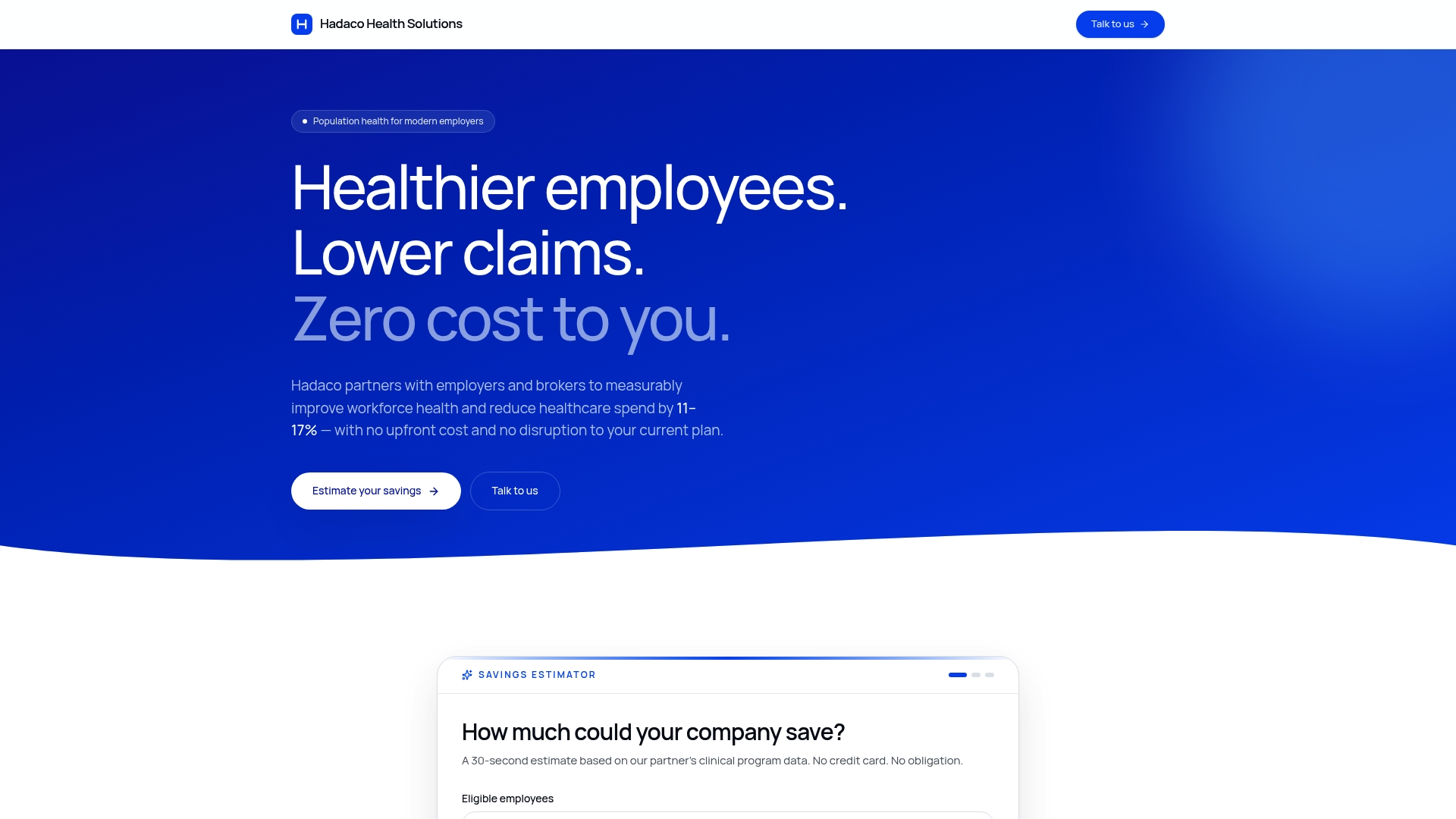
Before contracting with any vendor, including Hadaco, ask for:
- Sample reconciliations from an existing client engagement.
- The exact inputs behind the savings estimator, including baseline and trend assumptions.
- Written contract terms matching the audit, data access, and quality-gate items covered above.
If the answers hold up, visit Hadaco to run the estimator or book a consultation and compare the numbers against your own claims history.
Primary sources and federal guidance to review
- EEOC final rule on wellness programs and genetic information: incentive limits and nondiscrimination requirements.
- Health Affairs randomized controlled trial: three-year outcomes data.
- AJMC legal issues analysis: contracting and TCOC aggregation guidance.
- For broader cost-control context beyond wellness vendors, see this overview of cost containment strategies.
This article is general information, not a substitute for advice from a qualified doctor. Consult a qualified healthcare professional about your own circumstances before acting on anything here.
Sources
- Health And Economic Outcomes Up To Three Years After A Workplace Wellness Program: A Randomized Controlled Trial | Health Affairs
- EEOC final rule: Employer wellness programs and genetic information nondiscrimination
- Legal issues in value-based care contracts for self-insured employers | AJMC
- Illinois Workplace Wellness Study (Molitor et al.)
FAQ
What is a shared savings wellness program?
It is a vendor arrangement in which the employer pays the vendor from a verified portion of healthcare cost reductions, measured against an agreed TCOC baseline, rather than a flat per-employee fee. Payment depends on proof, not participation.
How long does it take to see real savings?
Randomized trial evidence shows modest behavior change but limited medical spending reductions within 18 to 36 months, so most credible programs expect a first verified reconciliation around eighteen months into the contract. Expect infrastructure and baseline work to dominate the first year.
What incentive limits apply to workplace wellness programs?
Health-contingent wellness incentives are generally capped at 30% of the cost of employee-only coverage, or 50% for tobacco-related programs, and a reasonable alternative standard must be available to employees who cannot meet the health-based goal.
Why do vendor-reported ROI numbers sometimes look better than reality?
Participation in wellness programs is often driven by employees who were already healthier and lower-spending, a selection effect documented in the Illinois Workplace Wellness Study. That means simple before-and-after comparisons can overstate the program's actual causal effect.
What does Hadaco charge upfront?
Hadaco runs with no upfront fees, and companies using the program report an average first-year savings of $451 per employee, a company-reported figure to confirm against your own claims baseline before finalizing a contract.