
Employers can legally require or encourage vaccination in the workplace, but only if the policy is documented, applied consistently, and paired with a real accommodation process for medical and religious exemptions. Get three things right immediately: put the rules in writing with a defined scope, build a working accommodation and privacy process, and back the policy with paid time and logistical support so employees can actually comply.
TL;DR:
- Employers must clearly define who is covered and who is exempt in their vaccination policies, including deadlines, proof submission, and consequences for noncompliance.
- All accommodation requests should be documented, routed through HR, and evaluated with an individualized process that complies with ADA, Title VII, and other laws.
- Vaccination records must be stored separately from personnel files and protected as confidential medical information, with limited access and clear retention policies.
- On-site clinics should be scheduled with paid time, staggered appointments, and prepared for emergency readiness, with prompt reporting of attendance to ensure staffing stability.
- Consistent enforcement, defined scope, and risk assessment reduce compliance risks and disputes, emphasizing the importance of applying policies uniformly across all departments.
Table of Contents
- Building a vaccination policy workplace checklist HR can actually use
- What ADA, Title VII, GINA, OSHA, and HIPAA require
- Running on-site clinics without disrupting operations
- How to manage exemption requests step by step
- How to verify vaccination status and protect employee privacy
- Announcing and enforcing the policy consistently
- Where vaccination fits inside a broader wellness strategy
- What actually separates a compliant policy from a fragile one
- A complementary way to raise uptake and prove it worked
- Where to find the primary guidance
- Sources
Building a vaccination policy workplace checklist HR can actually use
A workplace vaccination policy fails when it leaves gaps for managers to fill in on the fly. Every written policy needs the following, spelled out in plain language rather than left to interpretation.
Core policy elements:
- Scope: name who is covered (full-time staff, remote employees, contractors, vendors, and visitors) and who is exempt.
- Policy type: state clearly whether vaccination is mandatory, strongly encouraged, or disclosure-only.
- Deadlines: give a specific compliance date, not "as soon as possible."
- Proof and submission: list acceptable documentation and exactly where and how to submit it.
- Confidentiality: explain who sees the records and how they're stored.
- Accommodation process: describe how to request one and the response timeline.
- Consequences: spell out what happens for noncompliance and what alternatives exist.
Steps to draft it:
- Pull a starting framework from SHRM's vaccination policy guidance or OSHA's sample mandatory vaccination policy template.
- Route every accommodation request through HR, not line managers.
- Set a testing-and-masking alternative for anyone who isn't vaccinated for a valid reason.
- Assign one person to own recordkeeping and confidentiality compliance.
What ADA, Title VII, GINA, OSHA, and HIPAA require
Federal law doesn't ban employer vaccine policies. It constrains how you run them. The Americans with Disabilities Act (ADA) requires an interactive process for anyone requesting a medical exemption. That means an individualized conversation, not a form letter denial. Employers can only treat an unvaccinated employee as a "direct threat" after a specific, documented risk assessment, and any medical inquiry has to stay narrowly tied to that assessment under EEOC guidance.
Title VII protects sincerely held religious beliefs, not just beliefs tied to an organized religion, and employers must accommodate them unless doing so causes undue hardship. GINA limits how you can use family medical history, which matters if your accommodation forms ask about family health background or if vaccination incentives edge into wellness-program territory.
Statistic callout: OSHA's Emergency Temporary Standard framework required covered employers to offer a vaccination or testing-and-masking alternative, plus reasonable paid time off for vaccination and recovery. Not every employer falls under an active OSHA mandate today, but the underlying support obligations remain the industry benchmark.
Legal checklist:
- Document every accommodation request and the reasoning behind the decision.
- Keep medical inquiries limited to what the direct-threat analysis actually requires.
- Store vaccination records apart from personnel files.
- Confirm whether HIPAA applies to your specific recordkeeping setup, since most employer-collected proof of vaccination isn't covered by HIPAA the way many HR teams assume; a wellness-program HIPAA breakdown walks through where the line actually falls.
Running on-site clinics without disrupting operations
An on-site clinic works best when a pharmacy chain or your local health department handles delivery and you handle scheduling. That division of labor keeps clinical liability with the vendor and keeps your team focused on staffing coverage.

Offer vaccination at no cost, during paid work hours, and stagger appointments across shifts so an entire team doesn't take a sick day from side effects on the same afternoon. CDC workplace vaccination planning guidance recommends spacing appointments deliberately for exactly this reason, especially ahead of second-dose windows.
Logistics checklist:
- Provide up to four paid hours per dose, a benchmark OSHA has historically recommended for vaccination and recovery time.
- Confirm anaphylaxis readiness with the vendor before the clinic date.
- Collect consent forms in advance to avoid delays on-site.
- Decide whether to run this in-house or through a vendor partnership before the clinic date, not the week of.
Pro Tip: Ask your vaccination vendor for a same-day reporting summary. Waiting a week to find out who showed up makes it nearly impossible to fix staffing gaps before the next shift starts.
How to manage exemption requests step by step
Most accommodation failures aren't legal failures. They're process failures, where nobody wrote down who asked for what and when. Fix that with a repeatable sequence.
- Employee submits a request through a designated HR contact, using a form that asks only for essential information.
- HR logs the date, the basis (medical or religious), and any documentation provided.
- HR follows up only as needed. Medical documentation should be limited to what supports the individualized assessment.
- HR evaluates alternatives such as testing, masking, or temporary reassignment before denying a request.
- HR documents the outcome and the reasoning in writing.
What HR should never skip:
- Never let a manager independently approve or deny a request.
- Never ask for more medical detail than the assessment requires.
- Never leave a request undocumented, even an informal verbal one.
- Escalate to legal counsel when a request involves conflicting facts, a contested denial, or a pattern of similar requests across a department.
A tight, well-documented interactive process is also the strongest defense if a denied accommodation ever turns into a charge or a lawsuit.
How to verify vaccination status and protect employee privacy
Accept a CDC vaccination card, a pharmacy or provider printout, or a signed attestation as proof. An attestation without documentation is weaker evidence, so pair it with a brief written statement acknowledging the consequences of a false claim.
Store vaccination and any related medical files separately from personnel records, with access limited to HR or occupational health staff who genuinely need it, not the full HR team. Statistic callout: federal guidance under the OSHA ETS framework treated vaccination status as confidential medical information subject to strict handling rules, a standard worth keeping even where the ETS itself no longer directly applies.
- Set a retention period and stick to it.
- Give employees a clear path to review or correct their own records.
- Route subpoenas or third-party disclosure requests straight to legal counsel before responding.
Announcing and enforcing the policy consistently
Announce the policy with enough runway that employees can act, not scramble. Two to four weeks ahead of any deadline is typical. Lead with the safety rationale, then immediately point people to where they can get vaccinated and who handles accommodation requests.
Train managers to route every question to HR rather than answering it themselves. A manager who probes into someone's medical reasons, even out of curiosity, creates exposure the company doesn't need.
- Document every enforcement step the same way, every time.
- Apply progressive consequences uniformly across departments.
- Keep a single point of contact for accommodation questions.
Pro Tip: Write the manager talking points before the policy goes out, not after the first confused employee calls their supervisor.
Where vaccination fits inside a broader wellness strategy
A vaccination push works better as one piece of a population-health program than as a standalone mandate. Track uptake against sick-day trends and healthcare claim data to see whether the investment is paying off, not just whether people showed up to the clinic.
- Pair clinic access with existing wellness communication channels instead of building new ones from scratch.
- Use quarterly reporting to show leadership the connection between uptake and claims trends.
- Coordinate vendor relationships across your flu shot program and any COVID-19 workplace policies so staff aren't juggling three different sign-up processes, an approach covered in Hadaco's flu vaccination workplace program guide.
What actually separates a compliant policy from a fragile one
Most vaccination mandate disputes I've seen written about don't come from the mandate itself. They come from inconsistency: one manager who let a request slide, another who demanded medical records nobody was entitled to ask for. The written policy matters less than whether it's applied the same way in every department, every time.
Start with a narrow risk assessment. Define exactly who the policy covers and why, before you draft a word of accommodation language. That scoping work prevents most of the disputes that show up later.
— Gene
A complementary way to raise uptake and prove it worked
Running a compliant vaccination policy is one job. Proving it actually reduced sick days and healthcare claims is a different one, and most HR teams don't have the reporting infrastructure to do it well. Hadaco fills that specific gap. It's not a replacement for your legal policy or your clinic vendor. It's the layer that connects vaccination uptake to measurable outcomes.
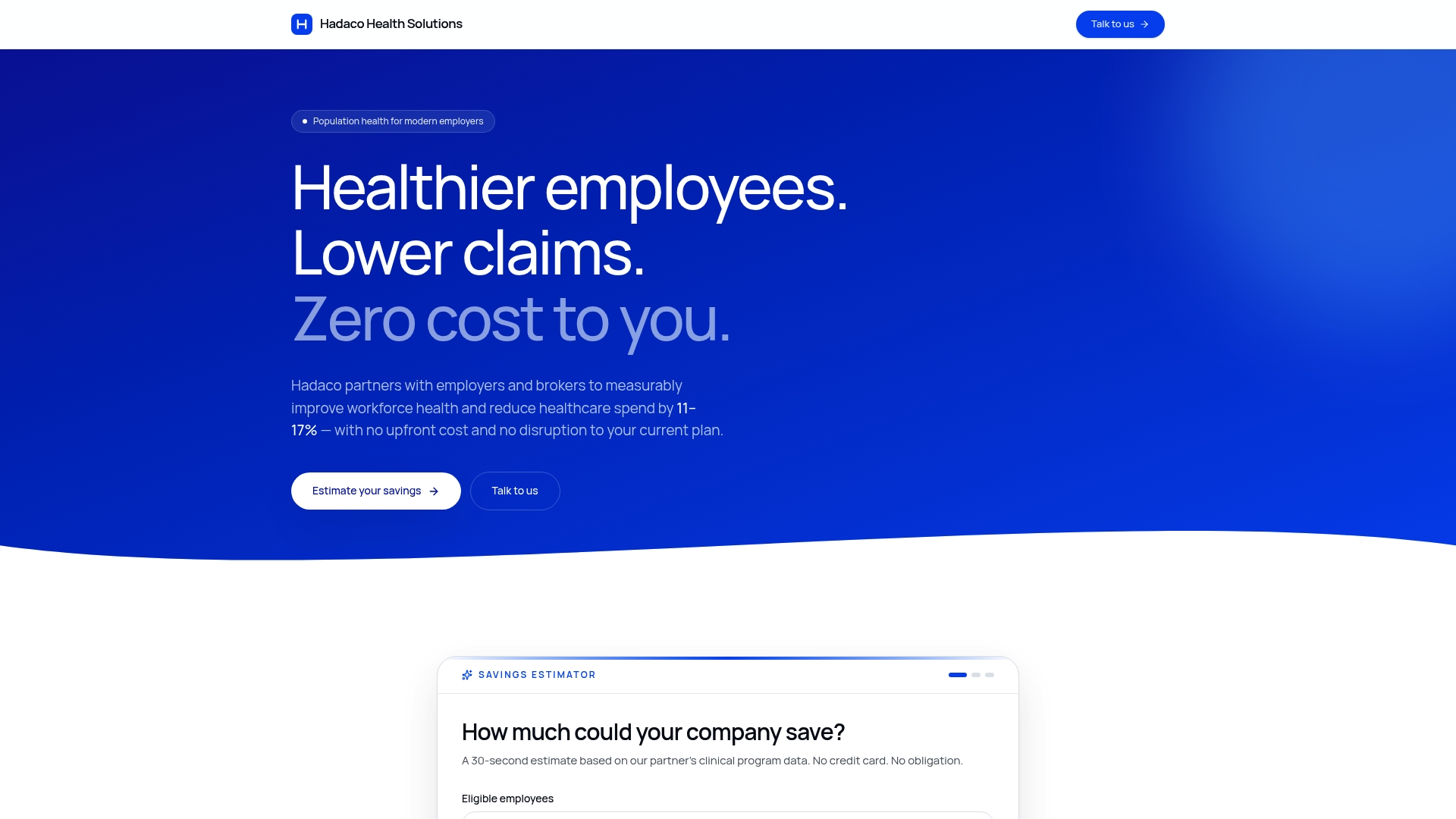
Hadaco builds evidence-based population-health programs that plug into your existing benefits without disrupting them, covering chronic disease management, preventive care, and employee engagement alongside vaccination campaigns. Employers may see measurable savings per employee in the first year, tracked through a transparent savings estimator and quarterly reporting, so leadership sees the return instead of guessing at it. There's no upfront fee to start. If you want to see what a savings estimate looks like for your workforce, visit Hadaco and run the numbers before your next open enrollment cycle.
Where to find the primary guidance
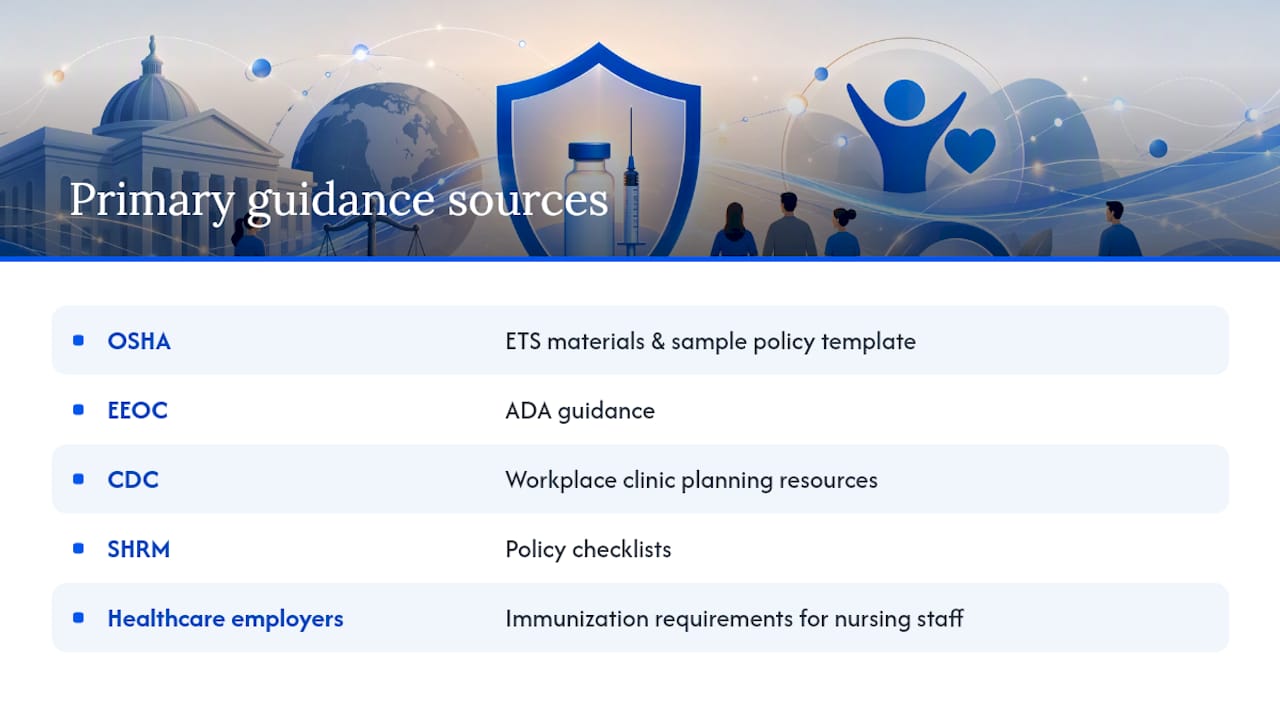
Start with OSHA's ETS materials and sample policy template, EEOC's ADA guidance, CDC's workplace clinic planning resources, and SHRM's policy checklists. Healthcare employers scoping role-specific requirements should also review immunization requirements for nursing staff.
This article is general information, not a substitute for advice from a qualified lawyer. Consult a qualified legal professional about your own circumstances before acting on anything here.
Sources
- What you should know about COVID‑19 and the ADA, the Rehabilitation Act, and other EEO laws (EEOC)
- OSHA: COVID-19 and the workplace — safety and health topics
- FAQs about COVID‑19 vaccination in the workplace: For employers (CDC)
- What should be in a vaccination policy? (SHRM guidance)