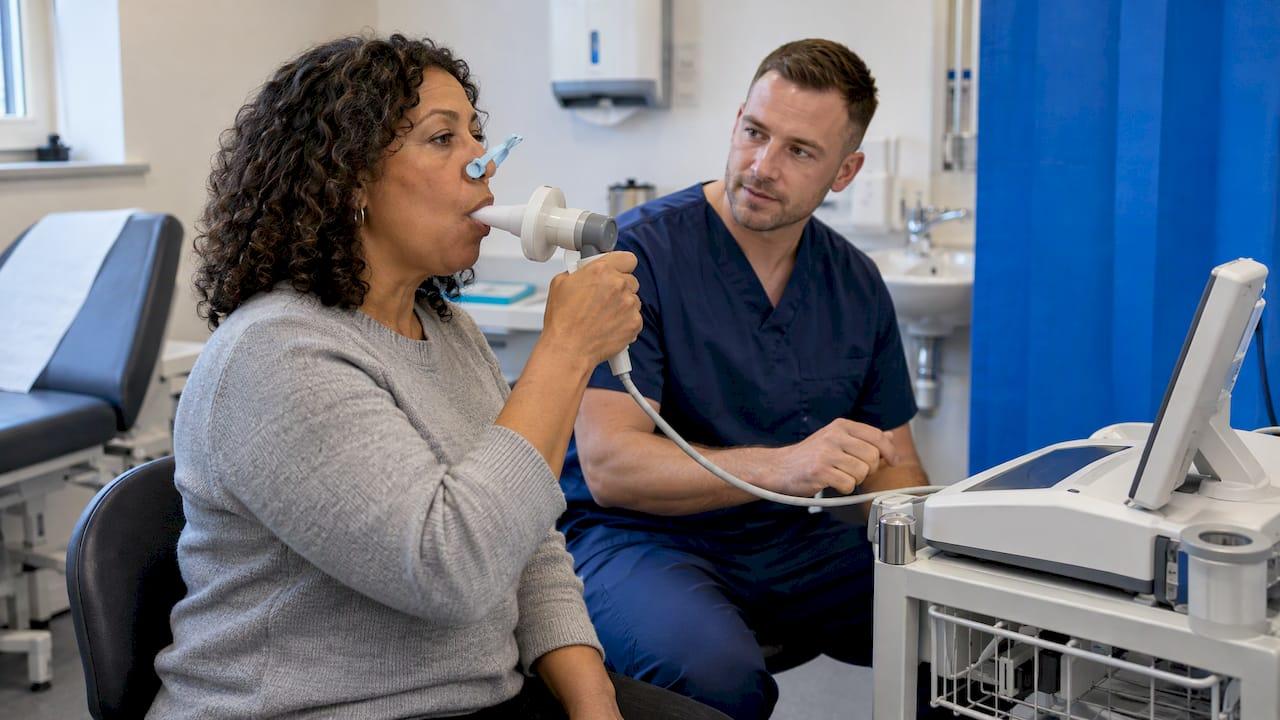
Managing COPD as an employer comes down to three jobs: cutting the workplace exposures that cause or worsen it, finding affected employees early, and supporting them with accommodations and care coordination that keep them healthy and working. Done together, these steps protect your people and put a ceiling on one of the more expensive chronic conditions in your claims data.
This guide is for HR, benefits and finance leaders at mid-sized and large U.S. employers. It covers what the evidence says about work and COPD, what your obligations look like, which accommodations help, and how to build a program that fits alongside your existing health plan.
TL;DR
- Work matters more than most employers assume. CDC/NIOSH estimates that occupational exposures contribute to about 14% of all COPD cases and 31% of cases among never smokers.
- COPD is costly for plans and payrolls. Employees with COPD have roughly twice the rate of ER visits and hospitalizations and miss more work than colleagues without it.
- Start with exposure control (eliminate, substitute, engineer), then add screening, tobacco support and practical accommodations.
- Keep individual health information private. Employers should see aggregated results, not individual diagnoses.
- A population health program that sits alongside your current plan can tie these pieces together and report outcomes quarterly.
Table of Contents
- Why COPD belongs on the employer agenda
- Which jobs and exposures carry the most risk
- What COPD costs employers
- Step 1: Reduce exposures at the source
- Step 2: Find COPD early, with privacy built in
- Step 3: Support employees who have COPD
- Step 4: Address tobacco and the wider chronic disease picture
- A 90-day starting plan
- Perspective: Where employers get the most from COPD programs
- How Hadaco fits
- FAQ
- Sources
Why COPD belongs on the employer agenda
Chronic obstructive pulmonary disease is often treated as a smoker's illness, and as a personal matter. The data say otherwise. The American Lung Association notes that 1 in 4 people living with COPD never smoked, and that occupational exposures account for 10 to 20% of symptoms or lung function impairment consistent with COPD.
The NHLBI puts the work-related share at almost 15 percent, pointing to dusts, fumes, smoke and chemical gases. A study of U.S. workers from 2012 to 2018 found that an age-adjusted average of 4.1% of workers had COPD, and that 27.3% of those cases were attributable to work (24.0% among never smokers). Estimates differ by method and data set, but they all point the same way: a meaningful slice of COPD starts or gets worse on the job.
A 2017 meta-analysis found a 22% higher risk of COPD among people exposed to airborne pollutants at work, with biological dusts showing the highest risk estimates.
For an employer, that means two levers. You can lower exposure for the people you employ today, and you can support employees who already have the disease, whatever its cause.
Which jobs and exposures carry the most risk
CDC/NIOSH reports that COPD risk is significantly elevated in several industries, including mining, blast furnaces and steelworks, rolling and finishing mills, grocery wholesale, and automotive repair shops. Occupations with elevated risk include maids and housemen, farmworkers, vehicle and mobile equipment mechanics, material-moving equipment operators and non-construction laborers.
The same source links specific agents to specific settings:
- Asbestos in blast furnaces, steelworks and finishing mills
- Aerosol paint in auto repair shops
- Pesticides among farmworkers
- Dust and ash among equipment operators and laborers
Broader hazard categories include mineral dusts (coal mine dust, silica, asbestos), organic dusts (cotton, wood, grains), welding fumes, diesel exhaust, asphalt fumes, smoke from fires and other chemical gases or vapors.
Not every exposure sits in heavy industry. The 2021 analysis of U.S. workers found that the highest work-attributable shares of COPD were in food services and drinking places, and among motor-vehicle operators and material-moving occupations. Exposures there included secondhand smoke, solvents, sawdust, fiberglass and welding fumes.

If your workforce includes restaurants, warehousing, fleets, facilities, light manufacturing or maintenance, treat COPD as relevant to you even if you have no mine or mill.
What COPD costs employers
The business case is easiest to see in utilization and absence.
A CDC analysis of 2011 to 2015 national survey data estimated that among about 166 million U.S. workers, 7 million had at least one COPD-related medical event. Annual medical spending attributed to COPD among workers was about $5 billion in 2017 dollars, and private health insurance paid 59% of it. Inpatient care was the most expensive setting, at $27,597 per person per year.
A study of an employed population found that workers with COPD had about twice the rate of emergency department visits and hospitalizations of those without it. Absence and short-term disability days ran about 1.5 times higher, and yearly direct and indirect costs were higher by $3,609 and $909 respectively.

A later analysis found that workers with COPD averaged 8.3 lost work days versus 2.1 for workers without COPD, and 6.4 bed days versus 2.0.
The pattern is consistent: most of the avoidable cost sits in acute events, such as exacerbations that end in the ER or a hospital bed. That is the part a well-run program can influence.
| Cost driver | What the research shows | What it means for you |
|---|---|---|
| Hospital and ER use | About twice the rate among employees with COPD | Early symptom recognition and medication adherence matter most |
| Absence and disability | About 1.5 times higher absence and short-term disability days | Flexible schedules and accommodations protect attendance |
| Lost work days | 8.3 days versus 2.1 | Prevention and exposure control reduce flare-ups |
| Plan spending | Private insurance pays 59% of worker COPD expenditures | Claims analysis shows your own exposure |
Step 1: Reduce exposures at the source
Exposure control is the most direct way to prevent new cases and keep existing ones from worsening. CDC/NIOSH states that prevention tailored to the industry or agent involved can prevent new cases and worsening of existing ones, and that exposure prevention and medical monitoring are warranted for groups at increased risk.
The standard approach is the hierarchy of controls, which American Family Physician summarizes as elimination first, then substitution, engineering controls, administrative controls and finally personal protective equipment. Administrative controls include shortening shifts, rescheduling breaks, rotating workers and training.
In practice, that looks like:
- Map exposures by job. List tasks that involve dust, fumes, vapors, smoke or chemical gases. Include indoor air issues in offices and kitchens, not just production floors.
- Eliminate or substitute where you can. Swap solvent-based products for lower-hazard ones, or remove a dusty task altogether.
- Add engineering controls. Local exhaust ventilation, enclosed processes and well-maintained HVAC systems protect everyone in the space.
- Use administrative controls. Rotate people out of high-exposure tasks and schedule dusty work when fewer people are present.
- Provide respiratory protection as the last layer, not the first.
Know the respirator rules
Where respirators are needed, OSHA's Respiratory Protection Standard (29 CFR 1910.134) applies. OSHA's compliance guide says employers must have a written respiratory protection program with worksite-specific procedures, a qualified administrator, appropriate respirator selection, training, medical evaluation for employees who must use respirators, fit testing for tight-fitting models and regular program evaluation.
For silica, OSHA's guidance notes that exposed employees face higher risk of silicosis, lung cancer, COPD and kidney disease, and that employers must provide appropriate respirators where exposures exceed the permissible exposure limit and follow the respiratory protection program requirements. Your safety and legal teams own this compliance work. Benefits teams should know it exists because it shapes the medical evaluation process.
Step 2: Find COPD early, with privacy built in
Many people live with undiagnosed COPD for years. Early detection gives employees a chance to change exposures, quit tobacco and start treatment before a hospital stay forces the issue.
The COPD Foundation's employer toolkit suggests several moves: on-site screening days with peak flow and spirometry, COPD information in annual wellness activities, and a claims analysis to identify COPD-related costs. It also recommends smoking bans around building entrances and, for work areas of employees diagnosed with COPD, HEPA air filters that do not emit ozone.
CDC/NIOSH's review of workplace spirometry monitoring explains why surveillance is worth doing: it gives an opportunity to preserve lung function through early intervention on exposures, lifestyle factors and treatment of respiratory conditions.
What you should and should not see
The same review is clear on confidentiality. Because of privacy concerns and the risk of reprisal, a health care provider should not disclose an individual employee's health information to the employer without the worker's consent. Aggregated data from monitoring programs, however, should be supplied to the employer so you can judge whether prevention and exposure controls are working.
Build your program around that line:
- Run screening through a third party or clinical partner, with employee consent.
- Receive de-identified, aggregated reports on participation, trends and outcomes.
- Keep managers out of the loop on diagnoses. They need to know about accommodations, not conditions.
- Tell employees in plain language what you can and cannot see.
Trust is what makes people participate. A workforce that fears reprisal will skip the screening that would have helped them.
Step 3: Support employees who have COPD
The NHLBI reports that 1 out of 4 people with COPD say they are unable to work, and at least 1 out of 3 say they are limited in what they can do at work. Reasonable support can change that picture for the people you want to keep.
The Job Accommodation Network (JAN), a service of the U.S. Department of Labor, lists accommodation ideas for respiratory impairments. The environmental and scheduling options include:
- Maintaining HVAC systems and testing indoor air quality
- Air purification and reducing workplace pollutants
- Conditioning or dehumidifying air and adjusting indoor temperature
- A smoke-free and fragrance-free work environment
- Advance notice of construction and cleaning
- Non-toxic building materials and solvents
- Additional rest breaks for fresh air or medication
- Work from home and flexible leave
The same publication also covers physical access: accessible parking with an unobstructed path, an entrance free of steps with automatic doors, a workstation moved closer to frequently used equipment, space for oxygen therapy equipment and a review of emergency evacuation procedures.
Most of these cost little. The harder part is process. Give employees one clear way to ask, train managers to respond to requests without asking about diagnoses, and review accommodations after a few weeks to see whether they work. If your organization is also shaping hybrid policies, our guide to return-to-office health policies covers how to handle health-related flexibility consistently.
For questions about your specific legal duties toward an individual employee, talk with employment counsel before you act.
Step 4: Address tobacco and the wider chronic disease picture
Tobacco is the biggest modifiable risk factor for COPD, and it compounds workplace exposures. The COPD Foundation toolkit recommends rewards for participation in tobacco cessation programs, with targeted incentives for employees diagnosed with COPD. Our employer's playbook on workplace tobacco cessation walks through program design and engagement.
COPD rarely travels alone. Employees with it often also manage heart disease, diabetes, depression or anxiety, and each condition makes the others harder to control. That is why a condition-by-condition approach tends to underdeliver. Our piece on an evidence-based plan for workplace chronic disease costs explains how to prioritize across conditions, and the Total Worker Health guide shows how to combine safety and wellness into one strategy.
Vaccination matters for people with lung disease too. If you are setting up or refreshing a program, see our guides to workplace flu vaccination programs and vaccination policy.
A 90-day starting plan
You do not need to do everything at once. A sequence that works for most mid-sized employers:
| Timeframe | Action | Owner |
|---|---|---|
| Days 1 to 30 | Run a claims analysis for COPD and related respiratory costs. Map high-exposure jobs. | Benefits, finance, safety |
| Days 31 to 60 | Review exposure controls and respirator program. Set up confidential screening and a simple accommodation request path. | Safety, HR |
| Days 61 to 90 | Launch tobacco support and care coordination for identified employees. Agree on quarterly reporting metrics. | Benefits, program partner |
Track metrics you can act on: screening participation, tobacco quit attempts, ER and inpatient use for respiratory conditions, absence days, and accommodation requests resolved. Report them in aggregate.
Perspective: Where employers get the most from COPD programs
We see employers approach COPD in pieces: a safety program here, a tobacco benefit there, a disease management vendor somewhere else. Each piece has value, but nobody owns the whole picture, and the employee in the middle gets a patchwork.
Our view is that COPD should be managed as part of a population health strategy. That means evidence-based interventions for chronic disease, preventive care, mental health and engagement, working together and layered on the benefit plan you already have. Nothing about it should force a change of carrier or a disruption for employees.
We also believe employers deserve to see the numbers. That is why we pair programs with a transparent savings estimator and quarterly reporting, so finance and HR can tie activity to outcomes. Our programs carry no upfront fees, and our service fees depend on demonstrated savings and engagement. Employers using our approach often see an average first-year savings of $451 per employee.
The goal is simple: fewer avoidable emergencies, more employees who stay engaged and healthy, and a culture where asking for support feels safe.
Gene
How Hadaco fits
If you want to turn these steps into a program rather than a to-do list, our population health programs are built for that. They deliver evidence-based interventions for chronic disease, preventive care, mental health and employee engagement, and they integrate with your current benefit plans without disruption. You get a cost savings estimator and quarterly outcome reporting, and we support both employers and their benefit advisors.
To see what a program could look like for your workforce, explore Hadaco's population health programs and book a consultation.
FAQ
Can employers be held responsible for work-related COPD?
It depends on the hazard and the setting. OSHA sets requirements for specific exposures, such as its respiratory protection standard and its silica standard, and employers in covered situations must follow them. Your safety and legal advisors can tell you which standards apply to your operations.
What can an employer see about an employee's COPD?
In medical monitoring, CDC/NIOSH guidance says individual health information should not go to the employer without the worker's consent, while aggregated data should be shared so you can judge whether controls work. Managers should hear about needed accommodations, not diagnoses.
What are the most useful accommodations for employees with COPD?
JAN lists cleaner and better-ventilated air, a smoke- and fragrance-free environment, extra rest breaks, flexible leave, work from home where feasible, and closer parking and workstations. The right mix depends on the role and the person, so start with a conversation about what would help.
How do I find out what COPD costs my organization?
The COPD Foundation's employer toolkit recommends requesting a claims analysis to identify COPD-related costs. Ask your carrier or benefits advisor for de-identified data on respiratory admissions, ER visits and medication spend, and compare it with your absence and disability records.
Does a smoker-only focus miss anything?
Yes. About 1 in 4 people with COPD never smoked, and work exposures contribute meaningfully, so a complete approach combines tobacco support with exposure control and screening.
Sources
- CDC/NIOSH: Jobs and Exposures That Increase Risk for Developing COPD
- NHLBI: Lung Health on the Job
- American Lung Association: COPD Causes and Risk Factors
- Chronic Obstructive Pulmonary Disease and U.S. Workers
- Occupational COPD and job exposure matrices: a systematic review
- Medical Expenditures Attributed to Asthma and COPD Among Workers
- Burden of illness for an employed population with COPD
- Health Care Utilization, Lost Work Days, and Bed Days Among Workers
- American Family Physician: Common Occupational Disorders
- OSHA Small Entity Compliance Guide for the Respiratory Protection Standard
- OSHA Small Entity Compliance Guide for the Respirable Crystalline Silica Standard
- COPD Foundation Employer Toolkit
- Workplace spirometry monitoring for respiratory disease prevention
- JAN Accommodation and Compliance Series