
Disease management and case management solve different problems. Disease management runs organized, condition-specific programs across a whole population to improve guideline-based outcomes, while case management provides intensive, individualized coordination for high-risk or complex patients. Population health teams and payers typically run the former; nurses and social workers acting as case managers run the latter. Below, we compare both models, cover U.S. billing context, review the evidence, and offer a decision checklist.
TL;DR:
- Use disease management for everyone with a diagnosis, then assign licensed nurses or social workers to patients with complex, individualized needs.
- For Medicare billing, chronic care management requires two or more chronic conditions, a comprehensive care plan, patient access at all times, and documented consent.
- Combined programs can improve provider monitoring and diabetes outcomes, but cost savings remain uncertain, while case management shows stronger utilization effects among high risk patients.
- Segment claims, utilization, and social risk, then pilot combined care for patients at elevated risk with KPIs aligned to each model, not generic engagement scores.
Table of Contents
- What disease management and case management actually mean
- How the two models compare across purpose, population, and metrics
- What CMS billing codes signal for payers and employers
- What the evidence shows about outcomes and cost
- A decision checklist for choosing the right approach
- How Hadaco fits alongside payer-based programs
- Getting the balance right between the two models
- See measurable savings with a population health partner
- FAQ
- Sources
What disease management and case management actually mean
Disease management is an organized, proactive, multicomponent program built around a specific diagnosis, such as diabetes or heart failure. It reaches an entire population with that condition, using registries, outreach, education, and guideline-based protocols to improve adherence and clinical outcomes over time.
Case management works differently. It is individualized, often triggered by a specific event (a hospital discharge) or a risk flag (repeated emergency visits), and centers on one patient's comprehensive needs rather than a diagnosis category. The Case Management Society of America defines case management as a collaborative process of assessment, planning, facilitation, care coordination, evaluation, and advocacy, built around whole-person needs rather than a single condition.
Both sit under the broader umbrella of care management:
- Disease management: population-level, condition-specific, proactive outreach.
- Case management: individual-level, needs-driven, often episodic or crisis-triggered.
- Care coordination: the umbrella term covering both, plus utilization management and navigation functions.
Mixing up these terms is common, and it tends to produce mismatched expectations when programs get evaluated later.
How the two models compare across purpose, population, and metrics
The clearest way to separate these models is to look at them side by side across the dimensions that matter to a benefits team evaluating a vendor or building an internal program.
- Purpose and goal: disease management aims to improve guideline adherence and condition-specific outcomes; case management aims to resolve complex, high-cost situations and prevent avoidable utilization.
- Target population: disease management reaches everyone with a given diagnosis, often through a registry; case management focuses on a smaller, higher-risk or higher-cost subset.
- Typical interventions: disease management uses education, reminders, self-management coaching, and protocol-driven outreach; case management uses assessment, individualized care plans, provider coordination, and direct advocacy.
- Staffing and competencies: disease management often relies on health educators, pharmacists, and population health analysts; case management requires licensed nurses or social workers trained in complex-case assessment.
- Time horizon and intensity: disease management runs continuously and at low to moderate touch across many people; case management runs intensively but for a shorter, defined period per patient.
- Metrics: disease management is judged on clinical measures like glycemic control; case management is judged on utilization and readmission measures.
A diabetes registry sending quarterly reminders about A1c testing and medication adherence is disease management. A nurse coordinating a complex patient's transition from hospital to home, arranging follow-up visits and home health, is case management.
What CMS billing codes signal for payers and employers
U.S. operational context matters because Medicare's chronic care management (CCM) framework shapes how both models get built and paid for. CMS chronic care management guidance defines CCM services for patients with two or more chronic conditions and requires elements like a comprehensive care plan, 24/7 patient access, and documented consent. CMS guidance also outlines time-based billing structures and related codes for Principal Care Management (PCM) and Principal Illness Navigation (PIN), each tied to specific documentation standards.
CMS frames CCM as a structured, billable service, not an informal outreach effort. That distinction matters for procurement: a disease-management vendor marketing "chronic care support" is not automatically CCM-compliant unless it meets those documentation and consent requirements.
Practical implications for procurement teams:
- Confirm whether a program's documentation supports CCM, PCM, or PIN billing, or whether it operates outside those codes entirely.
- Check for EHR interoperability, since claims-based disease management and clinically embedded case management need different data feeds.
- Align KPI expectations with the program type, not with the codes alone.
What the evidence shows about outcomes and cost
A Community Guide systematic review found disease-management interventions, especially for diabetes, produce measurable improvements in glycemic control and provider monitoring of process measures. Case management, when implemented alongside disease management, often strengthens provider monitoring further and shows some added clinical improvement in diabetes populations specifically.

Combined disease management and case management programs tend to outperform either approach alone on process measures like provider monitoring of glycemic control. That is a meaningful signal for benefits leaders deciding between a single-track program and a tiered one.
Key caveats worth carrying into any vendor conversation:
- Evidence on total cost-of-care reduction is mixed and varies by study design and population.
- Case management shows stronger utilization effects in high-risk cohorts than in general populations.
- Expect realistic KPI targets: clinical process measures move faster than hard cost outcomes, which take longer to materialize.
A decision checklist for choosing the right approach
- Segment your population using claims data, utilization patterns, and social risk flags to separate the broad population from the smaller high-risk group. Population health analytics tools make this segmentation workable at scale.
- Match goals to model: choose disease management when the priority is improving guideline adherence across a condition group, and choose case management when the priority is reducing readmissions or managing high-cost claimants.
- Set vendor and staffing criteria: ask about data systems, clinical staff credentials (RN, LCSW), measurement cadence, and a realistic ROI timeline.
- Pilot and measure: request specific KPIs tied to the model type before signing a contract.
Pro Tip: Ask any vendor to show how their reported outcomes map to CCM, PCM, or utilization metrics, not just a general "engagement" score.
For deeper training on case management competencies, the Case Management Society of America also offers standards and integrated case management frameworks worth reviewing alongside vendor claims, and professionals looking to build these skills further can explore healthcare management courses designed for care management career paths.
How Hadaco fits alongside payer-based programs
We built our population health programs for employers who want measurable results without disrupting existing benefit plans or CCM efforts already in place through a payer. Our approach includes a transparent savings estimator, quarterly outcome reporting, and no upfront fees, so benefits leaders can see projected and actual results before and after committing. In year one, companies working with us often see average savings of $451 per employee, alongside improved engagement and retention.
Our programs complement rather than replace CCM or PCM billing structures a payer might already run. We focus on the population-level layer: chronic disease prevention, engagement, and measurable outcomes that sit on top of existing benefits. Benefits leaders can apply the same decision checklist above when evaluating us: ask about pilot options, KPI alignment, and reporting cadence.
Getting the balance right between the two models
The sharpest mistake I see in this space is treating disease management and case management as competing choices instead of complementary layers. Disease management builds the guideline-adherence foundation across your population, while case management catches the smaller group that foundation cannot reach alone. My recommendation: segment your population first, pilot a combined approach for your highest-risk cohort, and require any vendor to report against KPIs that match the model type, not a generic engagement score. If you are weighing a pilot, a conversation with our team at Hadaco is a reasonable next step.
— Gene
See measurable savings with a population health partner
We designed our programs around what employers actually need: measurable population-level savings, transparent reporting, and integration that does not disrupt the benefits you already offer. No upfront fees means the financial risk sits with results, not with a contract signature.
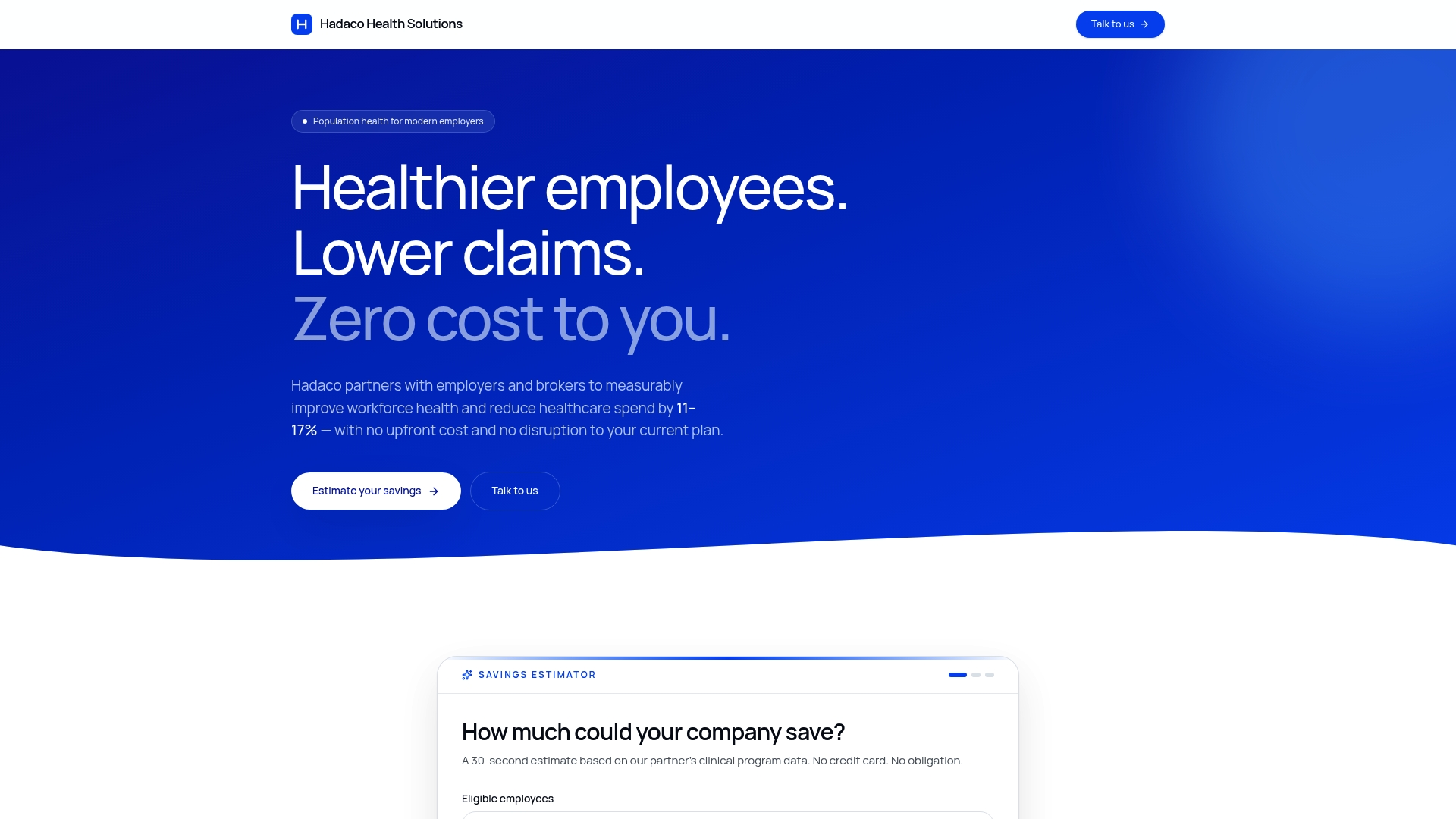
If you want to see what savings might look like for your workforce, explore our savings estimator and program details and book a conversation with our team to discuss a pilot built around your population's actual risk profile.
This article is general information, not a substitute for advice from a qualified doctor. Consult a qualified healthcare professional about your own circumstances before acting on anything here.
FAQ
What is the highest salary for a case manager?
Case manager salaries vary widely by region, setting, and credentials, and we do not have a single authoritative figure to cite here. Hospital-based and complex case managers with RN or LCSW credentials typically earn more than entry-level care coordinators, and specialty certifications can further affect pay.
What are the four types of case management?
Case management models are often grouped by setting or intensity, such as hospital-based, community-based, telephonic, and integrated or complex case management, though definitions vary across organizations. The Case Management Society of America frames integrated case management as a whole-person approach spanning medical, behavioral, and social needs rather than a fixed list of four categories.
Are case managers considered healthcare professionals?
Yes, case managers are healthcare professionals, often licensed nurses or social workers who complete assessment, care planning, and coordination for patients with complex needs. Their work falls under recognized standards of practice, including those published by CMSA.
Is case management certification worth it?
Certification can strengthen a case manager's credibility and may be required or preferred for certain roles, particularly in hospital or complex care settings. It signals familiarity with standards of practice and assessment frameworks used across the profession.
How does Hadaco's approach differ from a payer's chronic care program?
We focus on employer-facing, population-level programs that complement existing benefit plans rather than replace payer-run chronic care management. Our model includes a transparent savings estimator and quarterly reporting, giving employers visibility into results as they happen.
Sources
- Systematic review / Community Guide summary on disease management and case management
- CMS chronic care management guidance
- CMSA integrated case management and standards