
Health equity in benefits means structuring coverage, cost-sharing, and support programs so every employee has a fair shot at good health, regardless of race, income, job type, or zip code. The immediate action is an audit: pull disaggregated claims and utilization data, find where affordability or access is breaking down for specific worker groups, and fix those gaps before adding new programs. Measurement and social-driver supports, not new plan documents, are what actually move outcomes.
TL;DR:
- Disaggregated claims and utilization data reveal where affordability and access gaps exist for different worker groups, enabling targeted interventions.
- Employers should prioritize high-impact, quickly actionable domains like predeductible medication coverage and transportation stipends for immediate results.
- An equity audit, combining quantitative data with employee feedback, is essential before designing or scaling benefits programs to address specific gaps.
- Embedding measurable equity KPIs into vendor contracts and tracking disaggregated metrics quarterly ensures accountability and sustained progress.
- Digital tools must include non-digital navigation options to reach low-connectivity workers and prevent digital exclusion from equity initiatives.
Table of Contents
- What Health Equity in Benefits Actually Means
- The Core Components Employers Must Address
- How Do You Build an Equity-Focused Benefits Plan?
- What Should You Measure to Track Progress?
- Common Pitfalls Employers Run Into
- What Real Employer Outcomes Look Like
- Why This Is Long-Term Value Creation, Not a Cost Center
- Get Help Executing an Equity-Focused Benefits Strategy
- Sources
- FAQ
What Health Equity in Benefits Actually Means
Equality means giving everyone the same benefit. Equity means giving each employee what they need to reach the same health outcome, which often requires giving different groups different things. A warehouse worker on a rotating night shift and a salaried manager with flexible hours both have "access" to the same PPO plan, but one of them can actually use it during business hours without losing pay. That gap is not a coverage problem on paper. It is an equity problem in practice.
The CDC defines health equity as everyone having a fair and just opportunity to attain their highest level of health, and it recommends organizations monitor disaggregated data and pursue cross-sector strategies rather than one-size-fits-all programs. That framing matters for benefits teams because it shifts the question from "did we offer this benefit" to "did this benefit actually work for the people who needed it most."
Inequities inside employer plans usually show up in three places:
- Claims patterns where certain roles or locations show lower preventive care use despite identical coverage.
- Utilization gaps where high-deductible plans deter lower-wage employees from filling prescriptions or completing follow-up care.
- Outcome differences where chronic disease complications cluster among specific worker segments, driving disproportionate cost and absence.
The business case is not theoretical. The American Heart Association, working with the Deloitte Health Equity Institute and SHRM Foundation, launched an initiative aimed at improving health outcomes for 10 million U.S. That is a direct signal from major employers and health organizations that this is not a diversity initiative bolted onto benefits. It is a cost and productivity strategy. Employers who treat equity as a compliance checkbox usually miss the savings that come from closing utilization gaps before they turn into avoidable ER visits and disability claims.
The Core Components Employers Must Address
Health equity in benefits breaks down into a handful of concrete domains, and most benefits teams are only working on one or two of them.
Social determinants employers can actually influence. Transportation, childcare, food security, and wage stability sit outside the health plan but drive whether employees use it. McKinsey's analysis notes that income alone may be insufficient to remove barriers to care. An employee earning $22 an hour can afford a copay and still miss a specialist appointment because there is no one to watch their kids or no bus route that gets them there on time.
Coverage and affordability design. Sliding-scale premium contributions tied to income band, and predeductible coverage for high-value services like insulin or asthma inhalers, remove the point-of-care decision that forces someone to skip a refill. Employer guidance on equitable insurance design points to these as concrete, implementable levers rather than abstract policy goals.
Access and delivery. On-site or near-site clinics, hybrid telehealth options, and provider networks that reflect the language and cultural background of your workforce all reduce the friction between "covered" and "seen."
Nonclinical supports. Food and transportation stipends, care navigation services, and employee assistance programs round out the list. JMCP's commentary on the employer role in health equity recommends pairing these supports with data-driven benefit design rather than offering them as generic perks disconnected from actual utilization gaps.
Here is how most benefits teams should sequence this work:
- Map current benefits against each domain above and flag where nothing exists today.
- Identify which domain gap correlates most strongly with your claims data.
- Pilot one nonclinical support (transportation or childcare stipend) tied to a specific high-need group.
- Adjust cost-sharing structure for the highest-impact chronic conditions in your population.
- Expand network or telehealth access only after the first two levers show measurable uptake.
Pro Tip: Start with predeductible coverage for two or three high-value chronic-condition medications. It is one of the cheapest levers to pull, it shows up in claims data within a single quarter, and it does not require renegotiating your entire plan design.
How Do You Build an Equity-Focused Benefits Plan?
Turning the concept into practice takes five sequential steps, and skipping the first one is the most common reason equity initiatives stall out after a single year.
Step 1: Run an equity audit. Pull two to three years of claims data and disaggregate it by role, location, income band, and where legally permissible, race and ethnicity. Pair that quantitative picture with employee voice, whether through surveys, focus groups, or exit interviews, because claims data tells you what happened but not why. A tool built for employee health risk assessment can help structure this step so the data actually connects to individual risk profiles instead of sitting in a spreadsheet nobody reads.
Step 2: Prioritize by impact and feasibility. Not every gap deserves a program in year one. Score each identified issue on two axes: how many employees it affects, and how quickly you can act on it without a plan redesign. A transportation stipend for a 40-person warehouse crew is faster to launch than renegotiating a national PPO network.
Step 3: Pilot before you scale. Pick one or two interventions and run them for two to three quarters with pre-specified metrics defined before launch, not after. If you wait to decide what "success" looks like until the pilot ends, you will not have a clean way to judge it.
Step 4: Write equity performance into vendor contracts. This is the step most employers skip entirely. The Academy of Actuaries recommends shifting from short-term cost-savings evaluation to long-term value assessment, and that shift only sticks when it is contractual. Build KPIs into your carrier, PBM, and point-solution agreements that measure:
- Utilization rate changes among previously underserved segments.
- Network adequacy for language and cultural concordance.
- Response time on navigation and case management requests.
- Quarterly reporting cadence with disaggregated breakdowns, not aggregate averages.
Step 5: Scale, govern, and communicate. Once a pilot shows movement, expand it, but assign someone specific to own the governance. Quarterly reviews with leadership keep the initiative from quietly dying when budget season arrives, and consistent communication to employees, especially the ones the pilot targeted, builds the trust needed for the next phase to actually get used.
What Should You Measure to Track Progress?
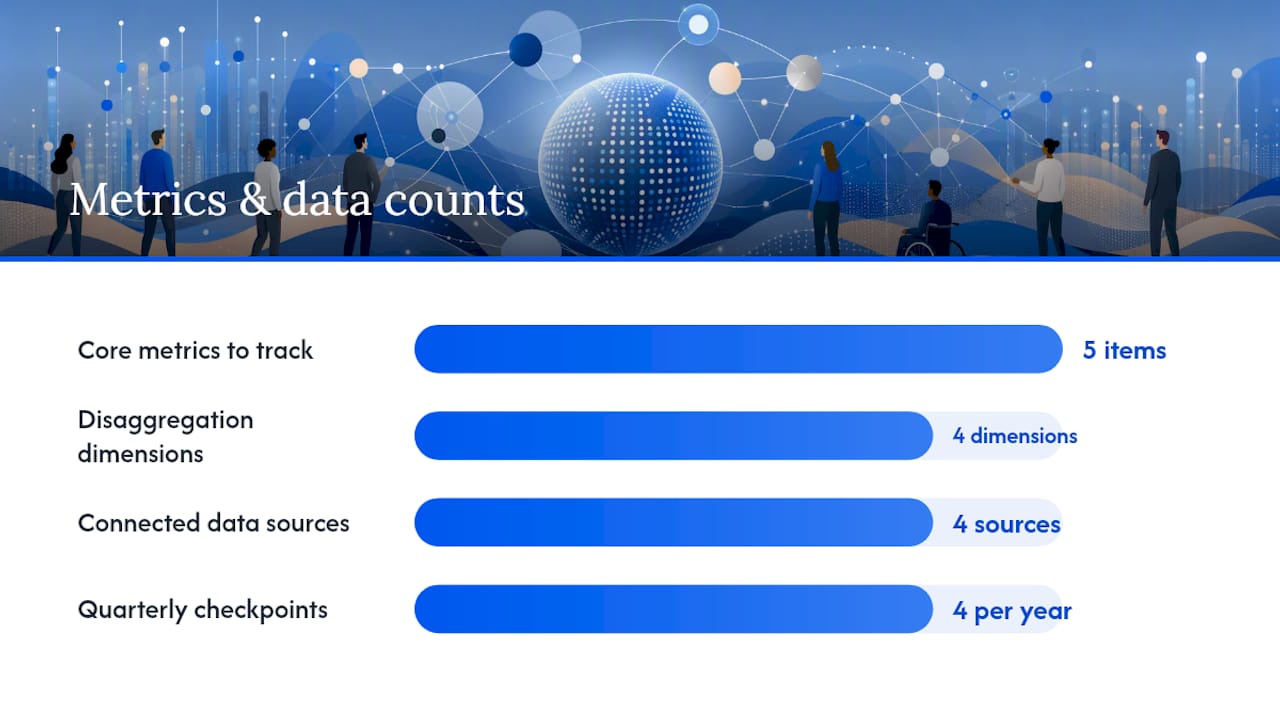
Employers who cannot show a number by the second quarter usually lose executive support for equity work, regardless of how sound the strategy is. The fix is picking metrics before launch and disaggregating every single one of them.
Core metrics worth tracking:
- Preventive care completion rates (annual physicals, cancer screenings, vaccinations).
- Medication adherence rates for chronic conditions like diabetes and hypertension.
- Utilization gaps between comparable roles or locations.
- Absence and short-term disability rates as productivity proxies.
- Per-employee healthcare spend trended quarterly, not annually.
Every one of those numbers needs to be broken out by race and ethnicity where legally permissible, income band, role or occupation category, and geography. A national average tells you almost nothing useful; a gap between your call-center staff and your corporate office tells you exactly where to intervene next.
The Academy of Actuaries brief on health benefit design recommends combining quantitative claims data with qualitative employee input, because numbers alone often miss the "why" behind a utilization gap.
Data sources should connect claims records, HRIS fields, vendor-supplied reports, and employee survey responses, aligned carefully so privacy protections stay intact and no individual becomes identifiable in a small subgroup. A quarterly reporting cadence to leadership keeps the initiative visible and gives you four checkpoints a year to catch a stalling metric before it becomes a full-year failure. Feed the same metrics directly into procurement language so every vendor renewal includes explicit equity KPIs rather than a generic "we support diversity" clause buried in the contract boilerplate.
Common Pitfalls Employers Run Into
The most well-intentioned equity programs fail for predictable reasons, and most of them are avoidable with a little foresight.
Digital-first design excludes the people who need it most. A wellness app or telehealth portal that assumes reliable private broadband will quietly fail your frontline and lower-wage employees, who often share devices or lack consistent connectivity. Pair every digital tool with a phone-based or in-person navigation option, not as a backup, but as an equally supported channel from day one.
Offering identical benefits to everyone is not equity. This is the single most common mistake in the space: assuming that because every employee has access to the same plan, the job is done. True equity work measures outcomes, not access, and uses disaggregated data to find the gaps that identical benefits leave open.
Generic communications fail to build trust. Outreach that comes only from HR, in only one language, through only one channel, rarely reaches the employees who need the program most. Community-engaged messaging, delivered through trusted supervisors or peer leaders, works far better than a mass email.
Legal and privacy coordination cannot be an afterthought. Income-based subsidies and any data disaggregated by race or ethnicity need legal and HR sign-off on collection, storage, and use before launch, not after a complaint arrives.
Pro Tip: Test every new benefit communication with a small group of the employees it is designed for before you send it company-wide. A five-minute conversation with three warehouse workers will catch more real barriers than a week of internal committee review.
What Real Employer Outcomes Look Like
Hadaco works with employers by layering evidence-based population health programs on top of existing benefit plans rather than replacing them, targeting chronic disease management, preventive care, and employee engagement without disrupting the carrier relationships already in place.
- Companies working with Hadaco reported average first-year savings of $451 per employee, a client-reported figure rather than an independent audit, alongside improvements in engagement and retention.
- A transparent savings estimator lets employers model expected impact before committing, rather than taking a vendor's word for projected results.
- Quarterly reporting keeps outcomes visible to leadership on the same cadence recommended for equity-focused metrics generally, so the program does not disappear into an annual renewal conversation nobody remembers the baseline for.
Every workforce is different, and a program built for one industry's claims profile will not automatically translate to another. Employers evaluating any population health partner, Hadaco included, should validate fit against their own disaggregated utilization data before signing a multi-year commitment.
Why This Is Long-Term Value Creation, Not a Cost Center
Benefits leaders keep treating health equity as a soft initiative that competes with the "real" budget priorities, and that framing is backwards. The actuarial community has already made the case for evaluating these programs on long-term value rather than immediate savings, and that shift in mindset is the actual unlock, not any single program design.
The leadership ask is simple: assign a named executive sponsor for equity work and put it on a quarterly review calendar alongside claims trend and renewal planning. Without an owner, even a well-designed pilot quietly loses momentum by the second budget cycle.
Tie that governance directly to the measurement and procurement levers already built into your vendor contracts. Employers who fold equity KPIs into renewal negotiations, rather than treating them as a separate conversation, are the ones still running these programs three years from now. The ones who do not usually cannot explain, by year two, what happened to the initiative they announced with such confidence in year one.
— Gene
Get Help Executing an Equity-Focused Benefits Strategy
Hadaco is built for employers who want the outcomes this playbook describes without renegotiating their entire benefit plan or waiting a year to see whether any of it worked. The program layers directly onto your existing carrier relationships, targets chronic disease and preventive care gaps using disaggregated data, and comes with no upfront fees, so the financial risk of testing it stays low while you validate fit against your own workforce.
The offering includes:
- A transparent savings estimator that models expected impact before you commit to anything.
- Quarterly outcome reporting built around the same disaggregated metrics this article recommends tracking.
- Support for both employers and their benefit brokers, so the program fits into existing advisory relationships rather than replacing them.
Companies working with Hadaco have reported average first-year savings per employee, a client-reported figure worth validating against your own claims baseline rather than assuming it applies universally. If you are ready to see what that could look like for your workforce, run your numbers through Hadaco's savings estimator and book a consultation to walk through fit before you commit to anything.
Sources
For teams that want to go straight to the primary documents behind this playbook:
- American Heart Association initiative with Deloitte and SHRM Foundation
- JMCP commentary on employers' role in advancing health equity
- American Academy of Actuaries: Health benefit design innovations for advancing health equity
- McKinsey: Income alone may be insufficient — employer actions to advance health equity
FAQ
What Does Health Equity Mean in an Employer Benefits Context?
Health equity means structuring benefits so every employee has a fair opportunity to reach good health, which usually requires different supports for different groups rather than one identical plan for everyone. The CDC's definition centers on removing avoidable, unfair barriers to care rather than simply extending the same coverage to all.
What Can Employees Actually Use Equity-Focused Benefits For?
Equity-focused benefits typically cover preventive screenings, chronic disease management, predeductible medications, transportation or childcare stipends, and culturally matched provider access. The goal is removing the specific barrier, financial, logistical, or cultural, that was previously stopping someone from using care they were technically covered for.
What Are the Business Benefits of Health Equity in Benefits Design?
Employers see reduced avoidable claims, better preventive care completion, and improved retention among historically underserved worker segments. Programs like Hadaco's report average first-year savings of $451 per employee as client-reported outcomes, alongside stronger engagement metrics.
What Are Some Examples of Health Equity Initiatives in Benefits?
Examples include sliding-scale premium contributions tied to income, predeductible coverage for chronic-condition medications, on-site or near-site clinics, and vendor contracts with built-in equity KPIs. The American Heart Association's workforce initiative is a large-scale example of employers coordinating around measurable equity targets for lower-income workers specifically.
How Do Employers Measure Whether Their Equity Efforts Are Working?
Employers should track disaggregated preventive care rates, medication adherence, utilization gaps, and per-employee spend, broken out by income band, role, and location on a quarterly basis. Feeding those same metrics into vendor procurement requirements, as recommended in the Academy of Actuaries' brief, keeps measurement tied directly to accountability.