
Yes, most employers can start a wellness program without paying anything upfront, through internal low-cost activities, vendor performance pilots, or insurer and EAP partnerships. Expect the first wins to show up in participation and preventive care uptake, not immediate claims savings. Hadaco is one vendor built around this exact model, charging no upfront fees and tying payment to results.
TL;DR:
- Most no-upfront wellness programs rely on internal activities, vendor pilots, or insurer partnerships, but all still incur hidden staff or data-sharing costs.
- Short, manager-led challenges and content sharing can boost participation without requiring vendor contracts or significant investments.
- Legal compliance dictates offering voluntary participation and controlling incentives, with specific rules on biometric screenings and data privacy to avoid compliance issues.
- Research shows voluntary programs improve self-reported behaviors but do not significantly reduce healthcare spending within the first three years.
- Successful pilots involve clear metrics, short time frames, and quarterly reporting to demonstrate measurable outcomes before expanding or committing funding.
Table of Contents
- What "No Upfront" Wellness Programs Actually Mean
- 12 Practical No-Upfront Wellness Ideas You Can Launch This Month
- Launching a No-Upfront Pilot: A Step-by-Step Timeline
- The Legal Guardrails You Cannot Skip
- What the Research Actually Shows About ROI
- Measuring Success Without a Big Budget or a Big Data Team
- Why a Vendor-Backed, No-Upfront Model Can Make Sense
- How Hadaco Runs No-Upfront Wellness Programs That Actually Report Back
- Sources
- FAQ
What "No Upfront" Wellness Programs Actually Mean
"No upfront" doesn't mean free. It means the employer isn't writing a check before the program starts. Three models dominate the space right now:
- Zero-budget internal programs run entirely on staff time and existing tools: step challenges, lunchtime learning, peer groups.
- Vendor-funded pilots let a wellness company front the setup and content in exchange for a data-sharing agreement and a trial period.
- Performance-based or savings-share contracts flip the usual vendor relationship: the provider gets paid only after it demonstrates measurable savings or engagement, an arrangement self-funded employer wellness programs use to remove the budget objection entirely.
- Insurer or EAP-funded options piggyback on benefits you're already paying for, using screenings, counseling sessions, or wellness credits bundled into the plan.
None of these are free of cost to the organization. Staff time, internal communications, and paid time off for participation all carry real, if hidden, expense. A performance contract also requires you to open up claims or engagement data so the vendor can prove its case, which is the trade you're making for zero cash outlay.
12 Practical No-Upfront Wellness Ideas You Can Launch This Month
You don't need a signed vendor contract to move the needle on engagement. Most of these cost nothing beyond a Slack message and a little manager buy-in.
- Walking groups organized by floor or department, meeting twice a week at a fixed time.
- Step challenges run through free apps most employees already have on their phones.
- Desk-stretch breaks scheduled into calendars at the same time every day.
- Lunchtime learning series on topics like sleep, nutrition, or financial stress.
- Peer support groups for parents, caregivers, or anyone managing a chronic condition.
- Curated content kits sent monthly, built from free public-health resources.
- Email nudges tied to seasonal health moments (flu shots, mental health awareness).
- Virtual group fitness hosted on free platforms or offered as a taste session by a prospective vendor.
- Insurer-funded biometric screenings, often already included in your plan at no added cost.
- EAP promotion campaigns that simply raise awareness of a benefit most employees forget exists, a strategy detailed in this breakdown of EAP benefits and employer ROI.
- Community provider sponsorships, where local gyms or clinics offer discounted sessions in exchange for exposure to your workforce.
- Volunteer wellness champions, employees who help run activities in exchange for recognition rather than cash.
The common thread: short participation windows, visible manager sponsorship, and low-cost recognition instead of monetary rewards. A four-week challenge with a manager posting daily updates will consistently outperform a six-month program nobody talks about.
Pro Tip: Recruit through managers, not mass email. Short enrollment windows paired with manager-led announcements can roughly double participation compared to passive email blasts alone.
Launching a No-Upfront Pilot: A Step-by-Step Timeline
A pilot only proves anything if it's structured. Here's a rollout that fits inside a single budget cycle without requiring sign-off from finance.
- Weeks 1 to 2, planning. Pick one or two metrics you actually care about, assign an HR lead, and loop in your benefits partner or broker early.
- Weeks 3 to 4, recruitment. Announce through managers, not just email, and set a hard enrollment deadline to create urgency.
- Weeks 5 to 8, launch. Run the activity or vendor-sponsored sessions, tracking attendance weekly rather than waiting until the end.
- Week 6, mid-pilot check-in. Survey participants briefly. Adjust format if engagement is sagging.
- Weeks 9 to 12, evaluation. Compare participation and completion against your baseline goals, and decide whether to scale, adjust, or fold the pilot into next year's benefits plan.
Roles matter more than most HR teams expect going in. You need an HR lead running logistics, a benefits partner reading the fine print of any vendor agreement, managers doing the actual recruiting, and someone, even part time, owning the data.
Collect the minimum viable data set: participation counts, completion rates, and a short satisfaction survey. Avoid pulling individual health data unless a licensed vendor or your carrier is handling it under proper privacy protections. If you're negotiating a performance-based vendor contract, put the payment trigger in writing before launch: a specific participation threshold, a defined savings percentage, or a preventive-service uptake target, verified through evidence-based wellness program benchmarks rather than a vendor's own marketing claims. For a longer version of this timeline, a 90-day wellness program rollout template built around CDC and Total Worker Health guidance is worth reviewing before you lock in dates.

The Legal Guardrails You Cannot Skip
Voluntary means voluntary. The moment an incentive feels mandatory, or a biometric screening feels like a condition of employment, you're in ADA and GINA territory, and the EEOC's final rules on employer wellness programs set clear limits on how far you can push participation incentives.
Keep this checklist close when designing anything with a screening or health questionnaire attached:
- Offer a reasonable alternative for anyone who can't or won't complete a biometric screening.
- Disclose exactly what data is collected, who sees it, and how long it's kept.
- Cap incentives at a level that doesn't tip into coercive territory.
- Never require a spouse or family member's genetic or health information as a condition of a reward.
- Loop in legal or benefits counsel before finalizing any incentive structure tied to a health outcome, not just a completion action.
Programs that reward participation (showing up to a screening) carry far less legal risk than programs that reward outcomes (hitting a specific biometric target). If your general counsel or broker hasn't reviewed your incentive design in the past year, that's worth fixing before you launch, not after. A closer look at GINA rules for wellness programs walks through where employers most often trip up.
What the Research Actually Shows About ROI
Wellness programs are now standard benefits infrastructure. The KFF 2025 Employer Health Benefits Survey found 56% of small firms and 83% of large firms offer some form of wellness program, with health risk assessments offered by 35% of small firms and 53% of large firms.
What the data actually says: A large randomized trial published in JAMA found a workplace wellness program improved self-reported health behaviors but produced no significant difference in clinical measures or health-care spending after 18 months. The Illinois Workplace Wellness Study found the same pattern extending out to three years: real behavior change, limited clinical or financial movement.
That gap between self-reported improvement and measurable spending reduction isn't a design flaw. It's a time-horizon problem. Chronic disease costs accumulate over years, self-selection skews who joins a voluntary program, and most pilots run too short to capture anything beyond early engagement signals. The practical fix is setting pilot KPIs around participation, preventive screening uptake, and engagement scores, then treating claims trend data as a multi-year indicator you check quarterly rather than a same-year scoreboard, a distinction covered in more depth in this analysis of wellness program ROI.
Measuring Success Without a Big Budget or a Big Data Team
Track what you can actually observe in the first 90 days, then widen the lens as the program matures.
Primary pilot metrics (track weekly or monthly):
- Participation rate against your enrollment target
- Completion rate for multi-week challenges or programs
- Preventive-service uptake (screenings, flu shots, EAP contacts)
- Engagement survey scores from a short post-pilot pulse check
Secondary, finance-facing metrics (track quarterly over 12 to 36 months):
- Preventive care utilization trends
- Claims trend signals, watched directionally rather than as a hard target
- Absenteeism patterns among participating departments
Build a one-page dashboard with these numbers and share it every quarter, not just at renewal time. That cadence gives finance a running record instead of a single annual pitch.
Pro Tip: A savings estimator paired with quarterly reporting turns "we think this is working" into a number a CFO can actually act on. Ask any vendor you're piloting whether they provide one before you sign anything.
Why a Vendor-Backed, No-Upfront Model Can Make Sense
The research is honest about what wellness programs can and can't promise in year one. That's exactly why aligning payment with performance matters more than the size of a vendor's feature list. Hadaco's model charges no upfront fees, builds programs around evidence-based interventions, and backs every claim with a savings estimator and quarterly reporting rather than a single annual summary.
Before signing with any vendor promising a no-upfront pilot, ask three questions: What specific metrics trigger payment? Who owns the data, and how is it protected? What happens contractually if the pilot underperforms? Vague answers to any of these, or a vendor unwilling to put success triggers in writing, is the clearest red flag in this space. A performance model only works when both sides can point to the same number at the end of the quarter.
— Gene
How Hadaco Runs No-Upfront Wellness Programs That Actually Report Back
Hadaco is built specifically for employers who want the evidence-based approach without the upfront invoice. There are no fees to start, the program layers on top of your existing benefit plan without disrupting it, and payment is tied to demonstrated outcomes rather than a flat retainer.
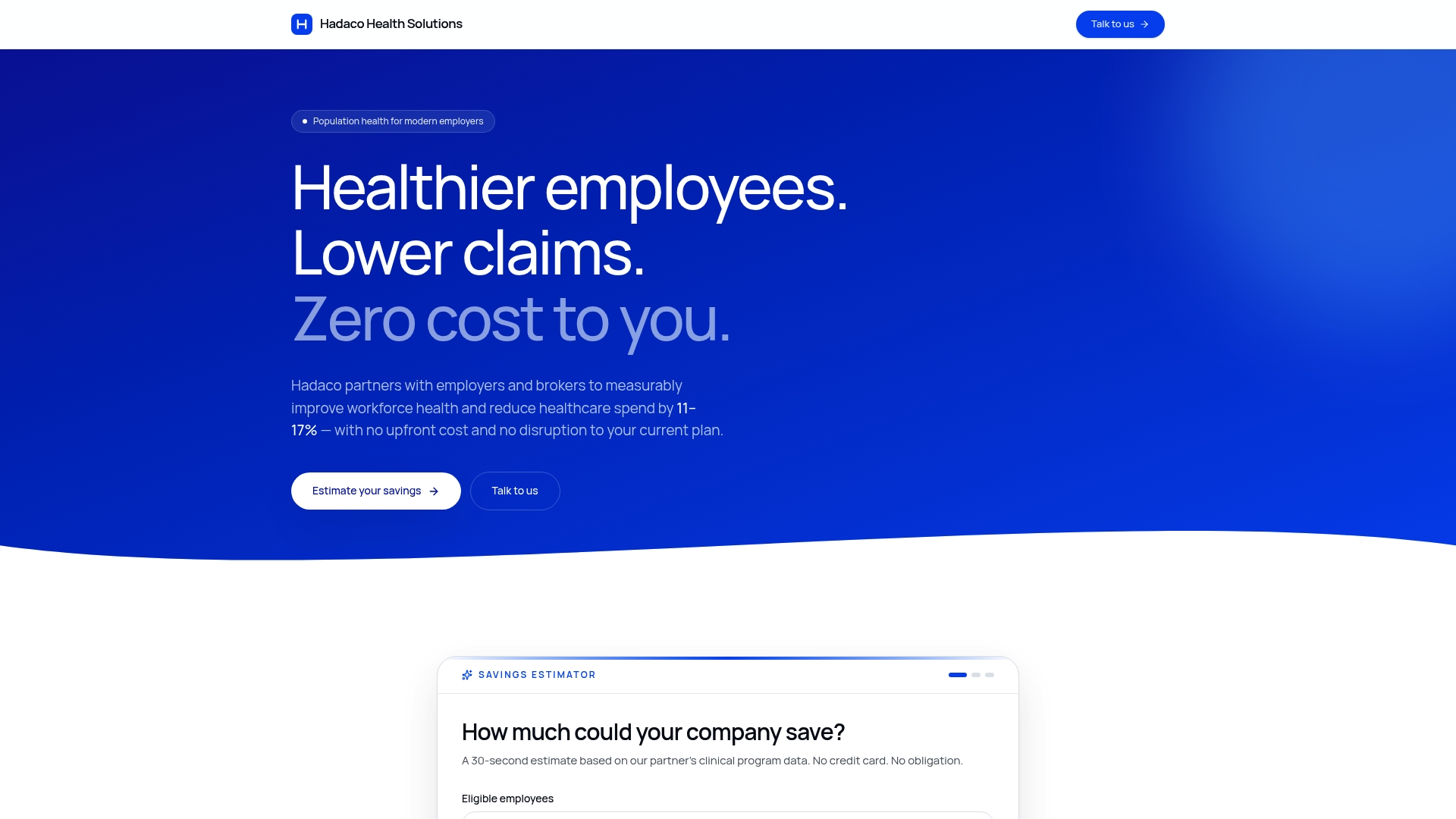
In year one, some companies have reported savings estimated through a transparent savings estimator and quarterly reporting, alongside improved engagement and retention. A pilot typically starts with a short data intake, moves into a defined rollout window, and reports results on a quarterly cadence so you're never waiting a full year to know whether it's working. If you're weighing a no-upfront pilot against building something internal, run your own numbers first. Get a savings estimate from Hadaco and see what a performance-based program could look like for your workforce before committing any budget at all.
Sources
- KFF 2025 Employer Health Benefits Survey
- Effect of a Workplace Wellness Program on Employee Health and Economic Outcomes (JAMA randomized trial)
- What do workplace wellness programs do? Evidence from the Illinois Workplace Wellness Study (MIT Sloan)
- EEOC issues final rules on employer wellness programs
FAQ
How much does a wellness program cost per month?
Costs vary widely based on the model. Internal, activity-based programs can be run at very low direct fees, while vendor-managed programs often price on a per-employee-per-month basis or, in performance-based arrangements like Hadaco's, charge nothing upfront and instead tie fees to demonstrated savings.
What is the 5-3-1 rule for wellness?
There's no single standardized "5-3-1 rule" recognized across the wellness industry, and definitions vary by source. If you've seen it referenced elsewhere, treat it as one vendor's shorthand rather than an established clinical or regulatory standard.
What is a drawback to wellness programs?
The biggest drawback is a mismatch between expectations and evidence. Randomized trials, including the Illinois Workplace Wellness Study, show real gains in self-reported behavior but little proof of reduced healthcare spending within the first one to three years, so programs sold on immediate cost cuts tend to disappoint.
Does insurance pay for wellness programs?
Many health plans already fund pieces of a wellness program, including biometric screenings, EAP sessions, and preventive care visits, at no added cost to the employer. A performance-based vendor like Hadaco can layer additional programming on top of that coverage without requiring a separate upfront fee.
What's the fastest way to test a no-upfront wellness program?
Run a pilot lasting several weeks built around one or two activities, manager-led recruitment, and a short weekly participation check. That structure lets you gather real engagement data before deciding whether to expand into a full vendor partnership or performance-based contract.