
A successful wellness program launches on a 90 day plan built around five moves: governance, a quick needs assessment, a small pilot, a communications push, and measurement from day one. That structure follows the CDC's four-step model of assess, plan, implement, evaluate, and it keeps the first year focused on evidence over guesswork. Get the pilot right, and the rest of the program has something real to scale.
TL;DR:
- A successful wellness program requires a clear governance structure with executive sponsorship and cross-departmental involvement from the start.
- The pilot phase should be limited to one or two activities at a single site, with participation targets of 25 to 40 percent to gather meaningful data.
- Measurement of outcomes should focus on participation, screening completion, and engagement over time, avoiding unrealistic expectations of cost savings in the first year.
- Incorporating organizational supports, like manager training and micro-nudges, enhances program sustainability and behavior change.
- Engagement tactics should prioritize frequent, small incentives and strong communication, with equity considerations built into incentive design.
Table of Contents
- What Does a 90-Day Wellness Program Rollout Look Like?
- How Do You Build Governance and Assess Employee Needs?
- What Should the Core Components of a Wellness Program Include?
- How Do You Pilot, Launch, and Scale a Wellness Program?
- What Engagement Strategies and Incentives Actually Raise Participation?
- How Do You Measure Wellness Program Outcomes and ROI?
- What Privacy and Legal Rules Apply to a Wellness Program?
- Why Hadaco Is Built for This Rollout
- What HR Teams Get Wrong About Wellness Program Design
- Sources
- FAQ
What Does a 90-Day Wellness Program Rollout Look Like?
The first quarter is where most programs win or lose their credibility with employees and finance. Skip a step, and you either launch something nobody trusts or spend a budget with nothing to show for it. Here is the sequence that works.
- Days 1 to 30, build the foundation. Name an executive sponsor and assemble a small cross-functional committee (HR, finance, a few frontline employees). Run a short anonymous survey alongside a scan of existing claims and absence data to find your two or three biggest health risks. Set SMART objectives tied to those risks, and lock a starter budget before you announce anything.
- Days 31 to 60, launch and learn. Pick one or two pilot activities, not ten. A biometric screening event paired with a walking challenge tends to generate participation without overwhelming HR bandwidth. Communicate weekly through multiple channels, recruit a handful of department champions, and track sign-ups against attendance daily, not monthly.
- Days 61 to 90, evaluate and plan forward. Pull participation and completion numbers, compare them against your original targets, and adjust anything that underperformed. Build a full 12-month calendar around what worked, and take that data back to leadership to secure the next budget cycle.
This cadence mirrors the 90-day operational playbook that most workplace wellness vendors converged on for a reason: it forces early wins before enthusiasm fades, and it gives you real numbers before you ask for a bigger budget.
How Do You Build Governance and Assess Employee Needs?
Governance is not a committee for show. It is the mechanism that keeps a wellness program tied to what employees actually need instead of whatever health trend is popular that year. The CDC's own guidance stresses that leadership commitment and a defined governance structure are what make programs relevant enough to survive past year one.
Start with people, not paperwork:
- Secure a senior executive sponsor who can unlock budget and remove roadblocks, not just sign off on emails.
- Recruit committee members from at least three departments, including someone from finance who cares about claims trends.
- Give the committee a charter with a clear decision on how often it meets and what it can approve without escalation.
Once governance is in place, assessment can move fast. A short, anonymous employee survey (ten questions or fewer) surfaces stated interest and barriers. A quick Health Risk Assessment deployment adds clinical signal on top of that. The CDC Worksite Health ScoreCard gives you a standardized way to benchmark your current policies and environment against best practice, and it takes an afternoon, not a consultant engagement.
Layer in existing HR and benefits data responsibly. Aggregate claims trends and absence patterns can point you toward the two or three conditions driving cost, whether that is musculoskeletal issues, stress-related absence, or chronic disease management. Never use individual-level health data to make personnel decisions, and keep any claims review at the aggregate level through your broker or carrier.
What Should the Core Components of a Wellness Program Include?
Most wellness program guidance converges on three canonical building blocks: biometric screenings, Health Risk Assessments, and wellness activities. Screenings catch measurable indicators like blood pressure and cholesterol. HRAs capture self-reported behavior and risk factors that screenings miss, like sleep quality or stress. Activities, whether that is a step challenge or a smoking cessation cohort, give employees a way to act on what the first two reveal. Run any of them alone and you get a fragment of the picture.
The stronger programs go further and wrap those clinical components inside organizational supports. That is the core idea behind NIOSH's Total Worker Health framework, which treats safety, work design, and health promotion as one system rather than separate initiatives. A screening event means little if the break room still has a vending machine as the only food option and managers discourage anyone from stepping away from their desk.
Low-friction interventions tend to outperform standalone classes because they live inside the workday instead of competing with it:
- Hourly break reminders built into calendar software rather than a poster in the break room.
- Manager training on recognizing burnout signs and modeling healthy boundaries around email.
- Ergonomic desk audits, which cost little and prevent a meaningful share of musculoskeletal complaints.
- Micro-nudges, like a two-minute stretch prompt during long meetings.
McKinsey's research on workplace health interventions backs this pattern directly: the programs that stick are embedded in the flow of daily work rather than bolted on as extracurriculars.
Pro Tip: Pilot one micro-intervention (like a scheduled stretch break) alongside your bigger screening event. It costs almost nothing and gives you a second, faster data point on what actually changes behavior.
How Do You Pilot, Launch, and Scale a Wellness Program?
Picking the right pilot site is a real decision, not an afterthought. You are choosing between two goals that sometimes conflict: a high-readiness location that will show quick wins, or a representative location that tells you whether the program will work company-wide. Documenting that trade-off before you launch keeps you honest about what your pilot data can and cannot prove later.
- Choose the site. A single office or business unit of 100 to 300 employees is usually large enough to generate meaningful participation numbers without straining committee bandwidth.
- Set participation targets before launch. A realistic first-quarter goal is 25% to 40% engagement in at least one activity, with a stretch target for screening completion.
- Define your success metrics up front. Participation rate, screening completion, and one or two behavior proxies (like self-reported activity minutes) give you a defensible basis for a scale decision, without overreaching into cost claims you cannot yet support.
- Set a minimum threshold for scaling. Decide in advance what number triggers expansion versus redesign. Waiting until after the data comes in to decide what counts as success invites bias.
- Plan the scale-up separately from the pilot. Scaling changes your governance needs (more committee bandwidth), your budget (per-employee costs shift at volume), and your vendor requirements (reporting cadence, integration with existing benefits).
Vendor selection deserves its own scrutiny at the scaling stage. Look for a partner who can integrate with your current benefits without disruption, report on outcomes quarterly rather than annually, and explain their savings estimates with actual methodology rather than a single flashy number.
What Engagement Strategies and Incentives Actually Raise Participation?
Incentive design fails most often when it relies on one large annual reward instead of frequent smaller ones. Behavioral research on habit formation consistently favors small, immediate rewards over a distant lump sum, because the reward needs to be close enough to the behavior for people to connect the two. Nonfinancial motivators matter just as much: recognition from a manager, extra flexible time, or public acknowledgment in a team channel often moves participation as much as a gift card does.
Communication is the other half of the equation, and most programs under-invest in it:
- Announce the program through at least three channels (email, team meetings, physical signage) before assuming employees have seen it.
- Recruit champions from departments outside HR. A peer promoting a challenge outperforms a corporate email every time.
- Give managers a short talking-point script so they reinforce the message consistently instead of paraphrasing it into something vague.
- Repeat the message on a weekly cadence during the pilot window, then shift to monthly once the program stabilizes.
Equity and accessibility need attention in the incentive structure itself, not as an afterthought. A step-count challenge disadvantages employees with mobility limitations or physically demanding jobs where extra steps at work already exist. Offer multiple paths to the same reward (a screening, a coaching call, a policy quiz) so no single physical requirement locks anyone out. For deeper tactics on sustaining engagement past the launch window, see this guide to wellness engagement strategies.
Pro Tip: If you only have budget for one incentive tier, put it toward completion of the Health Risk Assessment. That single data point does more to shape your next 12 months of programming than any activity challenge.
How Do You Measure Wellness Program Outcomes and ROI?
Set your expectations on ROI before finance sets them for you. The most rigorous evidence available, a randomized controlled trial run across a large employer population, found that wellness programs increased screening completion rates but did not produce statistically significant reductions in total medical spending or measurable productivity gains over two years. That does not mean programs fail. It means large, causal medical-cost reductions are hard to prove in a short window, and any partner who promises a guaranteed number without a methodology behind it is overselling.
Track metrics that are honest about what a first-year program can actually show:
- Participation rate across all offered activities, not just the flagship one.
- Screening and HRA completion rate, since this is your best early signal of reach.
- Program engagement over time (are the same people returning, or is it a one-time spike).
- Absence or short-term disability trends, as a directional proxy rather than a proven causal outcome.
- Employee-reported satisfaction and perceived support, gathered through a brief pulse survey.
The RCT evidence is a useful check on overpromising: expect meaningful engagement gains in year one, and treat any medical-cost savings claim as a multi-year hypothesis to test, not a guarantee to bank on.
Report results quarterly, not annually. Finance and executive teams respond better to a steady drip of participation and engagement data than a single year-end summary that arrives too late to influence next year's budget. Frame findings around leading indicators (participation, screening completion) alongside any lagging indicators you're tracking (absence, claims trend), and be explicit about which numbers are proven and which are directional. A structured dashboard approach, like the one outlined in this wellness analytics guide, makes that quarterly conversation far easier to run.
What Privacy and Legal Rules Apply to a Wellness Program?
Health data triggers real legal exposure the moment you start collecting it, and three laws come up most often: HIPAA when a program is tied to a group health plan, the ADA when disability-related inquiries or medical exams are involved, and GINA when family medical history enters the picture. None of these bar you from running a program. They require specific consent, confidentiality, and access controls around how that data moves.
Keep the operational side simple and consistent:
- Use plain-language consent forms that state exactly what data is collected and who can see it.
- De-identify or aggregate any data shared with managers or committee members, ever individual results.
- Limit detailed reporting access to a small named group, typically your benefits vendor and one or two HR leads.
- Put data-handling terms in writing with any outside vendor before launch, not after a screening event happens.
Tell employees directly how their data is protected before you ask them to participate. Programs that lead with a clear, short privacy statement consistently see higher assessment completion rates than ones that bury it in a benefits packet.
Why Hadaco Is Built for This Rollout
Everything in this playbook, the governance structure, the assessment data, the pilot metrics, only pays off if the program behind it can actually move the needle on health costs without disrupting the benefits you already offer. That is the specific gap Hadaco fills. Hadaco layers evidence-based interventions for chronic disease, preventive care, and mental health on top of your existing plan, with no upfront fees and a fee structure tied to demonstrated outcomes rather than a flat contract.
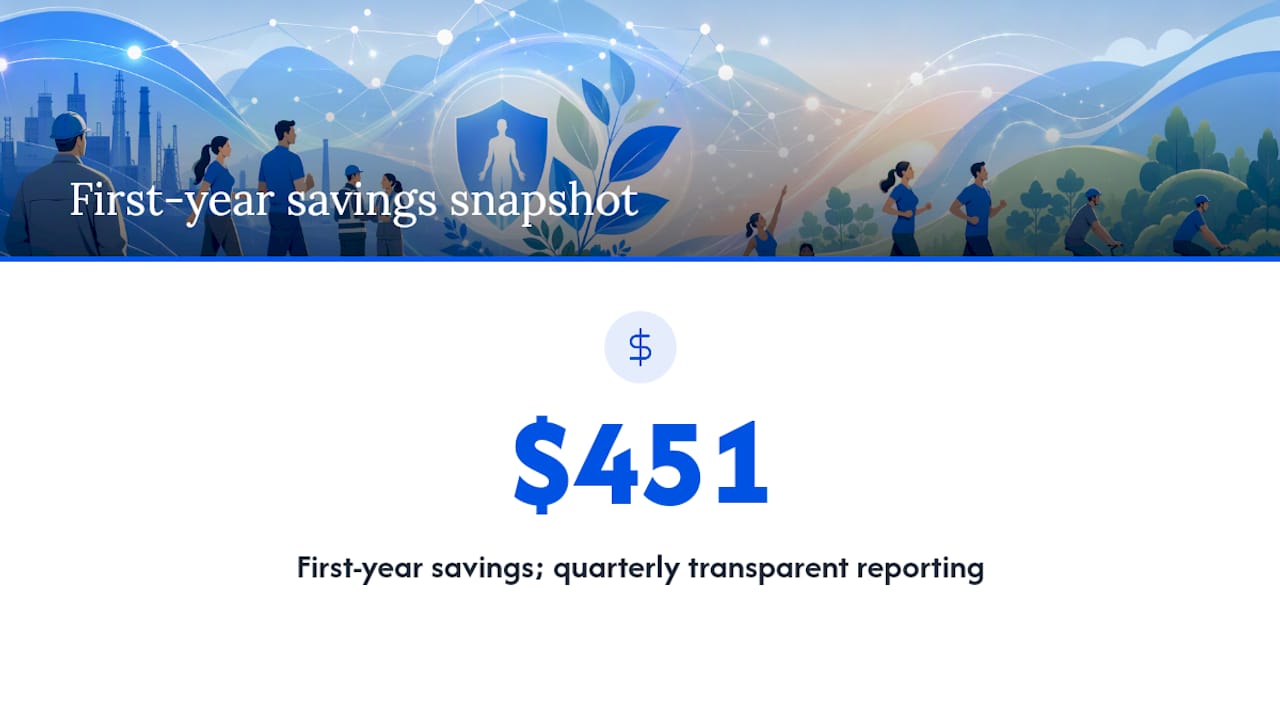
In their first year, employers working with Hadaco see average savings of $451 per employee, paired with quarterly reporting that shows exactly where those savings are coming from instead of a single opaque annual number. That transparency matters given how cautious you should be about ROI claims generally. Hadaco's savings estimator gives you a defensible projection before you commit to anything, which is exactly the kind of methodology-backed number finance teams want to see in a business case.
If you're evaluating Hadaco alongside other options, bring these questions to the conversation: How is the savings estimate calculated, and what data feeds it? How often will we see reporting, and what does it include? How does this integrate with our current carrier and benefits structure without requiring a plan change? Book a consultation with Hadaco to walk through your specific claims and engagement data and see what a realistic first-year projection looks like for your workforce.
What HR Teams Get Wrong About Wellness Program Design
The biggest mistake is treating incentives as the program instead of the on ramp to it. A gift card gets someone to a screening once. It does not build a culture where movement, sleep, and stress management are part of how the organization actually operates. Programs that lean entirely on point systems and one-off wellness days tend to show a participation spike, then a steep drop once the reward disappears.
The durable programs treat governance as ongoing work, not a launch task you complete and forget. That means the committee keeps meeting after month three, the metrics keep getting reported after the pilot excitement fades, and managers keep reinforcing the message long after the kickoff email is old news. Consult resources like Hadaco's employee wellness guides or book a consult to pressure-test your plan against real outcome data before you scale it company-wide.
— Gene
Sources
- Strategies for Building a Workplace Health Program | Workplace Health | CDC
- Illinois Workplace Wellness Study (RCT) findings
- From potential to practical: Fueling performance with proven workplace health interventions
FAQ
How Much Does a Wellness Program Cost Per Month?
Costs vary widely based on scope, ranging from a few dollars per employee per month for a basic digital platform to significantly more for comprehensive programs with screenings and coaching. Hadaco's model avoids upfront fees entirely, tying its cost structure to demonstrated savings instead of a flat monthly rate.
What Is the 5-3-1 Rule for Wellness?
Definitions of the 5-3-1 rule vary by source and context, so there is no single agreed-upon standard tied to workplace wellness programs specifically. If you encounter it referenced by a vendor or health plan, ask them to define the exact metric before applying it to your program.
What Does a Wellness Program Include?
A well-designed program combines three core components: biometric screenings, a Health Risk Assessment, and ongoing wellness activities, wrapped in organizational supports like policy changes and manager training. The strongest programs also add governance, communication, and measurement on top of those pieces.
What Is the Wellness Assistance Program?
The term "wellness assistance program" is not a standardized industry category. It's most often used loosely to describe any employer-sponsored initiative offering resources, activities, or support aimed at improving employee physical and mental health, similar to how the CDC frames a general workplace health program.
How Long Should a Wellness Program Rollout Take?
A focused rollout runs on a 90-day cycle: 30 days for governance and assessment, 30 days for pilot launch, and 30 days for evaluation and scaling. Full-year programming builds on that pilot data rather than launching everything at once.