
Reference-based pricing (RBP) caps what a plan pays for care at a set benchmark, often a multiple of Medicare rates, while a PPO pays contracted, negotiated rates to an in-network panel of providers. The core trade-off is straightforward: RBP can lower claim costs but shifts more balance-billing risk and provider-acceptance uncertainty onto employees, while a PPO trades higher negotiated rates for broader access and less member friction. How well either design actually works depends on plan documentation, exceptions processes, and how the employer manages compliance.
TL;DR:
- URBR can deliver the largest claim reductions but carries the greatest balance billing exposure; RBB and RBR sit closer to PPO predictability.
- Analyze 12 months of elective and shoppable claims before piloting, then test one or two categories for 12 months, tracking acceptance, disputes, and net savings.
- CMS ties maximum out of pocket compliance to reasonable provider access, making a documented exceptions process and updated acceptance lists essential before launch.
- Provider acceptance under RBP varies by geography and specialty, so employers should verify local access, stop loss terms, and their administrator’s dispute procedures before rollout.
Table of Contents
- 1. What is reference-based pricing and which variants should you know?
- 2. How does a PPO plan handle networks and cost-sharing?
- Side-by-side: costs, access, member experience, and operations
- Regulatory and compliance considerations employers must plan for
- How to decide between RBP and PPO and pilot the switch
- How population-health programs complement either plan design
- A pragmatic take for benefits leaders
- Reduce claims alongside your existing plan with Hadaco
- FAQ
- Sources
1. What is reference-based pricing and which variants should you know?
Reference-based pricing sets a payment ceiling for a given service rather than paying whatever a provider bills. Industry analysis from Milliman frames RBP as having evolved into three main approaches: reference-based benefits (RBB), reference-based reimbursement (RBR), and unbundled reference-based reimbursement (URBR). Each applies the benchmark a little differently, and the choice affects both savings and risk.
- RBB sets a defined benefit amount for a service, often tied to a network design, with members responsible for the difference if a provider charges more.
- RBR reimburses claims at a percentage of a benchmark, commonly a multiple of Medicare rates, regardless of network status.
- URBR goes further, often paying claim-line by claim-line against the benchmark, which Milliman notes can produce the largest savings but also carries higher balance-billing exposure.
Reference prices are usually anchored to Medicare multiples or sometimes to local contracted rates as a sanity check. Most employers who use RBP apply it to elective or shoppable services like imaging, outpatient surgery, and routine procedures, while keeping emergency and complex specialty care under more traditional network protections.
2. How does a PPO plan handle networks and cost-sharing?
A preferred provider organization (PPO) contracts with a network of providers at negotiated rates, then pays a higher share of costs when members stay in-network and a lower share, often with balance-billing risk, when they go out-of-network. The negotiated rate is fixed in advance, which gives employers more predictable claim costs than an open-ended billed-charges model, though not necessarily lower ones.
- PPOs remain the most common employer plan type nationally, according to KFF's 2025 Employer Health Benefits Survey.
- Average annual PPO premiums reported by KFF are around average premiums for single and family coverage, consistent with recent industry reports
- In-network cost-sharing is typically lower and more predictable than out-of-network cost-sharing under the same PPO plan.
Because PPO rates are negotiated rather than capped against an external benchmark, premium growth tends to track provider price trends in a given market rather than a fixed multiple.
Side-by-side: costs, access, member experience, and operations
The practical differences between RBP and PPO show up in four areas that benefits teams should evaluate together rather than in isolation.
- Cost. RBP's savings come from paying a capped benchmark instead of a negotiated or billed rate; Milliman's analysis suggests URBR designs often produce the biggest claim reductions but with the most access trade-offs, while RBB and RBR sit closer to a PPO's predictability.
- Provider access. PPOs guarantee a contracted network; RBP depends on whether enough providers in a given market will accept the reference price, which varies by specialty and geography.
- Member experience. PPO members generally face fewer surprises and less paperwork; RBP members may need to confirm provider acceptance in advance and could face disputes or balance bills if a provider does not accept the benchmark.
- Operational impact. RBP requires more active third-party administrator (TPA) involvement: maintaining provider acceptance lists, running an exceptions process, and handling disputes. PPOs shift most of that negotiation burden onto the carrier's existing network contracts.
Pro Tip: Run a claims analysis on your last 12 months of elective and shoppable-service spend before piloting RBP, since that is where the benchmark approach typically performs best with the least member disruption.
Employers choosing between the two are really choosing how much administrative control they want in exchange for savings. A PPO outsources network management to the carrier. RBP keeps the employer and TPA more directly accountable for access and disputes, which raises the compliance stakes covered next.
Regulatory and compliance considerations employers must plan for
Federal guidance shapes how RBP designs must be built to stay compliant, and ignoring it creates real exposure. The CMS reference-pricing FAQ requires plans using RBP to disclose the pricing structure, provide lists of affected services and providers on request, and maintain a documented exceptions process. CMS also ties maximum out-of-pocket (MOOP) compliance to whether members have reasonable access to providers who will accept the reference price.
Separately, the No Surprises Act limits balance billing for emergency care and certain non-emergency services at in-network facilities, requires specific cost-sharing calculations using recognized amounts, and provides an independent dispute resolution (IDR) process for payment disputes between plans and providers.
Practical compliance steps include:
- Disclosing the RBP structure and affected service categories in plan documents.
- Providing provider acceptance lists on request, not just on enrollment.
- Documenting a working exceptions process for members who cannot find an accepting provider.
One documented exceptions process is the single element CMS guidance flags most directly as a factor in MOOP compliance, according to the CMS reference-pricing FAQ.
How to decide between RBP and PPO and pilot the switch
Choosing a design is less about which model is objectively better and more about fit with your population, geography, and risk tolerance. Work through this before committing.
- Review your claims data for concentration: a handful of high-cost claimants or heavy reliance on a few specialty services changes the risk calculus for RBP.
- Map provider mix and geography, since RBP acceptance varies widely by market and specialty.
- Confirm stop-loss terms with your carrier, since claim volatility under RBP can affect renewal pricing.
- Ask your TPA directly how they run the exceptions process, how often provider lists are updated, and how disputes get resolved.
- Design a pilot limited to one or two service categories (commonly imaging or outpatient surgery), with a 12-month measurement window and KPIs like provider acceptance rate, dispute volume, and net claim savings.
Pro Tip: Before piloting, ask your TPA for a sample exceptions process documentation packet so your HR team knows exactly what a member experiences when a provider declines the reference price.
How population-health programs complement either plan design
Whichever plan design you choose, a population-health program works alongside it rather than replacing it. These programs reduce claim frequency and severity through chronic disease management, preventive outreach, and sustained employee engagement, which matters regardless of whether claims are paid at a PPO's negotiated rate or an RBP benchmark.
- Chronic care management targets the small share of claimants who generate a disproportionate share of cost.
- Preventive outreach catches conditions earlier, before they become high-cost claims.
- Engagement programs improve utilization of primary care instead of costlier emergency or specialty paths.
We built our own approach around this complementary model: no upfront fees, a transparent savings estimator, and quarterly reporting that shows measurable outcomes rather than projections.
A pragmatic take for benefits leaders
Neither RBP nor PPO is categorically better. The right answer depends on your claims concentration, provider market, and appetite for administrative involvement in exceptions and disputes. Pilot narrowly, measure acceptance and dispute rates honestly, and pair whichever design you choose with population-health interventions that reduce the number of expensive claims in the first place.
— Gene
Reduce claims alongside your existing plan with Hadaco
Whether you run a PPO or are testing reference-based pricing, the fastest lever most employers overlook is reducing how often employees need expensive care in the first place. Our programs integrate with your current plan design, no disruption, no upfront fees, and in their first year, employers working with us often see average savings of $451 per employee alongside improved engagement and retention.
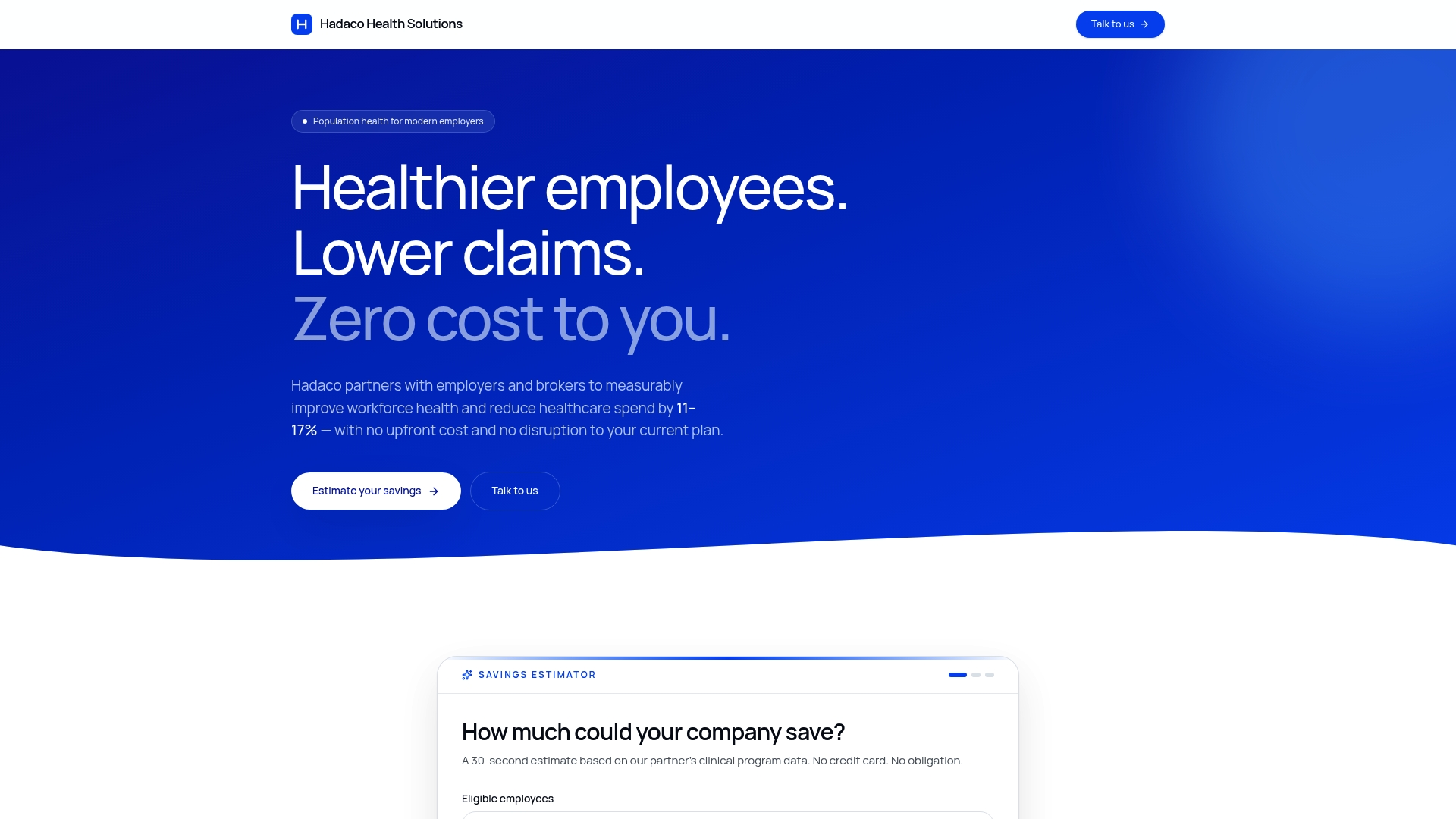
We provide a transparent savings estimator and quarterly reporting so your finance team sees real numbers, not projections. If you want to see what that looks like for your population, visit Hadaco to start a conversation.
This article is general information, not a substitute for advice from a qualified lawyer. Consult a qualified legal professional about your own circumstances before acting on anything here.

FAQ
Is RBP better than PPO for employers?
Neither is universally better: RBP can lower claim costs on shoppable services but increases balance-billing and provider-acceptance risk, while a PPO offers broader access and more predictable member experience at generally higher negotiated rates, as described in Milliman's analysis. The right fit depends on your claims concentration and local provider market.
Are RBP insurance plans good for every employer?
RBP plans work best when applied to elective or shoppable services where providers in the local market are likely to accept the reference price. Employers with concentrated specialty needs or thin provider markets face higher balance-billing exposure under RBP, per CMS guidance on reasonable access.
Is it better to have an EPO or PPO?
An EPO (exclusive provider organization) only covers in-network care except in emergencies, while a PPO also covers out-of-network care at a lower reimbursement level. The better fit depends on whether your population needs out-of-network flexibility or can work within a narrower network for lower premiums.
How does the No Surprises Act affect balance billing under either plan design?
The No Surprises Act limits balance billing for emergency care and certain non-emergency services at in-network facilities, and it requires specific cost-sharing calculations using recognized amounts, per CMS's overview of plan responsibilities. It also provides an independent dispute resolution process for payment disagreements between plans and out-of-network providers.
What should employers document before launching an RBP pilot?
Employers should document the RBP pricing structure, the specific services and providers affected, and a working exceptions process, as required by CMS's reference-pricing FAQ. Pairing this with a narrow pilot and clear KPIs helps surface access gaps before a full rollout.
Sources
- 2025 Employer Health Benefits Survey | KFF
- FAQs ABOUT AFFORDABLE CARE ACT: Reference pricing FAQ (CMS)
- Understanding the evolution of reference-based pricing and considerations for employers evaluating the approach (Milliman)