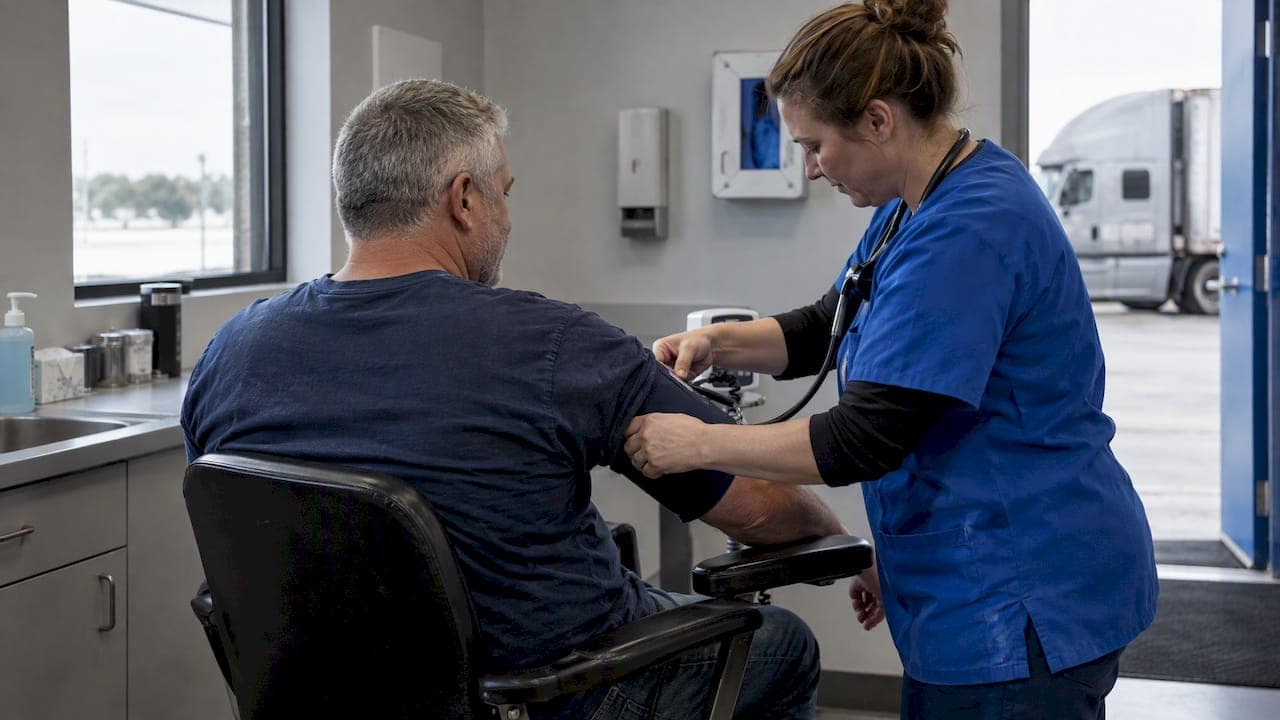
Employer-run, evidence-based population-health programs tailored to truck drivers reduce healthcare claims and improve retention while integrating with the benefits you already offer. Workplace health promotion programs have produced an estimated ROI of $2.53 for every dollar spent, and randomized trials built specifically for drivers show measurable weight and behavior change within six months. The programs that work report results quarterly, so you can track progress instead of guessing at it.
TL;DR:
- A CDC analysis estimated workplace savings of $22 to $40 per member per month, a benchmark employers can use when building financial projections.
- In the SHIFT trial, digital tracking predicted outcomes, and the intervention group differed by 3.31 kg in weight after six months.
- EEOC guidance permits group health plan incentives up to 30% of one employee’s coverage cost, with voluntary participation and confidential health data required.
- Measurable claims and utilization effects commonly take 12 to 36 months to accrue, while clinical and behavioral changes emerge earlier.
- Pilot at one terminal with an engaged manager, monitor completion weekly, and expand only after quarterly reviews show the program meets agreed targets.
Table of Contents
- Why truck driver wellness matters to your bottom line
- Core program components that actually work for dispersed drivers
- Proven engagement tactics: how to get drivers to complete the program dose
- Legal and privacy guardrails HR must follow (EEOC, ADA, GINA)
- Building the business case: metrics, timeline, and how to estimate savings
- Step-by-step implementation checklist for a pilot and scale-up
- Why Hadaco is a practical fit for trucking employers
- Author perspective: how to prioritize pilots and embed programs operationally
- Next step: get a savings estimate or schedule a consultation with Hadaco
- FAQ
- Sources
Why truck driver wellness matters to your bottom line
Drivers face a job that compounds chronic disease risk: long sedentary hours, irregular sleep, limited access to healthy food, and disrupted schedules. Sleep apnea, obesity, and hypertension show up more often in this workforce than in most desk-based ones, and each one drives both medical claims and safety risk. A driver who misses a DOT recertification because of an untreated condition is not just a health statistic, it is a vehicle off the road.
This is why population-health thinking, not individual fitness advice, fits the employer's actual job: you need fleet-wide risk reduction, not a wellness newsletter. The financial case is already documented outside trucking. One CDC-reviewed analysis found workplace programs saving an estimated $22 to $40 per member per month, with overall ROI of $2.53 per dollar spent once productivity and medical costs are combined. Applied to a driver population with elevated baseline risk, that same framework gives HR and finance a credible range to plan against rather than a hopeful guess.

Core program components that actually work for dispersed drivers
A program designed for an office workforce usually fails for drivers, because it assumes a desk, a cafeteria, and a predictable schedule. Standard, office-centric wellness formats do not transfer well to a workforce that lives in a cab, and tailored delivery through mobile channels performs better according to research on driver-specific barriers. The components worth requiring in any program you evaluate or build:
- Mobile-friendly health risk assessments and biometric screening options that do not require a clinic visit.
- Telephonic or app-based coaching that drivers can access between loads.
- Self-monitoring tools and short, modular training units built for cab downtime rather than classroom time.
- Integration with existing benefit plans, your EAP, and claims data to target the conditions actually driving cost.
- Clear completion definitions and quarterly reporting so finance can see progress against a baseline.
Each piece matters less on its own than as a system: screening identifies risk, coaching and self-monitoring act on it, and reporting proves it worked.
Proven engagement tactics: how to get drivers to complete the program dose
Participation is the variable that determines whether any of this pays off. In NIOSH's process evaluation of a mobile weight-loss program for truck drivers, behavioral self-monitoring and completing the full program dose were the strongest predictors of weight loss, more than any single coaching technique. The SHIFT randomized trial reinforced this: web-based self-monitoring was itself a significant predictor of outcomes, and the trial produced a 3.31 kg between-group difference at six months.
Practical tactics, in order of what to prioritize:
- Build in frequent, low-friction self-monitoring (weight, steps, food logging) with automatic feedback loops.
- Layer in a multicomponent mix, competitions, computer-based training modules, and motivational-interviewing style coaching, since combined interventions outperform single-tactic ones.
- Get terminal managers and supervisors visibly participating, since supervisor support measurably moderates program outcomes.
- Design incentives within EEOC limits and build in reasonable accommodations for drivers who cannot participate fully.
Pro Tip: Short, repeatable 5 to 20 minute modules beat long-form classroom training for drivers, who rarely have an uninterrupted hour to spare.
Legal and privacy guardrails HR must follow (EEOC, ADA, GINA)
Any program that collects health data or offers incentives tied to participation runs into federal rules you cannot design around after the fact. The EEOC's guidance on employer wellness programs permits incentives up to 30% of the total cost of self-only coverage when the program is offered as part of a group health plan, covering both employee and spouse participation.
Before launch, confirm these are in place:
- Incentive structure stays within the 30% limit and documentation shows participation is genuinely voluntary.
- Required written notices are distributed, and health data is kept confidential and separate from personnel files, with reporting to managers aggregated, never individualized.
- Alternative standards and accommodations exist for drivers who cannot meet a given health outcome due to a medical condition.
These are not optional add-ons. A program that skips notice requirements or reports individual-level results to supervisors creates legal exposure that outweighs whatever savings it generates.
Building the business case: metrics, timeline, and how to estimate savings

CFOs do not need to take wellness on faith, they need a KPI set and a realistic timeline. Track medical claims per driver, participation and completion rates, retention, DOT certification outcomes, and relevant safety metrics like preventable incident rates.
On timing, be honest with stakeholders: clinical signals show up fast, financial ones take longer.
- Clinical and behavioral improvements (weight, blood pressure, self-reported behavior) typically appear within six months, consistent with SHIFT trial results.
- Measurable financial impact on claims and utilization commonly accrues over 12 to 36 months as risk reduction compounds.
- Pooled ROI models, like the one underlying CDC's workplace program analysis, translate reduced health risk into projected dollar savings you can present to finance before full results are in.
- Use quarterly reporting cycles to show incremental progress and keep claims data integrated with program targeting so spend tracks against the conditions actually driving cost.
A program that only reports once a year leaves finance guessing for most of that window. Quarterly checkpoints let you adjust before a full plan year is spent on something underperforming.
Step-by-step implementation checklist for a pilot and scale-up
A pilot proves the model before you commit fleet-wide budget to it. The sequence that de-risks scale-up:
- Align HR, benefits, safety, operations, and finance on success metrics before selecting a single vendor or tool.
- Select a pilot cohort, run a baseline HRA and claims-data scan, and choose mobile tools with a defined coaching cadence.
- Train supervisors and terminal managers first, since their visible participation shapes driver uptake, then enroll drivers and run a focused engagement campaign.
- Track completion rates weekly, not quarterly, so you can intervene on low engagement early.
- Close the loop with quarterly reporting: review outcomes against your KPI set, adjust incentives, and expand to additional terminals only once targets are met.
Pro Tip: Pick one terminal with an engaged manager for your pilot rather than spreading a new program thin across the whole fleet on day one.
Why Hadaco is a practical fit for trucking employers
We build evidence-based population-health programs around the same framework this playbook describes: targeting chronic disease, preventive care, and sustained engagement rather than one-off perks. Our programs run on a performance-based model with no upfront fees, and employers working with us have seen average first-year savings of $451 per employee.
What this looks like in practice:
- A transparent savings estimator that gives finance a defensible projection before you commit.
- Quarterly reporting built around the same KPIs this playbook recommends tracking.
- Integration that complements your existing benefit plans rather than replacing or disrupting them.
- Evidence-based program design covering chronic disease, preventive care, and engagement in one system.
For a dispersed driver workforce, that combination means you get fleet-wide reporting without adding administrative headcount to manage it.
Author perspective: how to prioritize pilots and embed programs operationally
Start smaller than feels ambitious: one terminal, one clear KPI set, one quarter to review before expanding. Supervisor engagement and a disciplined quarterly review cadence matter more than any single wellness tactic you pick. Treat this as an operational program tied directly to claims and retention data, not a perk you roll out once and hope sticks.
— Gene
Next step: get a savings estimate or schedule a consultation with Hadaco
If the case above matches what you are trying to solve, the next move is a conversation, not another spreadsheet. We offer evidence-based programs with no upfront fees, a transparent savings estimator, and quarterly reporting that keeps finance and HR aligned on real numbers instead of projections you cannot verify.
- Request a savings estimate built on your actual claims and headcount data.
- Book a pilot consultation to scope a single-terminal rollout before committing fleet-wide.
- Review how the ROI framework works before your first call so your team arrives with the right questions.
FAQ
What is a truck driver wellness program?
A truck driver wellness program is an employer-run population-health initiative that addresses chronic disease, preventive care, and engagement for a driver workforce, usually through mobile-friendly screening, coaching, and self-monitoring tools. It is designed to reduce healthcare claims and improve retention while fitting alongside your existing benefit plans.
How much can employers save with a driver wellness program?
Savings vary by company, but one CDC-reviewed analysis found workplace programs generating $22 to $40 in per-member-per-month savings with an overall ROI near $2.53 per dollar spent. Employers working with us have seen average first-year savings of $451 per employee.
How long before a wellness program shows results?
Clinical and behavioral improvements, like weight loss and better self-reported habits, often appear within six months, based on the SHIFT randomized trial. Measurable financial impact on claims typically takes 12 to 36 months to fully materialize as risk reduction compounds.
What incentive limits apply to wellness programs under EEOC rules?
The EEOC permits incentives up to 30% of the total cost of self-only coverage when a program is offered as part of a group health plan. Employers must also provide written notice, keep participation voluntary, and maintain confidentiality of health data.
What makes driver wellness programs different from standard office wellness programs?
Standard office-based programs generally assume a desk and a predictable schedule, which does not match a driver's cab-based, irregular work pattern, according to research on driver-specific barriers. Effective driver programs instead use mobile delivery, short modular content, and frequent self-monitoring to fit around time on the road.
Sources
- Impacts of Workplace Health Promotion and Wellness (CDC analysis)
- Questions and answers about EEOC's notice of proposed rulemaking: employer wellness programs (EEOC)
- Weight control intervention for truck drivers: the SHIFT randomized trial (Johns Hopkins / SHIFT research)
- Process evaluation of a mobile weight-loss intervention for truck drivers (NIOSH / SHIFT process eval)