
A workplace wellbeing culture is an organization-wide way of working where leaders and systems make the healthy choice the default one, not the exception. The single biggest lever isn't a new app or a bigger benefits budget. It's visible leadership commitment paired with real integration into how the company operates day to day. Get that right, and you can expect higher engagement, lower turnover risk, and, over time, a moderating effect on medical spend.
The gap between companies that talk about wellbeing and companies that build it is wider than most HR teams assume. A national Harvard Business School survey found the average organization takes only a minority of possible health-related actions available to it, while top-quartile companies take many more actions than the bottom quartile.
What separates those two groups isn't budget. It's whether:
- Leaders model the behaviors they ask employees to adopt
- Wellbeing is written into strategy, not bolted on as a perk
- Progress gets measured and reported back to the business
Key Takeaways
A workplace wellbeing culture succeeds when visible leadership behavior and measurable systems replace one-off perks as the foundation of employee health strategy.
| Point | Details |
|---|---|
| Leadership drives perception | Relational factors like leadership and coworker support predict perceived employer health support more than policy alone. |
| Formalize the plan | Written wellbeing plans and dedicated staff separate organizations with lasting change from those with stalled programs. |
| Measure in layers | Combine perception surveys, participation data, and claims trends rather than relying on any single metric. |
| Pilot before scaling | Test one business unit for 90 to 180 days, remeasure, then expand with a realistic 12 to 36 month timeline. |
| Hadaco delivers measurable results | Hadaco integrates with existing plans and reports clients commonly save $451 per employee in year one with quarterly outcome reporting. |
Table of Contents
- What Is Workplace Wellbeing Culture and Why Leadership Drives It
- The Core Components of a Culture of Health at Work
- Practical Strategies to Embed Wellbeing Into Daily Work
- How to Measure Progress and Prove the Culture Is Working
- How to Roll Out a Wellbeing Culture Initiative Step by Step
- Where Hadaco Fits Into an Evidence-Based Wellbeing Strategy
- Employee Involvement and Feedback Shape Whether Culture Sticks
- What the Research Actually Tells HR Leaders to Do First
- Hadaco Gives You a Measurable Path to a Healthier Workforce
- Frequently Asked Questions
- Sources
What Is Workplace Wellbeing Culture and Why Leadership Drives It
Leadership isn't one input among many in a workplace wellbeing culture. It's the input that predicts most of the others. Research published in the Journal of Occupational & Environmental Medicine found that relational elements, meaning leadership behavior, coworker support, and genuine engagement, are the factors most strongly tied to whether employees feel their employer actually supports their health. Environmental and policy supports matter too, but they track more closely with lifestyle risk reduction than with how supported people feel day to day.
That distinction changes what HR should prioritize. A standing desk program signals investment. A CEO who visibly leaves at 5:30 to make a family dinner signals permission. Both matter, but the second moves the needle on trust faster.
Leaders build that trust through a handful of concrete, repeatable actions:
- Model boundaries themselves, like not sending after-hours emails and not answering them when they arrive
- Show up in wellbeing programs personally rather than only funding them
- Tie company mission and values language explicitly to employee health, not just customer outcomes
- Allocate real budget and staff time to wellbeing, not leftover dollars
Middle managers are the actual gatekeepers here. A senior leader can approve a mental health benefit, but if a frontline manager schedules mandatory 7 a.m. calls and treats sick days as a character flaw, none of it lands. Manager training on recognizing burnout, modeling flexibility, and having low-stakes check-ins matters as much as any executive memo.
Pro Tip: Audit your manager training curriculum before you audit your benefits stack. A wellbeing policy filtered through an untrained manager rarely survives contact with the org chart.
The Core Components of a Culture of Health at Work
A culture of health at work isn't one thing. It's a set of interlocking components, and treating any single one as the whole strategy is how programs stall out.
- Purpose and meaning. Employees need to see how their daily work connects to something larger than a task list. This shifts attitudes almost immediately once leaders communicate it clearly.
- Growth. Access to skill development, mentorship, and career pathways. The Surgeon General's Framework for workplace mental health names "Opportunity for Growth" as one of its Five Essentials.
- Health. Physical and mental health supports, from preventive screenings to therapy coverage.
- Agency. Real control over schedule, workload, and how work gets done, not just the appearance of flexibility.
- Connection. Deliberate, designed relationships between coworkers and teams, especially for remote or hybrid staff.
- Resilience. Systems that help people recover from setbacks, from adequate leave policies to psychological safety after failure.
Purpose, agency, and connection shift attitudes fast because people feel them almost immediately in daily interactions. Health outcomes and resilience take longer. Those show up as behavior change over months and years, which is exactly why culture measurement can't rely on a single survey snapshot.
Practical Strategies to Embed Wellbeing Into Daily Work
Policies set the boundaries. Programs fill the space inside them. Both need to work together, or you end up with a wellness newsletter nobody reads sitting next to a culture that quietly punishes anyone who takes a mental health day.
Policy-level moves worth prioritizing:
- Digital boundary rules, like no expectation of email response after hours or on weekends
- Flexible scheduling that accounts for caregiving and health appointments without a penalty
- Adequate paid leave, including mental health days distinct from sick leave
- Pay equity reviews, since financial stress is one of the most consistent wellbeing killers
- Tobacco-free workplace policies paired with cessation support, not just a ban
Programmatic and environmental supports that reinforce those policies:
- Healthy food labeling and options in cafeterias or vending areas
- Standing desks and movement breaks built into meeting norms
- A functioning Employee Assistance Program that people actually know exists
- Mental health coverage integrated into the core health plan, not a separate add-on
- Regular biometric and preventive screenings with clear next-step pathways
Communication needs a steady cadence rather than a single annual push. Quarterly campaigns, small incentives tied to participation (not outcomes, which can penalize people with chronic conditions), and peer champions embedded in departments all outperform a once-a-year wellness fair. Financial wellbeing deserves its own line item here too. Employers rolling out financial wellness programs alongside health benefits often see stronger overall engagement, because money stress bleeds into every other wellbeing metric.
Pro Tip: If your wellbeing strategy is a list of perks and nothing else, you have a benefits menu, not a culture. The test is simple: does it show up in how people are managed, not just what they're offered?
The most common mistake here is treating wellbeing as a stack of amenities rather than something woven into HR processes, performance reviews, and the company's stated mission.
How to Measure Progress and Prove the Culture Is Working
You can't manage what you don't measure, and wellbeing culture is no exception. The Culture of Health Assessment (CHAS) framework and similar validated tools give you a structured way to benchmark relational and environmental factors separately, rather than lumping everything into one vague "engagement score."
Measurement works best in layers, not a single dashboard:
- Perception metrics: employee surveys on whether they feel supported, trusted, and valued
- Participation metrics: program enrollment, EAP utilization, screening completion rates
- Retention and engagement metrics: voluntary turnover, internal mobility, engagement survey trends
- Financial metrics: claim trends and medical spend over multi-year windows, not quarter to quarter
Relying on claims data alone misses the early signals that predict where those claims are headed. A 2024 Johns Hopkins research report found that employers who ran structured wellbeing programs documented measurable culture-score improvements within 12 months, and those score gains have historically correlated with moderated medical spending down the line.
| Measurement Stage | What to Track |
|---|---|
| — | CHAS or equivalent culture assessment, current claims history, turnover rate |
| Short-term (3 to 12 months) | Participation rates, perception survey scores, EAP utilization |
| Long-term (12 to 36 months) | Retention trends, claims moderation, wellness program ROI |
How to Roll Out a Wellbeing Culture Initiative Step by Step
Sequencing matters more than ambition. A program that tries to do everything in month one usually collapses by month six.
- Secure senior sponsorship and build a cross-functional team. Pull in HR, finance, operations, and at least one frontline manager, and name a benchmark champion accountable for tracking progress.
- Design a pilot before you scale. Pick one business unit, set a defined timeline (90 to 180 days is realistic), choose two or three measures, and communicate the "why" before launch.
- Iterate on what the pilot shows. Adjust messaging, incentives, or manager training based on early participation data, not assumptions.
- Staff and budget for the long haul. Organizations with an established culture of health are much more likely to have a formal, written long-term wellness plan than those without one. Formal plans and dedicated staff time are what separate lasting change from a one-off initiative.
- Scale deliberately and expect a 12 to 36 month timeline for durable, organization-wide shifts. Watch for silos between HR and operations, and for turnover among program champions, as the two most common points of failure.
Pro Tip: Don't wait for a perfect company-wide launch. A well-measured pilot in one division gives you the proof and the playbook to scale with confidence.
Employers who plug into structured evidence-based wellness programs instead of building from scratch tend to skip years of trial and error on sequencing.
Where Hadaco Fits Into an Evidence-Based Wellbeing Strategy
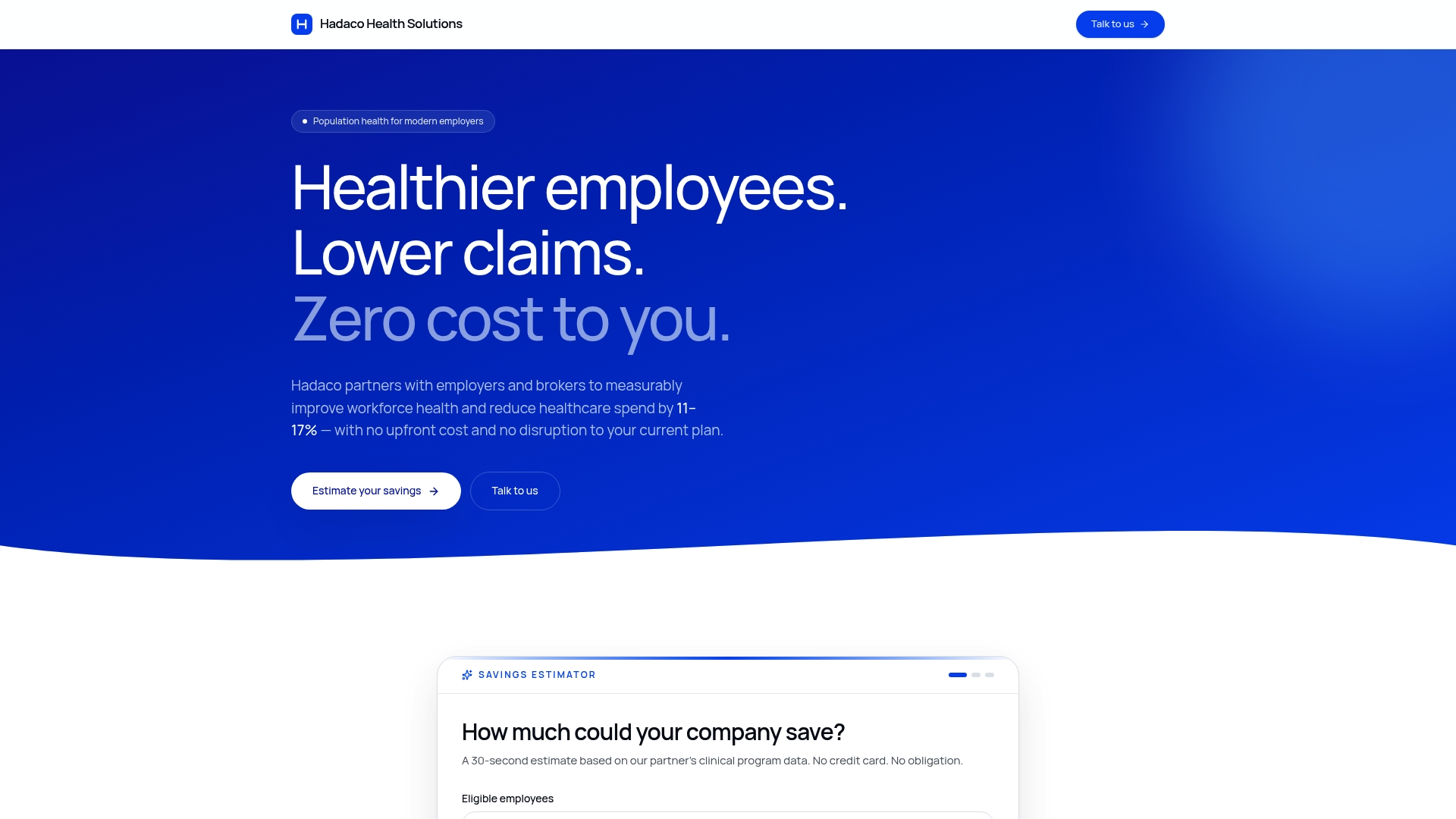
Hadaco's model reflects the same principles this guide has laid out: evidence-based interventions, integration rather than disruption, and hard reporting instead of vague promises. Programs plug into existing benefit plans, addressing chronic disease management, preventive care, and engagement without forcing a plan overhaul.
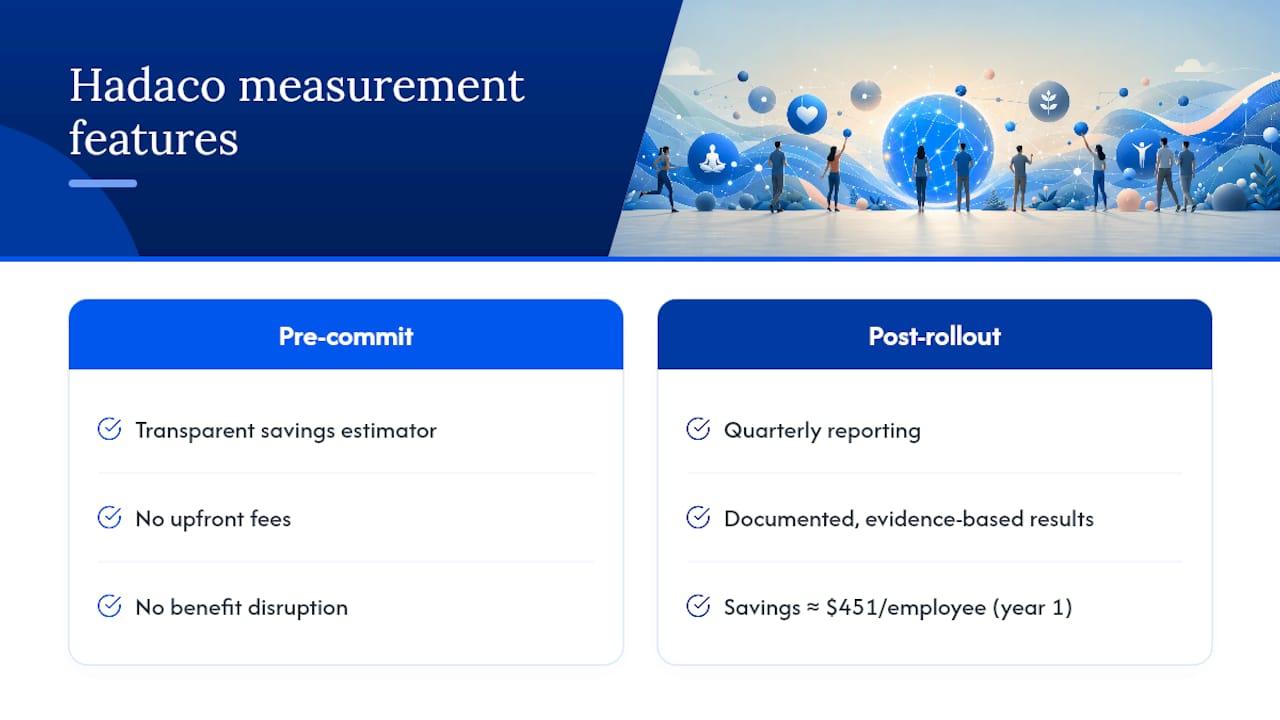
The proof points back it up. Hadaco clients commonly see average savings of $451 per employee in the first year, paired with measurable improvements in engagement and retention. Every client gets a transparent savings estimator upfront and quarterly reporting afterward, so the numbers driving executive conversations aren't estimates pulled from a sales deck.
That combination matters for three reasons:
- No upfront fees means the financial risk sits with the outcomes, not the employer's budget
- Quarterly reporting turns "we think this is working" into a documented trend line
- Complementing existing plans means HR doesn't have to fight a renegotiation just to start
Employee Involvement and Feedback Shape Whether Culture Sticks
Wellbeing programs designed entirely by HR and handed down to employees rarely earn the trust the earlier sections describe. People need a hand in shaping what gets built, not just a survey after the fact asking whether they liked it.
Structured feedback loops matter more than a single annual engagement survey. Quarterly pulse surveys catch problems while they're still small. Focus groups with a cross-section of departments, not just volunteers who already love the program, surface the objections that matter. Anonymous suggestion channels give people who won't speak up in a meeting a real way to be heard.
Employee resource groups and peer wellbeing champions do something surveys can't: they carry credibility a mandate from HR never will. A champion embedded in the warehouse floor knows things about shift fatigue that a corporate survey will never surface. Give these champions actual input into program design decisions, not just distribution duties for flyers, and participation tends to follow.

Feedback only builds trust if people see it acted on. A survey that identifies a problem and gets no visible response teaches employees that feedback is theater. Close the loop publicly, even when the answer is "we can't fix this yet, but here's what we're doing instead."
What the Research Actually Tells HR Leaders to Do First
Most wellbeing advice tells you to start with programs. The evidence says start with behavior. Leadership modeling predicts perceived support more reliably than any policy stack, which means the cheapest, fastest move available to most organizations is also the most overlooked one: get executives and middle managers acting differently before you buy anything new.
The conventional wisdom oversells environmental perks, standing desks, snack walls, wellness apps, as if they're the culture itself. They're not. They're the furniture inside a culture that leadership either builds or undermines every day through small, visible choices. The Harvard Business School data on the gap between top and bottom-quartile companies isn't really a story about budget size. It's a story about which companies bothered to formalize what they were doing and measure whether it worked.
If you're building this from scratch, prioritize manager training and a written plan before you shop for a new benefits vendor. The programs matter, but they only work inside a culture that already takes health seriously at the top.
Hadaco Gives You a Measurable Path to a Healthier Workforce
Everything in this guide points to the same conclusion: culture change works when it's paired with real accountability, not just good intentions. Hadaco is built around that exact idea. It layers evidence-based interventions for chronic disease, preventive care, and mental health onto your existing benefit plans, with no upfront fees and no disruption to what's already working.
If you're an HR or benefits leader trying to move from a wellbeing "initiative" to a documented, evidence-based culture of health, Hadaco gives you the two things most programs skip: a transparent savings estimator before you commit, and quarterly reporting afterward so the results are never a guess. Employers commonly see savings around $451 per employee in the first year, alongside stronger engagement and retention. You can also pair a wellbeing rollout with smaller, tangible gestures like the recognition ideas in Dudley's Toffee's manager gift guide to reinforce the culture you're building day to day.
Visit Hadaco to get your savings estimate and see what an evidence-based wellbeing program could look like inside your organization.
Frequently Asked Questions
What is a workplace wellbeing culture, in simple terms? It's an organizational environment where healthy choices, mental health support, and work-life balance are built into daily operations and modeled by leadership, not offered as optional extras.
How long does it take to build a real culture of health at work? Realistic timelines run 12 to 36 months for durable, organization-wide change, though early culture signals often show up within the first year.
What's the biggest mistake companies make with workplace wellness programs? Treating wellbeing as a stack of perks instead of integrating it into HR processes, manager training, and company mission statements.
How do you measure whether a wellbeing culture initiative is working? Combine perception surveys, participation and engagement data, and multi-year claims trends. A validated tool like CHAS gives you a structured baseline to track against.
Does leadership behavior really matter more than the benefits offered? Yes. Research consistently ties leadership and coworker support more closely to how supported employees feel than environmental perks alone, even though both play a role.
Sources
- Harvard Business School — Survey: Foster culture of health
- Elements of a Workplace Culture of Health, Perceived Organizational Support for Health, and Lifestyle Risk — JOEM
- Well‑Being at Work U.S. research report — Johns Hopkins Carey HCD Lab
- U.S. Surgeon General — Framework for workplace mental health and well‑being