
To consolidate wellness vendors, start with an inventory of every program you pay for. Map each one to an employee need, keep what shows results, merge what overlaps, and retire what no one uses. Then tell employees early and track the outcome for several years, not a single quarter. Done in that order, consolidation cuts administrative work and confusion without cutting access to care.
This guide is for HR, benefits and finance leaders at mid-sized and large employers who suspect their wellness stack has grown faster than its value. It walks through the decision, the audit, the criteria, the rollout and the measurement.
TL;DR
- Consolidate when programs overlap, confuse employees or cannot show results. Do not consolidate just to have fewer invoices.
- Inventory first: vendor, cost, renewal date, contact, the problem it solves and real utilization.
- Judge each vendor on population fit, data, integration, operating model, ROI and your capacity to implement.
- Most employers end up with a hybrid: fewer vendors, plus a few targeted programs where a specific need justifies one.
- Measure for years: engagement, cost per engaged member and claims, reviewed on a regular schedule.
Table of Contents
- What consolidating wellness vendors actually means
- Signs it is time to consolidate
- Step 1: Build a complete vendor inventory
- Step 2: Set the criteria for keep, combine or retire
- Step 3: Consolidate without disrupting benefits
- Step 4: Communicate the change to employees and stakeholders
- Step 5: Measure whether consolidation worked
- Our perspective: fewer vendors, more accountability
- See what a consolidated program could look like for you
- FAQ
- Sources
What consolidating wellness vendors actually means
Consolidation is not one move. It can mean replacing five point solutions with one platform. It can mean folding programs into your health plan's services. It can also mean keeping two or three specialists and dropping the rest. The common thread is a smaller, better-governed set of partners.

The case for it is easy to see. Business Group on Health reported in 2024 that some large employers contract with 12 or more "best-in-class" vendors. A sprawling ecosystem like that risks duplicated services and muddled communication. It also makes it hard to tell which vendor influenced an outcome, and it complicates procurement.
The trade-offs are just as real. A platform with a single sign-in can reduce confusion for employees. According to CFH, bundles can cost more than the best single programs, so each module should be compared on its own merits. Consolidation works when you treat it as a portfolio decision, not a shortcut.
Three common routes
- One integrated platform. A single vendor covers several needs, such as chronic disease support, preventive care and engagement, with one login and one reporting stream.
- Health plan and PBM services. Business Group on Health notes that some employers have gone all in with their plan and PBM and dropped point solutions. That saves administrative effort but reduces flexibility and specificity in your benefits strategy.
- Hybrid. The same source concludes that most employers integrate what they can and carve out targeted services where there is a clear need. For most organizations this is the realistic destination.
Signs it is time to consolidate
You do not need a crisis. A few patterns, taken together, usually say the stack has outgrown its purpose:
- Overlap. Two or three vendors target the same condition or the same behavior, and employees get duplicate outreach.
- Confusion. Employees cannot say which program is for what. Your own HR team struggles to explain the list.
- No attribution. When claims trend up or down, nobody can say which program contributed.
- Weak reporting. Vendors send participation numbers but cannot show results that tie to your claims.
- Admin drag. Separate contracts, renewals, data feeds and invoices consume more staff time than the programs justify.
The first three map directly to the test CFH gives: consolidate when programs overlap, confuse employees or cannot show results. If none apply, you may only need a lighter review, not a rebuild.
Step 1: Build a complete vendor inventory
You cannot consolidate what you have not mapped. Start by documenting every program and resource, including ones HR did not buy directly, such as a carrier's built-in tools or a program a regional office added on its own.
For each vendor, capture:
- Name, service category and primary contact
- Annual cost or per-employee-per-month fee
- Contract start, renewal date and notice period
- The problem it is meant to solve and the population it serves
- Registration and usage: how many employees enrolled and how many used it at least once
- Reported outcomes and how those were calculated
Then map the list against employee needs. Marsh McLennan Agency recommends reviewing carrier utilization reports, biometric screening results, aggregate health risk assessment data and employee interest surveys. It also points to the HERO scorecard and the CDC's Worksite Health Scorecard as benchmarks to help find gaps. Segal describes the same mapping of vendor offerings against identified needs as a core step in modernizing a program.
What the map should show you
Lay the vendors in rows and the needs in columns: diabetes, hypertension, musculoskeletal, mental health, preventive screenings, lifestyle, navigation. Three patterns will jump out:
- Rows with many marks are your overlap candidates.
- Columns with no marks are gaps. Consolidation is not only subtraction.
- Rows with low usage are candidates to retire or relaunch with better communication.
Keep contract dates beside this map. A vendor you want to drop in March but cannot exit until December is a planning issue, not a surprise to discover late.
Step 2: Set the criteria for keep, combine or retire
Decide how you will judge before you look at individual vendors. Otherwise the loudest vendor, or the one with the nicest dashboard, wins.
Milliman advises plan sponsors to ask six questions about any solution:
- Is it aligned with members' needs?
- Does historical data support the investment?
- Does it integrate into the overall benefits strategy?
- Does the operating model meet organizational needs?
- Are the ROI targets actuarially sound?
- Is there capacity to support implementation?
Milliman also stresses testing population fit explicitly. Ask whether the conditions a solution supports are prevalent in your workforce. Look at claim volume, workforce characteristics and the member engagement profile.
A simple scoring approach
Turn those questions into a scorecard. Rate each vendor from 1 to 5 on each criterion, and add two practical columns: contract flexibility and data access. Then sort vendors into three groups:
| Group | What it looks like | Typical action |
|---|---|---|
| Core | Strong fit, solid usage, clear data | Keep, and consider expanding scope |
| Overlapping | Good fit but duplicates another vendor | Merge into one, choose on results and integration |
| Marginal | Low usage, weak data or poor fit | Retire at renewal or run a time-boxed test |
If you want a structured way to test a vendor before committing, our 90-day pilot approach for evaluating wellness vendors lays out how HR can do it. For finance teams, testing vendor guarantees against a benchmark helps separate marketing promises from measurable commitments.
Step 3: Consolidate without disrupting benefits
The fear behind most delayed consolidations is simple: employees will lose something they rely on. The answer is sequencing, not avoidance.
Protect continuity of care first. Identify employees actively using a program you plan to retire, especially for chronic conditions. Plan a handoff so no one falls into a gap. Ask the incoming vendor how it will receive participants, and ask the outgoing vendor what data it can transfer under your agreement and applicable privacy rules. Your benefits counsel and broker should review the data-sharing terms.
Stage the change. Align retirements with contract renewal dates and move one category at a time. Moving diabetes support this year and mental health next year is easier to manage, communicate and measure than a single enterprise-wide switch.
Choose solutions that sit alongside your plans. Prefer partners that integrate with your current medical plan and benefit structure instead of requiring you to rework it. That is the principle behind how we design our own programs: they complement existing plans rather than replacing them.
Keep a carve-out option. The hybrid model exists for a reason. If a specialized need is not served well by your consolidated partner, a targeted program for that population can remain.
Mind the engagement dip. Any change risks lost momentum. Keep the most-used features, familiar entry points and any incentives employees already understand, and move them over deliberately. Our guide to wellness engagement strategies that raise participation covers what tends to keep people involved after a transition.

Step 4: Communicate the change to employees and stakeholders
Few employees care how many vendors you have. They care whether they can still get help, where to go, and whether their information is safe. Frame the message around those three things.
For employees
- Say what is staying, what is changing and when. Give exact dates for the cutover and the last day of any retiring service.
- Give one front door. A single page, one phone number and one login beat a list of vendor names.
- Speak in terms of needs. "Support for managing blood pressure" lands better than a vendor brand.
- Repeat it. Use the channels people actually read: manager huddles, email, intranet, payroll inserts and open enrollment materials.
- Address privacy plainly. Explain who sees what, and that employers receive aggregate reporting, not individual health details, if that is how your arrangement works.
For leaders and managers
Brief executives with the business case: administrative savings, a clearer view of outcomes and a smaller contract count. Give managers a short script and an FAQ so they can answer questions without escalating to HR. Tell your broker or benefits advisor early, since they often hold the contract and renewal details that drive timing.
For vendors
Notify outgoing vendors according to contract terms, and ask for transition support in writing. Tell incoming vendors what your baseline numbers are so that later results are measured against a clear starting point.
Step 5: Measure whether consolidation worked
Set the baseline before the first vendor leaves. Capture current spending, per-employee fees, participation rates and the claims trends in the conditions each program targets. Without it, you will argue about results later.
Mercer notes that more than $100B of digital-health venture funding in the US over ten years has driven innovation and also vendor consolidation, with overlapping services in employer offerings. Its US Health Benefits Large/Jumbo Practice Leader, Maura Cawley, advises that optimization is an ongoing process, not a one-time event. That means regular portfolio review and multi-year tracking of engagement, cost per engaged member and other metrics.
Metrics worth tracking
| Area | Metric | Why it matters |
|---|---|---|
| Cost | Program fees, per-employee-per-month spend, claims in targeted conditions | Shows financial effect |
| Administration | Number of contracts, data feeds, HR hours spent | Shows the efficiency gain |
| Participation | Registration, repeat use, cost per engaged member | Shows whether people use what you buy |
| Health | Screening completion, condition management indicators, use of preventive care | Shows whether the programs help |
| Experience | Employee survey feedback, help-desk questions | Shows whether the change is clear |
Review quarterly at first, then at least annually. Treat the review as a standing agenda item rather than a project. For ideas on how to bring in outside perspectives on results, corporate wellness programs offered by integrative clinics show one way employers think about supporting employee health beyond a single channel. If you want technology help with the reporting side, see our overview of benefits administration software.
Give results time. A first-year snapshot can be distorted by transition effects, so hold your conclusions until you have more than one cycle of data.
Our perspective: fewer vendors, more accountability
Most employers we speak with do not have a wellness problem. They have a coordination problem. Programs were added one at a time, each with a good reason, and nobody was asked to prove how they fit together.
We believe consolidation should be judged on outcomes, not on vendor count. That is why our approach to population health is built around evidence-based interventions for chronic disease, preventive care, mental health and employee engagement, delivered alongside your existing benefit plans instead of replacing them.
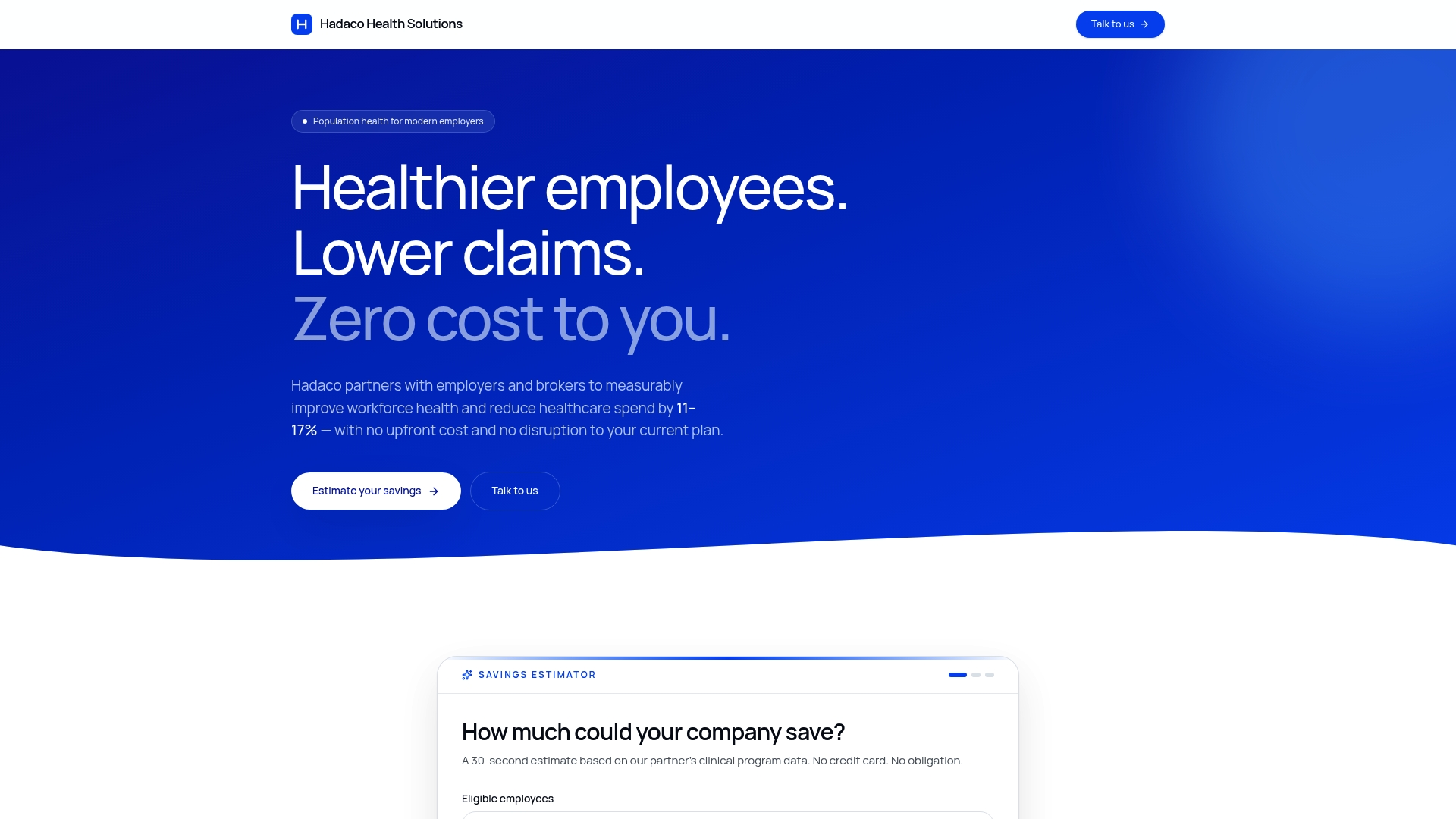
We also think employers deserve visibility before they commit. Our savings estimator lets you see a projected range up front, and our quarterly reporting keeps results on the table once the program is running. Our programs carry no upfront fees, and our fees are tied to demonstrated savings and engagement outcomes.
Companies we work with often see average first-year savings of $451 per employee, along with better engagement and retention. We think that is what a consolidated approach should aim for: lower claims, simpler administration and employees who actually use what you offer.
Gene
See what a consolidated program could look like for you
If your audit shows overlap in chronic disease, preventive care, mental health or engagement, our population health program is designed to cover those dimensions in one integrated approach that complements your current plans. Our team works with both employers and brokers, and you can use the savings estimator to see a projection before you talk to anyone.
Book a consultation to walk through your inventory and see where a single program could replace several. To see how the savings are framed, read how self-funded employers approach wellness.
FAQ
When should an employer consolidate wellness vendors?
Consolidate when programs overlap, confuse employees or cannot show results. Contract renewals are the natural trigger, because you can exit without penalty. If your vendors report participation but never tie it to claims, that is also a good moment to review.
Will consolidating reduce employees' access to care?
It does not have to. Map who uses each program, plan a handoff for people in active care, and stage changes by category. Choose a partner that works with your existing plans, and keep targeted carve-outs where a particular need requires one.
How many wellness vendors is too many?
There is no magic number. Business Group on Health reports that some large employers use 12 or more vendors, and that scale raises the risk of duplicated services and unclear attribution. A better test is whether every vendor has a distinct purpose, healthy usage and data you can trust.
How do I know if consolidation saved money?
Set a baseline for spending, administration time, participation and claims before you change anything. Then track engagement and cost per engaged member over multiple years, as Mercer advises, rather than judging on one quarter.
Should we move everything into our health plan's services?
Some employers do, and it reduces administrative burden. The trade-off, according to Business Group on Health, is less flexibility in your benefits strategy. Most employers choose a hybrid: integrate where possible and carve out specific services where there is a need.
Sources
- Point Solutions vs. Vendor Consolidation, CFH
- Integrated Benefits Experience: Four Key Considerations for Employers, Business Group on Health
- Well-being Foundations Playbook Step 1, Marsh McLennan Agency
- A Five-Step Strategic Approach to Wellness Program Success, Segal
- Choosing the right partner: How employers evaluate point solution vendors, Milliman
- Optimize your organization's health ecosystem, Mercer
- Corporate Wellness, Green Circle Wellness Clinic