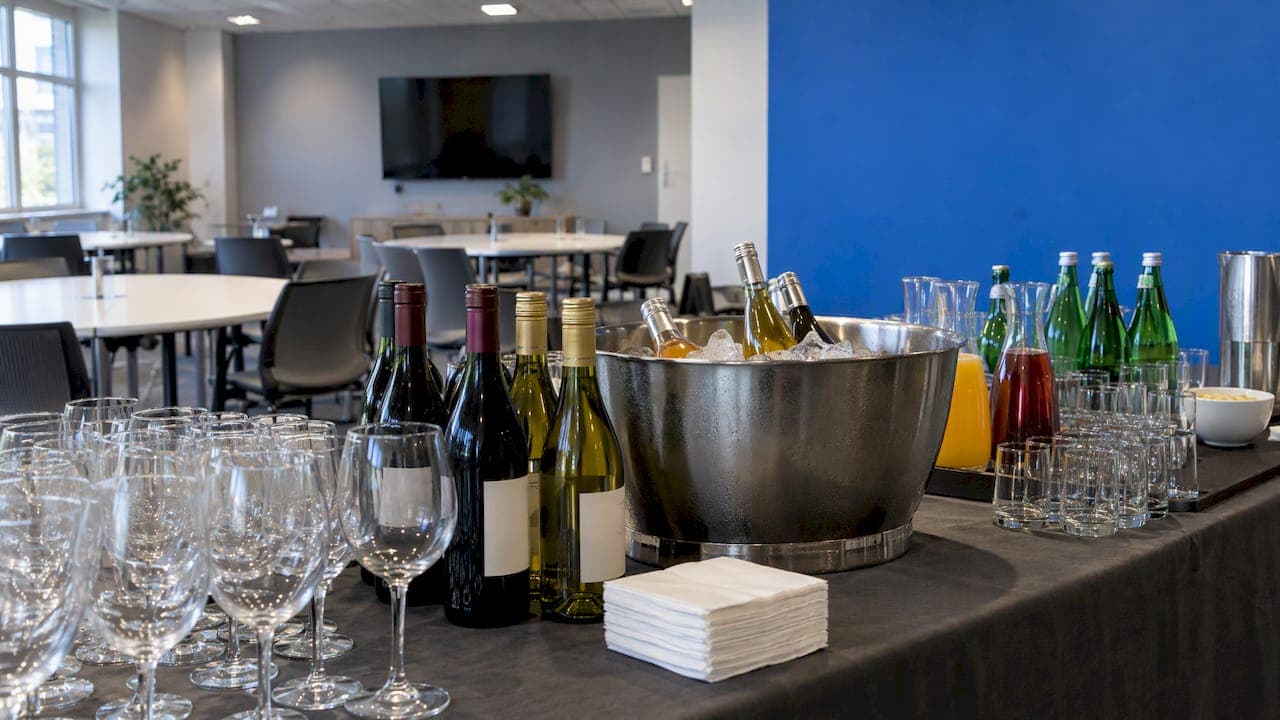
A workplace alcohol culture is the set of habits, expectations and unspoken rules about drinking around work: the happy hour that doubles as a promotion channel, the client dinner where abstaining gets noticed, the fridge of beer on Friday. A written policy covers only part of it. The rest is what people see their coworkers and managers do, and what they believe will be rewarded or frowned on. This guide shows HR and benefits leaders how to read that culture, what the evidence says about changing it, and how to measure the result.
TL;DR
- Culture is shaped by availability and by norms. In one national U.S. survey, 63.09% of workers said alcohol could easily be brought into, used in, or obtained at work.
- Workgroup norms matter more than a rulebook. A study of 137 workgroups found the most discouraging norms went with 69% lower odds of drinking at work, though the design is observational.
- Use a management process: assess, write a policy, train supervisors, offer support, measure against a baseline.
- Separate safety rules from support. Punishing someone for asking for help can create legal exposure under the ADA.
- Track your own absenteeism, safety incidents, claims, turnover and engagement. National cost figures will not tell you what alcohol costs your company.
Table of Contents
- What "alcohol at work culture" actually means
- Why drinking became part of work life, and why it is shifting
- Signs your culture leans on alcohol
- Why norms beat rules
- A step-by-step approach for HR
- The health angle employees care about
- Special cases: hospitality, shift work and sales
- Measure it like a CFO would
- Our perspective
- How Hadaco can help
- FAQ
- Sources
What "alcohol at work culture" actually means
Most searches on this topic start with a narrow question: can employees drink at work, or what do we do about someone who does? Those matter, but they are the visible tip. Researchers who study the issue describe a workplace alcohol climate with three parts:
- Availability: how easy it is to get or use alcohol at work or at work-related events.
- Descriptive norms: what people believe their coworkers actually do.
- Injunctive norms: what people believe their coworkers and leaders approve of.
The national probability sample of 2,148 U.S. workers that measured these found that 23.00% had been exposed in the previous 12 months to a coworker who used alcohol or was impaired during the workday. Exposure varied by gender, age, occupation and shift. That variation is the first lesson: "our culture" is rarely one culture. A sales floor, a night shift and a headquarters team can each have a different climate under the same handbook.
This is why a ban on possession can leave everything else untouched. If managers still close deals over drinks and treat the after-work crowd as the inner circle, the real message is the opposite of the written one.
Why drinking became part of work life, and why it is shifting
Alcohol has been a social lubricant in business for a long time. Many people use it to relax with colleagues, mark a win or break the ice with a client. That is the honest case for it, and it is why heavy-handed bans often get resentment instead of compliance.
The costs sit on the other side of the ledger. Excessive drinking cost the U.S. $249 billion in 2010, according to CDC, with lost workplace productivity and healthcare costs among the components. A CDC analysis of 32 states found that 20.8% of employed adults reported binge drinking in 2013 to 2016, ranging from 15.9% in community and social services to 26.3% in construction and extraction. These are older baselines, and the CDC authors caution that links between alcohol and productivity outcomes have many contributing causes.
The broader climate is changing too. Gallup reported in August 2025 that 54% of U.S. adults say they drink, the lowest in its nearly 90-year trend, and that a majority now see moderate drinking as unhealthy. For employers, that means a growing share of your workforce is not drinking, or is drinking less, and an alcohol-centered event excludes more people than it used to.

Signs your culture leans on alcohol
You do not need a survey to spot early signals. Look for these:
- Team celebrations, farewells and onboarding events default to a bar or an open tab.
- Non-drinkers are asked why, teased, or quietly skip events where networking happens.
- Alcohol is stocked in the office or served at routine meetings, with no end-of-day boundary.
- Leaders joke about hangovers or treat heavy drinking as a sign of commitment.
- Client entertainment is assumed to involve drinks, with no alternatives.
- Supervisors say they would not know what to do if someone seemed impaired.
One peer-reviewed study of the "grey zone" between work and leisure, the WIRUS culture study, gives a sharper checklist. It identified six dimensions that raise risk at work-social events: who invited the employee, whether attendance is truly voluntary, whether drinking is truly voluntary, whether the conversation is work-related, what rules apply, and how far the event is from home. The research drew on eight focus groups with 61 employer and employee informants in Norwegian companies, so treat it as a design tool, not a U.S. prevalence figure. It is still useful: you can score your last three company events against those six questions in ten minutes.
Why norms beat rules
The strongest evidence for culture change comes from a study of 5,338 workers in 137 workgroups across 16 worksites. Employees in workgroups with the most discouraging drinking norms were 45% less likely to be heavy drinkers, 54% less likely to be frequent drinkers and 69% less likely to drink at work than those in the most encouraging groups.
Two cautions belong next to that result. It is observational, so it does not prove that norms alone caused the differences. And it measures the immediate workgroup, not the company as a whole. The practical reading is that your frontline supervisors and senior leaders carry more influence than any poster. If they model alcohol-neutral events and never treat drinking as a condition of belonging, the written rule has something to stand on.
A step-by-step approach for HR
SAMHSA's employer framework for a drug-free workplace lists six components: assess workplace needs, identify resources, create a written policy, decide whether to provide an Employee Assistance Program, decide whether testing is appropriate, and provide employee and supervisor education. It also recommends ongoing evaluation against baseline measures. Here is how that translates into a working plan.
1. Assess before you announce
SAMHSA's guidance on assessing your workplace stresses that each workplace is affected to a different degree. Start with what you already hold:
- Absenteeism and unplanned leave patterns, by team and shift
- Safety incidents and near misses
- Disciplinary records that mention impairment
- Health plan claims, reviewed in aggregate and de-identified
- Anonymous pulse survey questions on event norms, pressure to drink and comfort raising concerns
Involve representative employee groups early, including people who do not drink. They will tell you things the data will not.
2. Write a policy that says what you do allow
A useful policy answers four questions in plain language: where alcohol may be present, who may serve or approve it, what counts as impairment, and where an employee can go for help. Cover remote work, travel, client events and off-site gatherings, since the grey zone is where most problems start.
If you employ commercial drivers or other safety-sensitive staff, separate federal rules apply. For example, covered motor carriers must provide written alcohol and controlled-substance policies and educational materials under 49 CFR 382.601. Those rules are specific to covered roles and do not apply to every employee.
3. Keep safety enforcement and support apart
Employers may prohibit impairment and enforce safety rules. The line gets risky when a blanket rule punishes disclosure. In an EEOC case, a federal jury found that a trucking company violated the ADA when it permanently barred a driver who self-reported alcohol abuse, without an individualized assessment or a reasonable accommodation such as treatment leave. The award was $119,612 in back pay.
That case involved a safety-sensitive driving role and is not a universal rule. The takeaway for HR is to decide fitness for duty and safety questions on the facts of each role, and not to treat asking for help as automatic grounds for discipline. Have employment counsel review your policy and your supervisor scripts before rollout. Our guide to ADA-compliant wellness programs covers the wider compliance picture.
4. Train supervisors for the conversation
Supervisors are the first to notice a change in performance or behavior, and the least likely to have been told what to do. Train them to describe observed behavior, not diagnose; to follow the safety procedure when someone appears impaired; to point to support; and to know when to bring in HR. Also train them on events: who chooses the venue, whether there are good non-alcoholic options, and when the official part ends.
5. Offer real routes to support
Policy without help reads as a threat. Decide whether an EAP is right for you, and look honestly at whether people use it. If utilization is low, our overview of EAP alternatives lays out other ways to deliver support. Mental health access matters here too, since stress and drinking often travel together: see our HR guide to employee mental health programs.
6. Redesign the events
This is the fastest visible change, and it costs little:
- Hold some celebrations at lunch, in the morning or around an activity.
- Serve interesting non-alcoholic drinks as a standard offer, not an afterthought.
- Cap or ticket alcohol where it is served, and end events at a stated time.
- Make sure promotions, introductions and client wins are not decided at events people can skip.
- Have senior leaders attend and visibly not need a drink.
The health angle employees care about
People respond better to a health frame than a compliance frame. Alcohol touches sleep, mood, blood pressure, liver health and more, and the effects on the body are broader than most employees assume. For example, alcohol and bone health is a topic many drinkers have never considered. Sharing balanced, non-judgmental health information alongside the policy helps employees see it as care instead of surveillance. Keep the message about choice and information, and never single out individuals.
Special cases: hospitality, shift work and sales
Industries differ because availability and norms differ. Construction and extraction showed the highest binge-drinking prevalence in the CDC occupational analysis, while community and social services showed the lowest. Hospitality workers often finish a shift when others are going out, and alcohol is part of the product. Sales teams often treat client entertainment as part of the job. In each case, the fix is the same pattern with local detail: assess that group, involve its people, adjust the events and give supervisors a script. Our piece on hospitality wellness programs and shift coverage shows how scheduling shapes whether any program gets used.
Measure it like a CFO would
A culture project that cannot show results loses funding. The CDC researchers' caution about causation points to the right method: do not assume every absence or claim is about alcohol, and track your own organization's numbers against a baseline set before you start.
| Measure | Where it comes from | What to watch |
|---|---|---|
| Absenteeism | HRIS, by team and shift | Monday and post-event patterns |
| Safety incidents | Safety logs | Trend by site, not individual cases |
| Claims | Aggregate, de-identified plan data | Related diagnoses and utilization |
| Turnover | HRIS exit data | Exit-interview mentions of culture |
| Engagement | Pulse surveys | Comfort declining a drink, event inclusion |
| Program use | EAP and support participation | Usage after supervisor training |
Review quarterly, tell employees what you found, and adjust. Our guide to evidence-based wellness programs goes deeper on setting baselines and judging whether an intervention worked.
Our perspective
We work with employers on population health, and alcohol culture shows up in our conversations as a thread running through bigger issues: chronic disease, mental health, engagement and retention. We rarely see it as a stand-alone problem, and we do not think it should be treated as one.
Three convictions shape our view. First, a culture is a system, so it needs a plan with an owner, a baseline and a quarterly review, not a one-time awareness week. Second, support has to work alongside your existing benefits. Employers should not have to rip out their plans to address health risks; the better path complements what is already in place. Third, measurement is what earns trust with finance. You should be able to see what is changing in your own claims and engagement data, and what is not.
We also think leaders should be careful with the story they tell. Alcohol is one factor among many in workforce health costs, and the research supports a measured claim, not a dramatic one. Start with an honest read of your own workplace, change the events and the norms leaders model, and keep help easy to reach.
— Gene
How Hadaco can help
If alcohol is one of several health and engagement issues you are working through, Hadaco delivers evidence-based population health programs that integrate with your current benefit plans without disrupting them. They cover chronic disease, preventive care, mental health and employee engagement, with a savings estimator and quarterly outcome reporting so you can see results. Programs carry no upfront fees. See how Hadaco works and book a consultation.
FAQ
Can employees drink alcohol at work?
In most U.S. private workplaces, the employer decides. No general federal law bans a company from allowing alcohol at an event, though employers must still manage safety and liability, and some roles, such as DOT-covered drivers, face specific federal rules. Most employers prohibit impairment at all times and limit alcohol to approved events with clear boundaries.
Why do people drink at work events?
Often for social reasons: to relax, bond or fit in. Norms play a large part. In the workgroup study above, groups with encouraging norms had much higher rates of drinking at work, which suggests many people follow what they see around them. Pressure rises when attendance or drinking is not truly voluntary.
How should a manager handle an employee who seems impaired?
Focus on safety and observable behavior, not guesses about the cause. Follow your written procedure, involve HR promptly and avoid public confrontation. If the employee discloses a possible alcohol problem, speak with HR and employment counsel before acting, since the ADA may require an individualized assessment and reasonable accommodation.
What should an employer alcohol policy include?
At minimum: where and when alcohol is allowed, a definition of impairment, rules for off-site and client events, consequences, and how to get help. SAMHSA's framework also recommends supervisor and employee training and ongoing evaluation. Have counsel review it for your jurisdiction and job types.
Sources
- Workplace Substance Use Climate: Prevalence and Distribution in the U.S. Workforce
- Drinking social norms and drinking behaviours: a multilevel analysis of 137 workgroups in 16 worksites
- Six shades of grey: the WIRUS culture study
- Binge Drinking by Occupation Groups among Currently Employed U.S. Adults in 32 States, 2013–2016 (CDC)
- Excessive alcohol use continues to be drain on American economy (CDC)
- U.S. Drinking Rate at New Low as Alcohol Concerns Surge (Gallup)
- Plan and Implement a Program (SAMHSA)
- Assess Your Workplace (SAMHSA)
- Jury in EEOC Suit Says Old Dominion Freight Line Must Pay Former Driver $119,612 (EEOC)
- 49 CFR 382.601 (eCFR)