
TL;DR:
- Workplace biometric screenings provide de-identified health data and a snapshot of key health markers. They drive cost savings only when tied to follow-up coaching and chronic disease management programs. Effective programs focus on targeted interventions and ensure privacy compliance while maximizing employee engagement.
A biometric screening in the workplace is a short clinical check that gives employers de-identified population health data and gives employees a snapshot of key health markers like blood pressure, cholesterol, and glucose. Done right, it is one of the fastest ways for HR to see where chronic disease risk is concentrated in a workforce before claims costs spike.
The immediate next step for most HR teams: define your program goal first (baseline data, incentive eligibility, or chronic disease targeting), then build a vendor shortlist using the checklist in Section 7 below.
Who benefits most:
- HR and benefits leaders get aggregate, de-identified population data to design targeted interventions and calibrate incentives.
- Health managers can benchmark workforce risk year over year and track whether programs are moving the needle.
- Employees get a personal health snapshot, often with a brief clinician review, that many would not otherwise seek on their own.
One honest caveat on ROI: screenings alone do not reduce claims. The savings come from what happens after the screening, specifically coaching, primary care referrals, and chronic disease management programs. A screening without connected follow-up tends to feel like a one-off administrative exercise to employees, and it produces little measurable return for employers.
Pro Tip: Pair your screening event with same-day health coaching appointments. Employees who receive a brief clinician review immediately after testing are significantly more likely to follow up with a primary care physician or enroll in a wellness program.

Table of Contents
- What a biometric screening is — and what it is not
- What a typical workplace biometric screening actually measures
- Why employers run biometric screenings — and what realistic ROI looks like
- How to plan and run a biometric screening program from start to finish
- Legal and privacy rules every U.S. employer must understand
- What biometric screenings cost and how to vet vendors
- How to use aggregate screening data to drive real program changes
- What the research says about biometric screening program design
- Key Takeaways
- Why biometric screenings are only as good as what comes after them
- Hadaco turns biometric screening data into measurable savings
- Authoritative sources for further reading
What a biometric screening is — and what it is not
A biometric screening is a clinical set of laboratory tests and physical measurements that produces a snapshot of an individual's current health status. It is a screening tool, not a diagnostic one. An elevated fasting glucose reading does not mean an employee has diabetes; it means they should talk to a physician. That distinction matters for how you communicate results to employees and how you design follow-up pathways.
Delivery models employers commonly use:
- Onsite events: A vendor sends clinical staff to your location. Appointments run 10–20 minutes, biometric measures are taken first, then a fingerstick or venipuncture blood draw. Best for high-density, single-location workforces.
- Commercial lab visits (patient service centers): Employees visit a Quest Diagnostics or Concentra location on their own schedule. Useful for distributed teams or employees who prefer privacy.
- Physician result forms: Employees complete the screening with their own primary care physician and submit results. Removes the clinical burden from the employer entirely, though turnaround and format consistency can vary.
- Home/self-collection kits: Mailed kits with fingerstick lancets and prepaid return envelopes. Participation rates can be strong for remote workforces, but panel breadth is limited compared to venipuncture.
Fingerstick draws produce results in minutes and cover a core lipid and glucose panel. Venipuncture draws go to a lab for processing, which takes longer, but the panel can include a full metabolic workup. For most employers running an annual baseline program, fingerstick is sufficient. For populations with known chronic disease risk, the broader venipuncture panel is worth the extra day or two of wait time.
What a typical workplace biometric screening actually measures
The standard panel at most onsite biometric screening events covers the markers most predictive of cardiovascular disease, metabolic syndrome, and diabetes risk. Here is what HR should expect vendors to include in a core program:
Physical biometrics:
- Blood pressure (systolic and diastolic)
- Body mass index (BMI), calculated from height and weight
- Waist circumference
- Resting heart rate
Laboratory values (fingerstick or venipuncture):
- Total cholesterol
- HDL cholesterol ("good" cholesterol)
- LDL cholesterol ("bad" cholesterol)
- Triglycerides
- Fasting glucose (requires 8–12 hours of fasting)
- Hemoglobin A1c (HbA1c), which reflects average blood sugar over roughly three months and does not require fasting
- Basic metabolic panel elements (creatinine, liver enzymes) when venipuncture is chosen
The CDC estimates that more than 1 in 3 American adults has prediabetes, and the vast majority do not know it. A fasting glucose or A1c reading in a workplace screening is often the first time an employee encounters that information.
Pro Tip: For a first-year program, start with the core fingerstick panel: blood pressure, BMI, total cholesterol, HDL, LDL, triglycerides, and fasting glucose. Add A1c and a full metabolic panel in year two once you have baseline data and can identify which employee segments need deeper clinical insight.
Why employers run biometric screenings — and what realistic ROI looks like
The business case for a workplace health screening rests on one premise: you cannot manage what you cannot measure. Aggregate screening data tells HR where chronic disease risk is concentrated, which conditions are underdiagnosed, and which employee segments need targeted interventions. That intelligence directly informs benefits design, vendor selection, and incentive calibration.
Population health use cases:
- Identifying the percentage of employees with elevated blood pressure or pre-diabetic glucose levels before those conditions generate high-cost claims
- Targeting chronic disease management programs (hypertension coaching, diabetes prevention) to the employees who need them most
- Benchmarking workforce health year over year to measure whether programs are working
- Calibrating wellness incentives to participation and engagement rather than outcomes alone
From the employee side, the teachable moment is one of the most underrated parts of a well-run screening. A brief clinician or health coach review immediately after testing, while the numbers are in front of the employee, drives behavior change in a way that a mailed report never does. Employees who understand what their LDL number means are far more likely to schedule a follow-up appointment or enroll in a coaching program.
Biometric screening adoption rates in 2025 were 28% for small employers (under 500 employees), 51% for mid-sized employers (500–5,000 employees), and 46% for large employers (over 5,000 employees). Mid-sized employers show the highest adoption rate, likely because they have enough scale to justify vendor contracts but enough cost sensitivity to prioritize early risk detection.
Common employer KPIs to track:
- Participation rate (target: 60%+ for a meaningful population sample)
- Percent of employees with at least one elevated marker
- Referral rate to primary care or coaching programs
- Year-over-year change in at-risk percentages
For a deeper look at how to frame the financial case internally, Hadaco's guide on corporate wellness ROI walks through the metrics benefits leaders use to justify program investment.
How to plan and run a biometric screening program from start to finish
A screening event that produces useful data and strong participation does not happen by accident. The planning timeline typically runs 8–12 weeks from vendor selection to event day.
Pre-planning checklist:
- Define the program goal: baseline data collection, incentive eligibility, or chronic disease targeting.
- Choose a delivery model: onsite event, lab-based, physician form, home kit, or hybrid.
- Set a budget per employee and confirm whether coaching or referral services are included.
- Confirm medical oversight: who reviews flagged results and triggers referrals?
- Map the data flow: how does aggregate reporting reach HR, and who handles individual PHI?
- Draft a privacy plan and confirm your vendor will sign a HIPAA Business Associate Agreement (BAA).
Communications and employee prep:
Send a program announcement 4–6 weeks before the event. Two weeks out, send fasting instructions for employees scheduled for lipid or glucose panels: fast for 8–12 hours, drink water, take prescribed medications as directed unless told otherwise by a physician, and avoid coffee or stimulants before blood pressure measurement. Wear loose, comfortable clothing. A reminder the day before with the appointment time and location reduces no-shows significantly.
Event logistics:
- Schedule 10–20 minute appointment slots per employee.
- Set up a private, quiet area for blood pressure readings (ambient noise and stress elevate readings).
- Have consent forms ready at check-in; never begin a draw without signed consent.
- Accommodate shift workers with early-morning or evening slots.
- For remote or mobile employees, offer physician result forms or home kits as a parallel track.
Follow-up workflow:
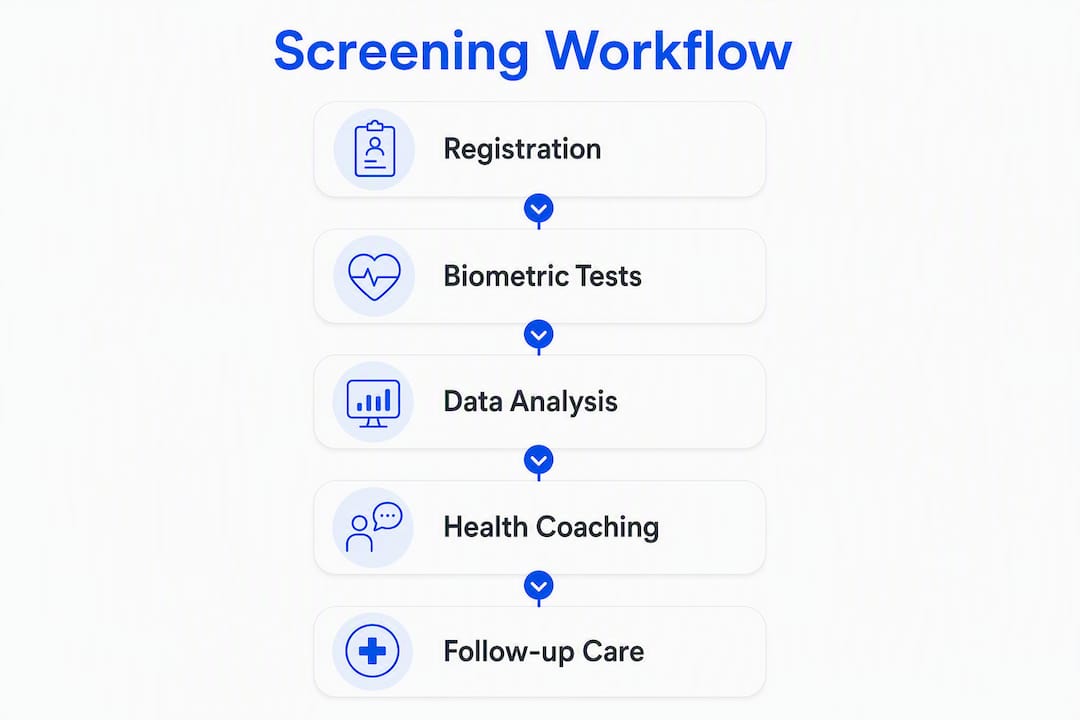
The screening event is the beginning, not the end. Employees with flagged results should receive a referral to their primary care physician or a telehealth option within 48–72 hours of results delivery. Enroll employees with elevated chronic disease markers in coaching or condition management programs. Track enrollment and engagement rates quarterly.

Pro Tip: Schedule health coaching appointments on the same day as the screening event, immediately after the blood draw. Employees who receive a face-to-face or telephonic coaching session while their results are fresh are far more likely to take a concrete next step than those who receive a results report days later.
For practical engagement tactics, Hadaco's resource on workplace wellness challenges covers communication strategies and leadership buy-in approaches that apply directly to screening programs.
Legal and privacy rules every U.S. employer must understand
Biometric screening programs touch three federal frameworks: HIPAA, GINA, and the ADA/EEOC guidance on medical examinations. Getting these wrong creates legal exposure; getting them right is straightforward with the right vendor and program design.
Core regulatory considerations:
- HIPAA: Any individually identifiable health information collected during a screening is protected health information (PHI). Employers should receive only aggregate, de-identified reports. Your vendor must sign a HIPAA Business Associate Agreement before any data is collected.
- GINA (Genetic Information Nondiscrimination Act): Screenings that include family medical history or genetic tests trigger GINA restrictions. Most standard biometric panels do not include genetic testing, but confirm this with your vendor.
- ADA/EEOC guidance: Employers generally cannot require medical exams unless the exam is job-related and consistent with business necessity. Biometric screenings offered as part of a voluntary wellness program are permissible, but the program must be genuinely voluntary. Tying participation to health insurance eligibility or significant financial penalties raises ADA compliance questions.
- State privacy laws: Several states, including California, Illinois, and Texas, have biometric privacy statutes that add consent and data retention requirements beyond federal law. Confirm your vendor's compliance posture for every state where employees are located.
Practical controls:
- Never allow individual-level PHI to flow to HR, managers, or benefits decision-makers.
- Use aggregate, de-identified reports only for program design and benefits decisions.
- Document participant consent at the point of screening, not retroactively.
- Include data security and breach notification language in every vendor contract.
Incentive design is where most employers run into compliance friction. The EEOC's ADA guidance permits incentives for voluntary wellness programs, but the definition of "voluntary" has been contested in rulemaking. For any incentive program where the reward or penalty exceeds a modest threshold, have employment counsel review the design before launch.
For ideas on structuring incentives within compliance guardrails, Hadaco's guide on wellness incentive design covers the practical options and the pitfalls to avoid.
This article is general information, not legal advice. Confirm current EEOC, ADA, HIPAA, and state law requirements with qualified employment counsel before finalizing your program design.
What biometric screenings cost and how to vet vendors
Pricing for onsite biometric screening programs varies based on panel breadth, delivery model, geographic spread, and whether coaching or reporting services are bundled. Most vendors do not publish per-employee rates publicly, but the key cost drivers are consistent across the market.
Pricing drivers:
- Panel selection: A fingerstick core panel costs less than a full venipuncture metabolic workup.
- Onsite staffing and travel: Minimum headcount requirements and travel fees apply for small or remote locations.
- Lab processing: Venipuncture samples require certified lab processing, which adds cost and turnaround time.
- Reporting portal: Aggregate reporting dashboards and data exports are sometimes bundled, sometimes priced separately.
- Coaching and referral services: Same-day health coaching adds cost but materially improves follow-up rates.
- Scale discounts: Per-employee costs drop at higher volumes; negotiate based on total headcount, not just event attendance.
Typical timeline from decision to results:
- Vendor selection and contracting: 2–4 weeks
- Scheduling and communications: 3–4 weeks
- Screening event(s): 1–3 days depending on workforce size
- Fingerstick results: available same day or within 24 hours
- Venipuncture lab results: typically 3–7 business days
- Aggregate employer report: 1–2 weeks after results close
Vendor-selection checklist:
- What biometric measures and lab panels are included in the standard offering?
- How are results delivered to employees (portal, paper, app)?
- What aggregate and de-identified reports does the employer receive, and how quickly?
- Does the vendor sign a HIPAA BAA, and what are their data security certifications?
- Who provides clinical oversight for flagged results?
- Can the vendor support hybrid delivery (onsite plus lab-based or home kits) for remote employees?
- What follow-up services (coaching, referral, condition management) are available?
- Can the vendor provide references from employers of similar size and industry?
Red flags to watch:
- No HIPAA BAA offered or delays in providing one
- Individual-level results accessible to the employer without explicit employee consent
- No clinical oversight for abnormal findings
- Inability to support hybrid delivery for distributed workforces
- Vague data ownership language in the contract
Established vendors like Quest Diagnostics and Concentra offer both onsite and lab-based delivery with aggregate reporting, clinical oversight, and coaching integrations. Evaluate them on the checklist above, not on brand recognition alone.
How to use aggregate screening data to drive real program changes
Aggregate, de-identified screening data is the output that justifies the program investment. Vendors typically deliver an employer-facing report within two weeks of the screening event, showing population-level distributions across every measured marker.
Common aggregate metrics and what to do with them:
| Metric | Signal | Suggested action |
|---|---|---|
| Participation rate — | Low data quality; results may not represent population | Improve communications, add hybrid delivery, review incentive design |
| 30%+ of employees with elevated blood pressure | High cardiovascular risk concentration | Launch hypertension coaching; review EAP and telehealth access |
| — | Metabolic risk; likely diet and activity related | Nutrition program, on-site healthy food options, activity challenges |
| Elevated fasting glucose in 15%+ of employees | Pre-diabetes prevalence above national average | Enroll eligible employees in CDC-recognized Diabetes Prevention Program |
| BMI distribution skewed toward obese category | Weight-related chronic disease risk | Weight management coaching, physical activity programs |
| Low referral uptake after flagged results | Follow-up pathway is unclear or inaccessible | Simplify referral process; add telehealth option; follow up directly |
Vendors like Passport Health provide administrative portals where HR can view aggregate trends over time, filter by location or department (where population size permits de-identification), and export data for benefits planning.
The most common mistake employers make with aggregate data is treating it as a report card rather than a planning tool. A high prevalence of elevated glucose is not a failure; it is a targeting signal. It tells you exactly where to direct your diabetes prevention budget.
Pair screening data with claims data when possible. The combination reveals whether high-risk employees identified in screenings are generating disproportionate claims, which is the clearest ROI story you can tell a CFO.
What the research says about biometric screening program design
The evidence on workplace biometric screening programs points consistently toward one conclusion: program design matters more than the screening itself.
Biometric screening adoption reached 51% among mid-sized employers (500–5,000 employees) in 2025, with rates at 28% for small employers and 46% for large employers, but participation rates and downstream engagement vary widely based on how programs are structured. The HERO consensus statement on workplace health programs identifies senior leadership support, evidence-based follow-up services, and integrated program governance as the primary drivers of program success. A screening event without those elements rarely moves health outcomes.
Best-practice checklist from HERO, OPM, and industry experience:
- Leadership buy-in: Senior leaders who participate visibly in screening events drive participation rates up across the organization.
- Teachable moment: A brief clinician or health coach review at the time of screening is a key driver of employee engagement and subsequent behavior change.
- Linked follow-up care: Connect every flagged result to a clear, accessible next step: a coaching program, a telehealth appointment, or a referral to primary care.
- Hybrid delivery: Mixing onsite events with lab-based or home-kit options materially improves participation for distributed workforces.
- Annual cadence with trend reporting: A single screening produces a snapshot; annual repetition produces a trend line that shows whether interventions are working.
- Pair with a health risk assessment (HRA): Combining biometric data with an employee health risk assessment gives HR both objective clinical markers and self-reported behavioral data for a fuller population health picture.
The OPM workplace health screening fact sheet frames screenings explicitly as risk-identification and benchmarking tools, not diagnostic endpoints. That framing should shape every communication you send to employees: the screening is a starting point, not a verdict.
Key Takeaways
A biometric screening program only delivers measurable employer ROI when it is paired with follow-up interventions, aggregate data analysis, and a compliant, vendor-vetted data flow.
| Point | Details |
|---|---|
| Screen with intent | Define your program goal before selecting a vendor: baseline data, incentive eligibility, or chronic disease targeting. |
| Protect individual privacy | Employers should receive only aggregate, de-identified reports; require a HIPAA BAA from every vendor. |
| The teachable moment drives results | A brief clinician review immediately after screening is the single highest-leverage follow-up tactic. |
| Adoption benchmarks vary by size | In 2025, biometric screening adoption rates were 28% for small employers, 51% for mid-sized employers, and 46% for large employers; use these figures to benchmark your own participation targets. |
| Hadaco connects screenings to savings | Hadaco's performance-based population health programs pair screening insights with coaching, referrals, and quarterly reporting to convert data into measurable claims reductions. |
Why biometric screenings are only as good as what comes after them
Here is the part most vendors will not say plainly: the screening is the easy part. Sending a clinical team to your office, drawing blood, and delivering a report is a logistics exercise. The hard part, and the part that actually reduces claims, is what you do with the data.
The employers I see get the most from biometric screening programs are not necessarily the ones with the highest participation rates or the most sophisticated panels. They are the ones who treat the screening as the first step in a conversation with their workforce about health, not as an annual checkbox. They use aggregate data to make specific program decisions. They enroll employees with elevated markers in coaching programs that have real clinical backing. They track whether those employees' numbers improve the following year.
The conventional wisdom in workplace wellness is that you need a big, comprehensive program to see results. The evidence suggests otherwise. A focused intervention targeting the 15–20% of your workforce driving 80% of your claims, identified through screening data, outperforms a broad program that touches everyone lightly. Screenings give you the map. The question is whether you use it.
Employers who are serious about reducing healthcare costs through population health management should also be tracking the employer healthcare trends shaping benefits strategy in 2026, particularly the shift toward value-based care and chronic disease prevention as primary cost levers.
Hadaco turns biometric screening data into measurable savings
Most employers run a biometric screening and get a report. Hadaco takes that data further. Hadaco's population health programs are built to convert screening insights into targeted interventions, with coaching, chronic disease management, and primary care referral pathways integrated from day one. There are no upfront fees; Hadaco's model is performance-based, meaning the program pays for itself through demonstrated claims reductions.
Companies working with Hadaco typically see savings per employee in the first year, with quarterly reporting that shows exactly where those savings are coming from. Hadaco complements your existing benefit plan rather than replacing it, and the savings estimator on the Hadaco site lets you model expected outcomes before committing to anything.
If you are ready to move from screening data to measurable results, request a consultation with Hadaco to see what a performance-based population health program looks like for your workforce size and risk profile.
Authoritative sources for further reading
The sources below are the most relevant government, clinical, and industry references for U.S. employers designing or evaluating biometric screening programs.
Government and regulatory sources:
- Workplace Health Screenings Fact Sheet | U.S. Office of Personnel Management (OPM) — Federal agency guidance on the business case, program design, and legal framework for workplace health screenings. Government/regulatory.
- Prediabetes and Type 2 Diabetes Prevention | CDC — Prevalence data and evidence base for the CDC-recognized Diabetes Prevention Program, relevant for employers acting on elevated glucose findings. Government/clinical.
Clinical and peer-reviewed research:
- HERO Consensus Statement on Workplace Health Programs | PubMed — Foundational consensus statement from the Health Enhancement Research Organization on program design elements that drive outcomes. Peer-reviewed/industry.
- Workplace health promotion research | NCBI — Research on employer-sponsored health promotion and population health management. Peer-reviewed.
Vendor informational pages (for logistics and panel reference):
Legal and compliance reference: