
Prioritize structural fixes first: staffing levels, scheduling, and ergonomics, then layer in targeted evidence-based supports like peer-group mindfulness and employee assistance programs. NIOSH's evaluation of a telephone call center and an 8-week mindfulness trial both point the same direction: fix the job before you coach the person. We help employers implement and report on exactly this kind of program.
TL;DR:
- Audit staffing and handling time, add call buffers of six seconds and protected breaks, then review ergonomics, workspace conditions, and debriefs after abusive calls.
- An eight week web mindfulness program reduced stress and improved emotional health; weekly peer practice increased participation and benefits, but effects weakened by one year.
- Health questionnaire programs can offer incentives up to 30% of one employee's coverage cost, with notice, confidentiality safeguards, and limits on individual data access.
- Run a 90–120 day pilot across representative day and night shifts, tracking participation, validated stress scores, handling time, absenteeism, and claims trends before scaling.
Table of Contents
- Priority checklist: operational and environmental fixes to reduce strain
- Evidence-based employee supports that work in call centers
- Compliance and incentive design for employer wellness programs
- Pilot, measure, and scale: an implementation and ROI roadmap
- Nutrition and physical activity interventions for sedentary agents
- Tying wellness programs to existing performance metrics and incentives
- Building social support among remote and hybrid agents
- Training managers to spot burnout and compassion fatigue
- Technology and apps built for call center wellness
- Client perspective: how Hadaco delivers measurable call-center wellbeing outcomes
- How to request a pilot or savings estimate from Hadaco
- FAQ
- Sources
Priority checklist: operational and environmental fixes to reduce strain
Most call center stress traces back to the job design itself, not individual resilience. A 2024 scoping review of contact-center interventions found that multi-component programs, combining environmental restructuring with training and job redesign, produced more consistent results than single-component fixes like a wellness poster or a one-off seminar.
Work through these in order:
- Audit workloads and staffing ratios against current call volume and revise average handling-time targets that push agents past sustainable pace.
- Program short rest buffers (as little as six seconds) between calls and protect regular breaks, including an occasional full shut-down period during a shift.
- Bring in a certified ergonomist to assess workstations, and check HVAC performance, lighting levels, and cleaning schedules in the physical space.
- Retrain supervisors to use call monitoring data for coaching conversations first, with discipline only after documented support, a shift that research on supervisor coaching links to better morale.
- Add a structured debrief protocol for agents after hostile or abusive calls, rather than leaving them to self-regulate and move straight to the next queue.
NIOSH's own field evaluation of a corporate call center recommended nearly this same sequence: workload assessment, rest-buffer programming, ergonomics review, environmental checks, hostile-call debriefing, and standing health and safety committees. These changes are inexpensive relative to turnover costs, but they require real management buy-in and small telephony configuration changes, not just a memo.
For the physical environment piece, a workspace ergonomics guide covers practical setup options, from adjustable seating to recovery tools agents can use between shifts.
Pro Tip: Start with the rest-buffer and break-structure changes. They touch telephony settings, not hiring budgets, and show up in agent feedback within weeks.
Evidence-based employee supports that work in call centers
Organizational fixes address the environment, but some individual-level supports have real evidence behind them in this specific setting. An 8-week web-based mindfulness program run inside a corporate call center reduced perceived stress and improved emotional well-being among participants.
The effect got stronger with peer support. Adding weekly peer-group practice sessions to the same mindfulness program increased both participation and the size of the benefit at eight weeks, according to the same randomized trial, though gains diminished somewhat by the one-year mark.
Design choices that make or break adoption:
- Schedule peer-group practice during low-volume call hours, rotating times to cover day and night shifts fairly.
- Keep weekly time commitment to about one hour to avoid productivity pushback from supervisors or agents.
- Use small groups of 10 to 12 people so the cohesion that drives engagement actually forms.
- Pair digital delivery with occasional light clinical input for employees who need more than peer support.
Employee assistance programs and telehealth counseling remain the right referral path for agents who need more than a mindfulness cohort, and a comparative look at stress management techniques is a useful primer when deciding which approaches to offer alongside EAP access. The biggest barrier to any of this is time: agents won't attend a program that competes with their shift. Blended delivery, protected low-volume windows, and small participation incentives solve most of that friction.
Compliance and incentive design for employer wellness programs
Wellness incentives are regulated, and getting the structure wrong creates real exposure. The EEOC's final rules on employer wellness programs explain how the ADA and GINA apply: programs that ask health questions can offer incentives up to 30% of the cost of employee-only coverage, with specific notice and confidentiality requirements attached. Tobacco cessation programs typically allow a higher threshold under separate rules.
A few distinctions matter before you design anything:
- Participatory programs (attend a seminar, complete a health assessment) face fewer restrictions than health-contingent programs tied to an outcome like a biometric target.
- Health-contingent programs must offer a reasonable alternative standard for employees who cannot meet the original target, plus clear disclosure of that alternative.
- Vendor contracts should specify who sees individual-level data, require aggregate-only reporting to the employer, and restrict data use to the wellness program itself.
- Genetic information, such as family medical history collected through a health questionnaire, triggers separate GINA obligations, covered in our guide to GINA and wellness programs.
For the ADA-specific design questions around reasonable alternatives, see our ADA compliance guidance, and for data handling specifically, our HIPAA applicability breakdown. Loop in legal counsel or your benefits broker before finalizing incentive amounts or data-sharing terms, particularly if the program touches biometric screening.
Pilot, measure, and scale: an implementation and ROI roadmap
Run a defined pilot before committing to a company-wide rollout. A 90 to 120 day window gives enough time to see participation patterns and early signal without overcommitting budget.
- Select one site or shift cohort large enough to be representative, and include both day and night shift agents.
- Launch the operational fixes (breaks, ergonomics) immediately, and introduce the peer mindfulness cohort in week two or three.
- Track participation rate, a validated stress or well-being score, average handling time, short-term absenteeism, and early claims signals.
- Report results quarterly and attribute savings conservatively, treating early claims improvements as emerging trends rather than confirmed outcomes.
| Metric | What to track | Reporting cadence |
|---|---|---|
| Participation | Share of eligible agents engaging weekly | Monthly |
| Well-being score | Validated stress/well-being instrument pre/post | Start and end of pilot |
| Operational | Average handling time, absenteeism | Monthly |
| Claims signal | Early trend in claims costs | Quarterly |
Our 90-day rollout template and claims attribution guidance walk through exactly this cadence, including what to bring to finance before asking for a scale-up budget.
Nutrition and physical activity interventions for sedentary agents
Call center work is sedentary almost by design: agents sit for most of a shift, often with limited movement built into the job. That sedentary pattern compounds the stress already present in high-volume queues, so nutrition and movement interventions work best when they're structural rather than optional add-ons.
Practical options that fit an eight-hour shift:
- Short standing or stretch breaks tied to the same rest-buffer programming used for call recovery, rather than a separate initiative agents have to remember.
- Sit-stand desk options or desk-based movement tools for agents who want them, without mandating a full workstation overhaul.
- On-site or nearby access to better food options during breaks, since vending-machine defaults tend to reinforce fatigue rather than counter it.
- Walking meetings or movement breaks for supervisors and team leads, which normalizes activity for the floor overall.
None of this needs to be elaborate. The goal is removing friction: make the healthier option the easy one during a 15-minute break, not a project agents have to plan around their shift.
Tying wellness programs to existing performance metrics and incentives
Wellness programs fail when they run parallel to the metrics agents are actually judged on. If average handling time, call volume, and quality scores drive pay and promotion, a wellness initiative that ignores those numbers will read as decorative.
The fix is integration, not replacement. Build wellness participation into existing performance conversations: a supervisor reviewing handling-time trends can also note whether an agent used their protected breaks or engaged with a peer support session. Some employers tie a modest portion of a team incentive to program participation rather than individual health outcomes, which avoids the incentive-limit issues covered earlier while still signaling that engagement matters.
Performance dashboards used for call quality can carry a wellness participation column alongside the metrics already tracked, so supervisors see both in one view instead of treating wellness as a separate system nobody checks. The data discipline matters here too: aggregate participation reporting, not individual health data, is what belongs on a performance dashboard.

Building social support among remote and hybrid agents
Call centers were once defined by a shared floor, and that physical proximity did real work in building informal support between agents. Remote and hybrid arrangements remove it, which is part of why isolation shows up so often as a complaint in distributed teams.
Structured replacements help close that gap:
- Virtual team huddles at shift start, kept short, focused on connection rather than metrics review.
- Peer mentor pairings for new hires, modeled on the same peer-group structure that strengthened the mindfulness program's results.
- Recognition channels where supervisors and peers can flag a well-handled difficult call in real time, not just in a monthly review.
- Optional video-on team check-ins scheduled around low-volume periods, so attendance doesn't compete with queue coverage.
The same peer-group design that improved mindfulness program participation applies broadly here: small, consistent groups build the kind of informal support that a shared break room used to provide for free.
Training managers to spot burnout and compassion fatigue
Agents absorb a steady stream of frustration, complaints, and occasionally abuse from callers, and that emotional labor accumulates differently than ordinary job stress. Supervisors are usually the first people positioned to notice when an agent is sliding toward burnout or compassion fatigue, but most haven't been trained to recognize the signs.
Manager training should cover the practical markers: a sudden drop in call quality from a previously strong performer, increased absenteeism, visible frustration after hostile calls, or withdrawal from team interactions. The response matters as much as the recognition. Supervisors coached to use performance data for coaching conversations rather than immediate discipline, a shift workplace research on monitoring and morale ties to better outcomes, create the kind of environment where an agent is more likely to flag a problem before it becomes a resignation.
Pairing manager training with the hostile-call debrief protocol covered earlier gives supervisors a concrete tool to use in the moment, not just a list of warning signs to watch for after the fact.
Technology and apps built for call center wellness
A growing set of tools now targets the specific pressures of call center work, from real-time stress indicators to automated break scheduling. Workforce management software that already governs scheduling and queue routing is often the easiest place to layer in wellness-relevant features, since it already touches shift structure.
Useful categories to evaluate:
- Break-scheduling tools integrated with the existing telephony or workforce management system, so rest buffers get enforced automatically rather than depending on supervisor memory.
- Pulse-survey apps that capture a quick well-being check-in without requiring a long questionnaire agents will skip.
- Digital mindfulness or peer-group platforms, the same category used in the web-based mindfulness trial referenced earlier, now available as standalone tools.
- Dashboard integrations that surface wellness participation alongside the call quality metrics supervisors already review.
The technology matters less than the integration. A stress-monitoring feature nobody looks at adds nothing, while a break-scheduling tool wired into the system agents already use tends to get adopted without a separate training session.
Client perspective: how Hadaco delivers measurable call-center wellbeing outcomes
We built our approach around a simple idea: wellness programs should complement the benefit plans employers already have, not replace or disrupt them. Our evidence-based population health model layers chronic disease management, preventive care, and engagement programs onto existing coverage.
In a typical first year, employers working with us see average savings per employee, alongside improved engagement and retention. What we provide from day one:
- A transparent savings estimator built from your own claims profile, before you commit to anything.
- A structured pilot plan modeled on the 90 to 120 day approach covered earlier in this piece.
- Quarterly reporting that tracks participation, engagement, and claims trends against baseline.
For a deeper look at how we structure evidence-based programs, see our practical guide for employers.
— Gene
How to request a pilot or savings estimate from Hadaco
The fastest next step is a baseline claims review. We use your current claims data and workforce profile to build a no-obligation savings estimate, the same kind of number this playbook recommends tracking from day one.
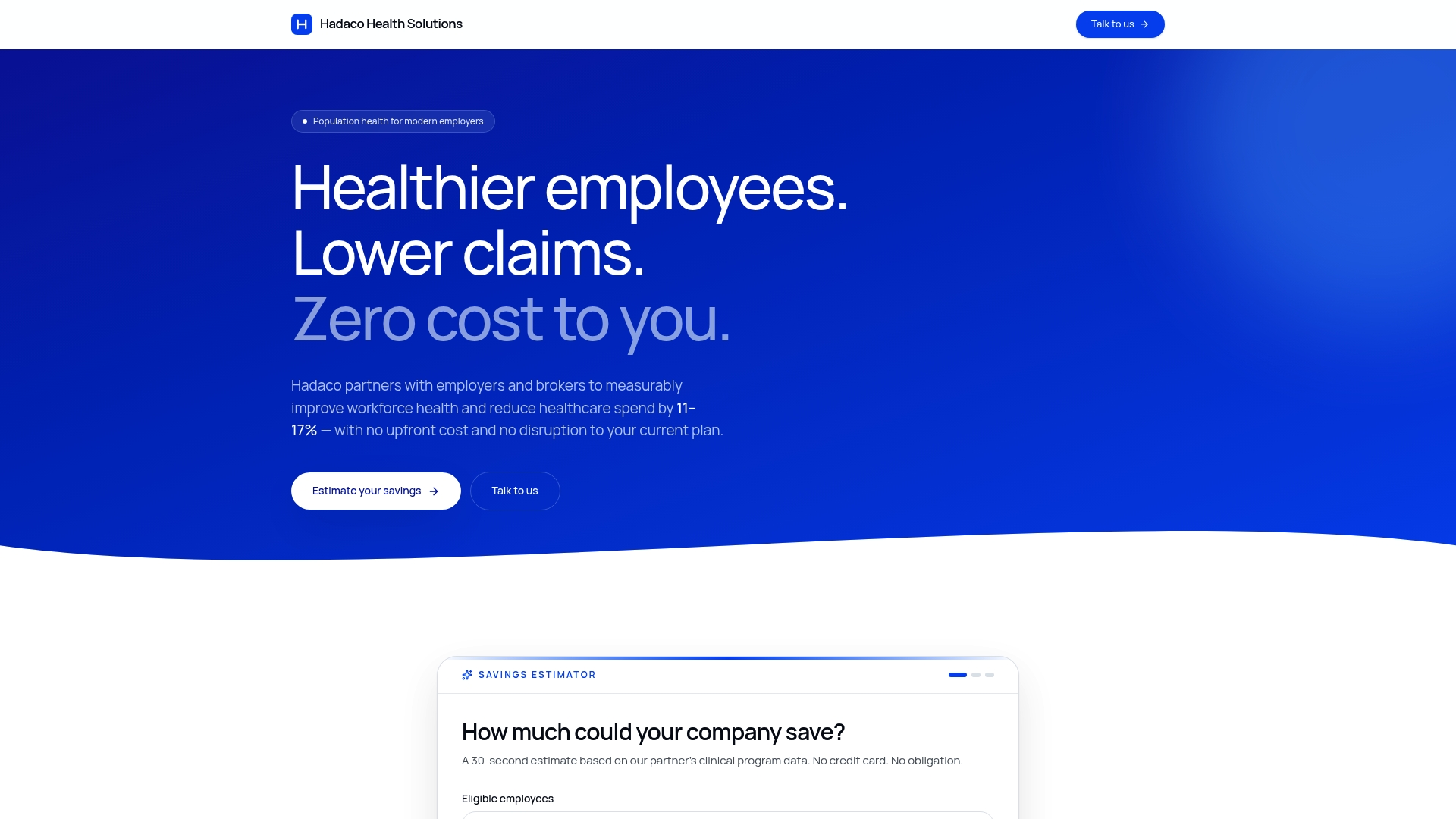
From there, we can walk you through a 90 to 120 day pilot template and the quarterly reporting structure that keeps finance and HR aligned on real numbers instead of projections. There's no upfront fee to get started. Visit Hadaco to request your estimate and pilot plan.
FAQ
What is the most effective first step for call center wellness?
Start with operational fixes: workload assessment, rest buffers between calls, and ergonomics review, since NIOSH's call center evaluation and a recent contact-center review both found these changes outperform individual-only programs. Add targeted supports like peer-group mindfulness after the structural fixes are in place.
Does mindfulness training actually reduce call center stress?
An 8-week web-based mindfulness program run in a corporate call center reduced perceived stress and improved emotional well-being, with stronger effects when weekly peer-group support was added. The benefit diminished somewhat by the one-year mark, which is why ongoing peer practice matters more than a one-time course.
How much can employers offer as a wellness incentive without breaking EEOC rules?
Under EEOC guidance, wellness programs that ask health questions can generally offer incentives up to 30% of the cost of employee-only coverage, with specific notice and confidentiality requirements. Tobacco cessation programs can typically use a higher limit under separate rules, so confirm current thresholds with legal counsel before finalizing a design.
What does Hadaco typically save employers in the first year?
Employers working with us typically see average first-year savings per employee, alongside improved engagement and retention. We provide a transparent savings estimator and quarterly reporting so those numbers are tracked against your own baseline, not an industry average.
How long should a call center wellness pilot run before scaling?
A 90 to 120 day pilot gives enough time to see participation trends, early well-being score changes, and initial claims signals without overcommitting budget. Our 90-day rollout template outlines the structure employers use to decide whether to scale.
Sources
- A web-based mindfulness stress management program in a corporate call center: RCT (PMC)
- Evaluation of job stress and work-related health concerns at a telephone call center (NIOSH HHE)
- EEOC issues final rules on employer wellness programs
- A systematic scoping review of health-promoting interventions for contact centre employees (PLOS One)