
A risk-sharing wellness program is a contract in which the vendor's pay depends, in whole or in part, on results the employer can measure: lower claims, better health markers, real engagement. Instead of paying a flat fee and hoping for savings, the employer and the vendor each carry part of the financial risk. Done well, it aligns incentives. Done badly, it hides weak programs behind clever fee language. This guide explains how the money is divided, what the evidence says about wellness savings, which U.S. compliance rules apply, and what to check before you sign.
TL;DR
- Risk sharing means vendor fees are tied to outcomes such as minimum savings or clinical targets, so the vendor loses money when the program underdelivers.
- Common structures include per-member-per-month fees, per-engaged-member fees, and performance guarantees that discount fees when targets are missed.
- The evidence on wellness is mixed: programs aimed at chronic conditions have shown stronger returns than general lifestyle programs, so design matters more than the label.
- Incentives and health data trigger ADA, GINA and ACA rules, so involve counsel before launch.
- Insist on a clear baseline, an independent way to verify results, and regular reporting.
Table of Contents
- What risk sharing means in an employer wellness program
- How costs, savings and risk get divided
- What the evidence says about wellness savings
- How a risk-sharing program complements your existing health plan
- Compliance: the rules that shape any wellness incentive
- Our perspective: what we would want in the contract
- How to evaluate a risk-sharing wellness proposal
- Working with Hadaco
- FAQ
- Sources
What risk sharing means in an employer wellness program
In a conventional wellness arrangement, the employer pays for access: a monthly fee, a fee per screening, or a fee per participant. Whether claims fall is the employer's problem. In a risk-sharing arrangement, some or all of the vendor's compensation is contingent on a result that is defined in the contract before the program starts.
Three questions define any such deal:
- What is the result? Lower claim costs, a clinical outcome (for example blood pressure control among members with hypertension), an engagement threshold, or a combination.
- Against what baseline? Savings only mean something relative to what would have happened otherwise. The baseline method is the most negotiated and most abused part of these contracts.
- Who pays when it misses? The vendor may refund fees, discount future fees, or forgo a performance fee entirely.
The model has become familiar in health care contracting more broadly. FTI Consulting notes that direct-to-employer contracting models often combine per-member-per-month fees with shared risk and cost-savings components. Wellness and population health vendors are following the same path.
How costs, savings and risk get divided
The split between employer and vendor depends on the fee model. Milliman describes the main contracting methods for wellness and point solutions as fee-for-service, fixed per-case fees, per-member-per-month models, and per-engaged-member models, each with a different financial risk profile for the employer.
| Fee model | How you pay | Who carries the risk | Watch for |
|---|---|---|---|
| Fee-for-service | Per service delivered | Employer | Costs rise with utilization, with no link to results |
| Fixed per-case fee | Flat amount per case handled | Mostly employer | Definition of a "case" |
| Per member per month (PMPM) | Flat fee for every eligible member | Mostly employer | You pay for members who never engage |
| Per engaged member | Fee only for members who participate | Shared | How "engaged" is defined |
| Performance-based or fees at risk | Fees contingent on savings or outcomes | Shared or mostly vendor | Baseline, attribution and measurement |
The most important layer on top of any fee model is the performance guarantee. According to Milliman, guarantees define desired clinical outcomes or minimum savings and typically discount the underlying program fees when targets are not met. That is the mechanism that moves risk from you to the vendor.
If you are comparing structures that bundle recurring fees with services, it helps to see how subscription-style pricing works in other corners of health care; how telehealth membership fees work shows what a flat monthly fee does and does not cover, which is the same question to ask about a flat wellness PMPM.
A simple worked example
Take a hypothetical employer with 1,000 covered employees. These figures are illustrative, not a quote from anyone.
- Flat PMPM model: the employer pays a fixed fee every month. If claims do not move, the employer has still paid the full fee.
- Guarantee model: the vendor guarantees a minimum level of savings. If the measured savings fall short, a defined share of the fees is discounted or refunded.
- Fully contingent model: the employer pays out of demonstrated savings only. If there are no savings, there is no fee.
The further down that list you go, the more the vendor has riding on its own forecast, and the more carefully you must scrutinize how savings are calculated, because the vendor now has a stake in the measurement itself.
What the evidence says about wellness savings
Before sharing risk, ask whether the underlying program can produce savings at all. The research is honest about this, and the answer is not uniformly positive.
The skeptical findings. RAND's national study found that participants improved in exercise, smoking behavior and weight control, but not cholesterol control. Participation over five years was linked to an estimated $157 lower annual health care cost, though the change was not statistically significant. A more recent public-sector example: Merative's analysis of Wisconsin's state employee wellness program estimated about $0.11 in savings per dollar spent from 2021 to 2024, a net loss. The same memo reports annual contract costs of roughly $15 million including incentives, split about evenly between administrative fees and $150 member incentive payments.

The encouraging findings. In a RAND study of a Fortune 100 employer, disease management programs returned $3.80 per dollar invested, while lifestyle management returned $0.50. The researchers note that programs aimed at employees with existing chronic conditions drive most of the near-term savings, while lifestyle programs target longer-term risk.
The takeaway for a risk-sharing contract is practical:
- A program focused on general lifestyle activity (step challenges, one-off screenings) is a poor candidate for a savings guarantee, because the evidence does not support fast claim reductions.
- A program that targets people with chronic conditions, and follows them with real care support, has a stronger evidentiary case.
- A vendor willing to put fees at risk is making a testable claim. Your job is to test it.
For a deeper look at how the pieces fit together, see our guide to evidence-based wellness programs and our breakdown of workplace chronic disease costs.
How a risk-sharing program complements your existing health plan
A common fear is that adding a risk-sharing program means replacing the carrier, the TPA or the benefit design. It does not have to. A well-built program sits beside the medical plan: it identifies members with chronic conditions or rising risk, engages them, and coordinates with the care they already have, while your plan keeps paying claims as before.
That has several practical consequences:
- No plan redesign. Network, deductibles and carrier relationships stay as they are.
- Shared data, narrowly scoped. The vendor needs claims or eligibility data to find and measure the right members. Agree on exactly what is shared, who sees it, and how it is protected.
- Measurement runs against your claims. Savings are judged on the claims your plan actually pays, which makes your own data the scorecard.
- Plan classification matters. Troutman's compliance guide explains that an add-on wellness program may be part of the group health plan when the plan contracts for it, when its reward or penalty changes employee contributions or cost sharing, or when it is promoted as part of the plan. That classification changes which compliance obligations apply.
How your plan is funded also affects the economics. Self-funded employers keep the claim savings directly, while fully insured employers see them mostly through future renewals. We cover that trade-off in self-funded versus fully insured wellness.
Compliance: the rules that shape any wellness incentive
Risk sharing is a financial arrangement between you and the vendor, but the employee-facing part, the incentives and the health data, is regulated. Review all of this with employment or benefits counsel before launch.
ADA and GINA. Programs that make disability-related inquiries or ask for medical exams must be voluntary and reasonably designed, with privacy protections. Our posts on what employers can legally ask under GINA and on ADA-compliant wellness go into the details.
ACA limits on rewards. For health-contingent programs, the Department of Labor says the total reward generally may not exceed 30% of the cost of coverage, or 50% for programs designed to prevent or reduce tobacco use. If dependents can participate, the cost of their coverage is included.
Outcome-based programs. The same guidance says these programs must be reasonably designed to promote health or prevent disease, give members an opportunity to qualify at least annually, make the full reward available through a reasonable alternative standard or waiver for anyone who does not meet the initial standard, and disclose that alternative in plan materials.
There is a design principle behind the rules too. A 2012 consensus statement in the Journal of Occupational and Environmental Medicine advises that programs should aim to give people opportunities to improve their health, not only to cut costs, and that outcome-based incentives should not threaten an employee's ability to keep affordable insurance. A vendor whose fees depend on savings must never put pressure on individual employees to hit health numbers. If a contract creates that pressure, push back.
Our perspective: what we would want in the contract
We built Hadaco around one belief: if a vendor says its program lowers claims, it should be willing to be paid on that claim. So we offer programs with no upfront fees, and our compensation is tied to demonstrated healthcare savings and employee engagement outcomes. For our clients, first-year savings have averaged $451 per employee, and we aim for a double-digit reduction in claim costs.
What we have learned from that arrangement shapes how we would advise any employer, including those who choose another path:
- Start with the chronic and the preventable. Savings come where costs concentrate. Programs for chronic disease, preventive care and mental health, paired with engagement, are where measurable change happens.
- Make the estimate transparent before anything is signed. Our savings estimator lets an employer see the logic behind the projection, not just the headline.
- Report quarterly. A year is too long to find out a program is off track. Quarterly reporting gives both sides a chance to correct course.
- Complement, do not disrupt. Employees should not have to change plans, doctors or habits just because HR changed vendors.
- Treat health as more than a claims line. Engagement and retention improve when employees feel supported, and that is part of the return.
Our guide to testing vendor guarantees walks through how to benchmark any guarantee, ours included, against a realistic per-employee figure.
— Gene
How to evaluate a risk-sharing wellness proposal
The JOEM guidance suggests employers define goals, target populations and design, review incentive risks with legal counsel, set up aggregate evaluation measures, and consider independent third-party analysis of financial outcomes. Turn that into a checklist:
- Goals and population. Which members, with which conditions, and what counts as success? RAND lists broad outreach, clear messaging from leaders, treating wellness as an organizational priority, and continuous quality improvement as key facilitators, so budget for communication, not just the vendor fee.
- Baseline. Ask how the pre-program baseline is built, how it adjusts for members who join or leave, and how it treats unusually large claims.
- Guarantee terms. What is guaranteed (savings, clinical outcomes, engagement), what is the remedy (fee discount, refund), and over what period?
- Definitions. If fees depend on engaged members, find out exactly what "engaged" means.
- Independent verification. Reserve the right to have a third party validate results.
- Data and privacy. Limit what is shared and keep results aggregate.
- Legal review. Have counsel check incentives against ADA, GINA and ACA rules.
- Exit terms. What happens to data, member relationships and fees if you end the contract?
Measuring outcomes once you are live
The JOEM guidance recommends measuring success with aggregate data on health risk improvements, participant satisfaction, engagement and retention, and, for more advanced analysis, tracking effects on health plan costs, workers' compensation and productivity.
In practice, a quarterly scorecard should include:
- Enrollment and active engagement rates by population
- Clinical indicators for targeted chronic conditions, in aggregate
- Claims trend against the agreed baseline
- Retention among participants compared with non-participants
- Dollars owed or credited under the guarantee
If you use incentives to lift participation, note that the share of large firms offering them for health risk assessments grew: KFF reports that 32% of large firms offering health benefits did so in 2019, up from 14% in 2008. Ideas that work without crossing compliance lines are in our posts on wellness incentives and engagement strategies.
Working with Hadaco
If you are a CFO, HR leader or benefits advisor weighing a performance-based approach, Hadaco's population health programs are built for it: evidence-based interventions for chronic disease, preventive care, mental health and engagement, layered on your existing plans, with no upfront fees and a transparent savings estimator.
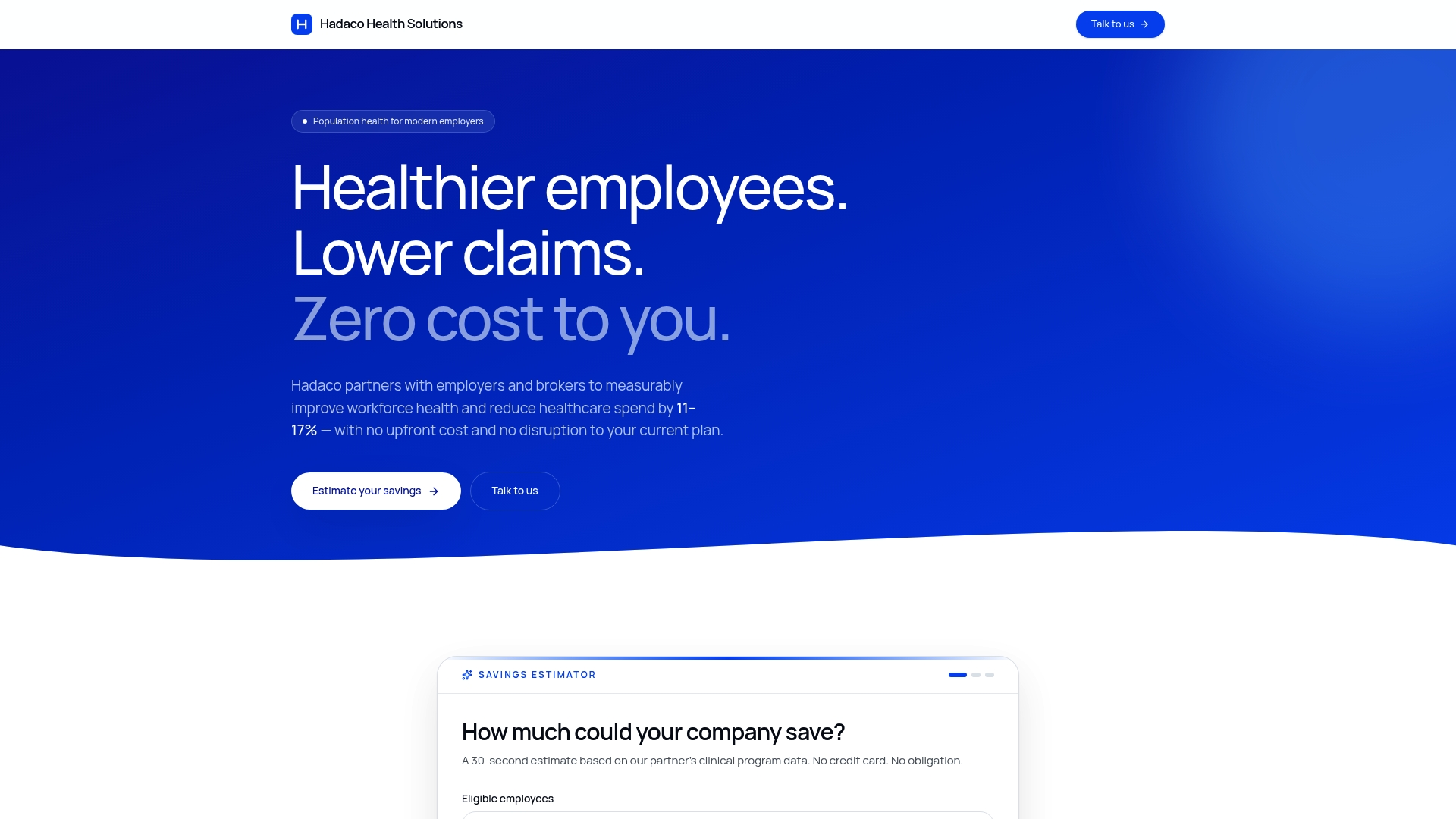
We support employers and their brokers alike, and we report outcomes every quarter so you can see what you are getting. You can also read how wellness programs reduce employee healthcare costs before booking a consultation.
FAQ
Is risk sharing the same as a health care sharing ministry?
No. Health care sharing ministries are member-funded arrangements that are an alternative to insurance. Risk sharing in an employer wellness program is a vendor contract in which the vendor's fees depend on results, while your medical plan continues to operate as usual.
Can a vendor guarantee savings?
Vendors can guarantee minimum savings or clinical outcomes, and Milliman notes that the usual remedy is a discount on program fees when targets are missed. The guarantee is only as good as its baseline and measurement terms, so review those closely and consider independent verification.
Do wellness incentives in a risk-sharing deal need legal review?
Yes. Rewards tied to health outcomes or health information fall under ACA, ADA and GINA rules, including reward caps and reasonable alternatives. Have your benefits or employment counsel review the program design and your plan documents before launch.
Which employers benefit most from risk sharing?
Employers with meaningful chronic condition spend and enough covered lives to measure results reliably. RAND's findings suggest programs targeting existing chronic conditions produce stronger returns than general lifestyle programs, so that is where a guarantee is most credible.
Sources
- Direct-to-Employer Contracting Has Arrived, FTI Consulting
- Best practices: Is your point solution on point?, Milliman
- Workplace Wellness Programs Study: Final Report, RAND
- Wellness Contract Extension memo, Wisconsin Group Insurance Board
- Do Workplace Wellness Programs Save Employers Money?, RAND
- Wellness Program Design and Compliance, Troutman
- Trends in Workplace Wellness Programs and Evolving Federal Standards, KFF
- FAQs about Affordable Care Act and Health Insurance, U.S. Department of Labor
- Guidance for a Reasonably Designed, Employer-Sponsored Wellness Program, JOEM